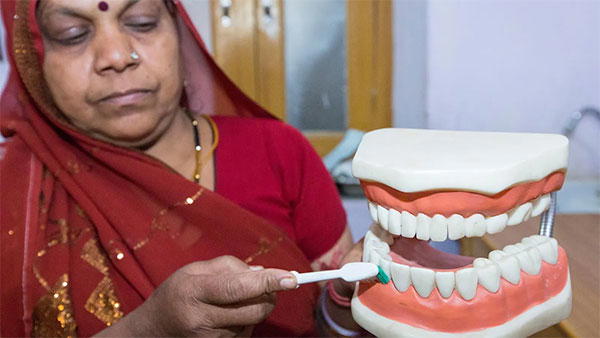
Typically, eating and drinking is essential to the yuletide celebrations. But health is also worth attention as we eat and drink. And oral care is a vital aspect of health. So here is the best way and time to brush your teeth, according to experts.
Brushing your teeth effectively lowers your chances of getting a host of chronic diseases, as well as keeping your teeth and gums healthy. But the majority of us are doing it wrong.
For a routine most of us have been practising since before we were tall enough to see into the bathroom mirror, we are remarkably bad at brushing our teeth.
In Sweden, one study found as few as one in 10 people practice the best brushing technique. The British health insurer Bupa found that almost half of respondents did not know how to brush their teeth properly in a survey of 2,000 people in the UK.
“It is very likely that anyone who has not had formal instructions from their dentist or hygienist brushes incorrectly,” says Josefine Hirschfeld, associate professor and specialist in restorative dentistry at the University of Birmingham in the UK. “From my experience, this will be the vast majority of the population in any country.”
Perhaps that is not surprising, given the bamboozling variety of information available on how you should brush your teeth. One study found at least 66 differing, sometimes conflicting, pieces of expert advice.
“I think it’s very confusing for the consumer,” says Nigel Carter, chief executive of the Oral Health Foundation in the UK. This confusion is amplified by the array of dental products available to buy, from tongue-scrapers to interdental waterjets.
What’s the best method?
“Lots of patients understand that what they need to do is remove food remnants,” says Hirschfeld. “That is only partially true. It’s much more important to remove bacteria from the teeth.”
These bacteria and other microorganisms grow inside everyone’s mouth, and form a claggy biofilm commonly known as dental plaque. It is made up of around 700 different species of bacteria, the second-greatest diversity in the human body after the gut, as well as a host of fungi and viruses. “They are living in the sticky film stuck to the teeth and also to the soft tissues,” says Hirschfeld. “This sticky film can’t be easily rinsed off – it really needs to be manually cleaned.”
The most important place to remove it from is not in fact the teeth, but the gumline. This is where microbes are best able to infiltrate the gum tissue and cause inflammation, and eventually conditions such as periodontitis. In fact, “brushing your teeth” is something of a misnomer. “Think of brushing your gumline, rather than the teeth themselves,” says Hirschfeld. “The teeth will then be brushed automatically.”
So what exactly is the best way to do this?
One of the most effective ways to clear the biofilm is known as “the modified Bass technique”. This requires considerably more manual dexterity than the vague put-the-brush-in-your-mouth-and-look-busy method that many of us use, as I soon find out.
In my bathroom, armed with my bamboo-handled, Nylon-bristled manual toothbrush, I prepare to attempt the modified Bass. Stuck to the mirror is my new miniature hourglass that times two minutes (more on that later). I turn it over, and begin.
The modified Bass technique involves placing the brush at a 45-degree angle to the tooth face (tilted down for the lower jaw and upwards for the upper, as if you are trying almost to edge the bristles below the gums). You then make small, vibratory movements back and forth at the gumline. After closely studying several videos, I give it a go.
A few moments later, my mirror is sprayed with white flecks of toothpaste and my brush is on the floor. In my enthusiasm I have somehow fumbled the brush, scraped the hard bamboo head across my gums and dropped it.
Undeterred, I give my toothbrush a brisk wash and try again, this time more tentatively. The small, brisk-but-gentle movements that Hirschfeld carefully described to me are surprisingly difficult to emulate. As a right-hander, it feels something like attempting to write in neat cursive script with my left. By the time I’ve painstakingly negotiated my entire gumline – upper, lower, inside and out – with an attempt at the modified Bass, I check my little green hourglass. My two minutes are up, who knows how long ago, and I haven’t even started flossing yet.
There are other techniques besides the modified Bass that do a good job of removing the biofilm. On another occasion, I try out the modified Stillman – similar to the modified Bass, with the addition of an occasional pleasing sweeping motion away from the gumline, during which I envisage a biofilm of microbial gunk being swept into a foamy oblivion.
After a week of experimentation, and dwindling flecks of toothpaste on the mirror as I feel I’m getting the hang of it, my gums start to feel a little sore. It turns out that in my enthusiasm, I’ve been applying too much pressure.
The pressure applied should be no more than 150-400g, says Hirschfeld, though the optimal pressure is still up for debate. Brushing too hard, especially with a firmer-bristled brush, can cause trauma to the gums. Small tears in the soft tissue caused by overzealous brushing are an opportunity for bacteria to enter the bloodstream. And grating the brush’s bristles over the enamel can wear miniscule grooves in the tooth, which add up to significant erosion over time. People who use a manual toothbrush often press harder than those who use an electric brush, many of which have sensors to warn when the pressure is too great.
For a few days, I try a different technique, intended for children and people with less manual dexterity. The Fones method involves holding the brush at 90 degrees and making circular motions over the teeth, skimming the gumline. It’s certainly easier to do while I experiment with getting the pressure about right. But I resolve to master the modified Bass once my gums have recovered from my eagerness.
“The modified Bass technique is one of the best ones. It cleans the teeth in the best possible way, without causing trauma to the teeth and gums,” says Hirschfeld.
But the Oral Health Foundation’s Nigel Carter notes, reassuringly, that getting the textbook version right isn’t always what matters. “What dentists and hygienists generally recommend these days is to look at what the person is doing, and make modifications to their existing technique to improve,” he says.
How long?
Brushing for at least two minutes at a time, twice daily is the recommendation from the American Dental Association, the NHS, the Indian Dental Association, the Australian Dental Association, and many other national health organisations.
The trouble is, most of us are bad at estimating how long two minutes really is. The average duration that we actually brush for varies widely, from 33 seconds, 45 seconds, 46 seconds, to 97 seconds, according to different studies. Only around 25% of people brush their teeth for long enough, with the correct pressure and motion, according to one study led by Carolina Ganss, a professor in the department for conservative and preventive dentistry at Justus-Liebig University Giessen in Germany.
Fortunately, there are easy solutions such as using an app your phone, a miniature hourglass stuck to the bathroom wall (as I chose) or an electric toothbrush that has an inbuilt timer.
In general, the longer the time spent brushing, the greater the quantity of biofilm removed, says Carter, but it is thought that around two minutes is about the length of time needed to get around all the surfaces of the teeth and gum line. For people who have gum disease or other oral health conditions, though, it might take longer to ensure the biofilm has been thoroughly dislodged.
“In fact, the optimal brushing time is highly dependent on the individual situation,” says Hirschfeld. “It’s not really defined, and it cannot be defined, because every person’s dental and oral situation is different. What matters is that all teeth are cleaned all the surfaces of each tooth also including difficult to reach areas – and that can easily take a lot longer than two minutes.”
How often?
The advice in countries such as the US, the UK and Australia is to perform your carefully timed, diligently executed brushing technique twice a day. The Indian Dental Association, however, advises up to three times (including an after-lunch brush) can be beneficial. For most people with no major oral health issues, there’s no benefit to going over and above this guidance.
“More is not necessary to remove bacteria from the teeth and it might actually be harmful to brush more often than twice a day”, as excessive brushing risks abrasion to the tooth, says Hirschfeld. Though again there are exceptions. “If you think of people wearing braces where foods get really easily trapped, those patients are commonly advice to brush after each meal,” she adds.
Brushing twice also helps hedge against imperfect technique. “Strictly if you brushed perfectly once a day would probably be enough, because it’s the older plaque on your teeth that actually causes the problems for both tooth decay and gum disease,” says Carter. “But none of us do 100%. So the idea is that by doing it twice you’re getting the bits that you missed before, so each day you’ll be cleaning everything.”
Before or after food?
Is it better to brush your teeth before or after breakfast? From toothpaste manufacturers to dental hospitals, many advocate that it is better to brush your teeth before breakfast than afterwards. But this is still an area of debate.
“There is no specific strong recommendation,” says Hirschfeld. “But lots of dentists will recommend brushing afterwards, because not only will they remove the plaque but also food remnants from the breakfast.”
Whether before or after breakfast would work better for you depends on what you eat and when. This is because there need to be two things for a biofilm to develop: microbes, and food for them to eat.
“Without bacteria or without food, you cannot develop cavities,” says Hirschfeld. “If you brush the bacteria away really thoroughly before breakfast, then in theory it shouldn’t matter how much sugar you eat. If there are no bacteria that can ferment it, then it’s fine.” But removing 100% of the biofilm in a single brushing session before breakfast is by no means assured, especially given most people’s questionable brushing habits.
Equally, brushing after breakfast can be effective. “If you do have the sugars on top of the existing bacteria and then you brush them away, that should be equally fine,” says Hirschfeld.
One of the main drawbacks of brushing after breakfast, however, is that you need to leave a good gap between eating and brushing – the American Dental Association recommends waiting 60 minutes. The reason is that acids in food, and in the by-products of microbes’ digestion of carbohydrates, temporarily make the teeth vulnerable.
“Acids attack the enamel layer of the teeth and soften it for a certain amount of time,” says Hirschfeld. This strips out some of the key components of the enamel – calcium and phosphate – though these are replaced over a period of hours by minerals in the saliva. “So the process is self-repairing. But if you don’t wait for that self-repair to happen, then this eroded surface will become very susceptible to just being brushed off.” BBC
Disclaimer
Comments expressed here do not reflect the opinions of Vanguard newspapers or any employee thereof.