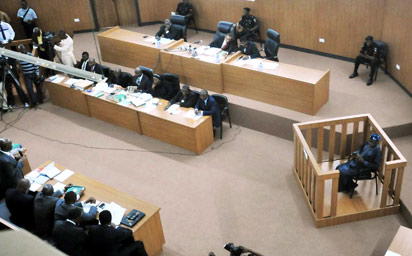
The Code of Conduct Tribunal sitting
*The story of CCB’s potential gambit
This is an exclusive story of how the Code of Conduct Bureau, CCB, is inching in the direction of a danger that could potentially pour cold water on its attempt to be seen to be carrying out its mandate of fighting corruption in public office without prejudice. It is a story of subterfuge, underhandedness and a seeming display of uncoordinated approach in the fight against corruption. Using the summoning and docking of former Lagos State governor, Bola Tinubu, by CCB as a case in point, this report would show that the air of anti-corruption is already suffering a massive dose of contamination.
By Jide Ajani, Deputy Editor
It was a whimsical dismissal of the invitation! The leadership of Code of Conduct Bureau, CCB, had sent words to Governor Magartakda Wamako of Sokoto State to appear before it. The governor, seeking counsel from well-informed stakeholders in the anti-corruption war in the country, was advised to ignore the invitation. The governor acted in like manner based on the counsel.Nothing has happened! And, nothing may happen! The information at the disposal of Sunday Vanguard is as unbelievable as it is ridiculous. But the pieces of information are true, very true.
In fact, the latest dramatisation by CCB, that is the summoning and docking of former Lagos State governor, Bola Tinubu, is just one in a long string of possible mishaps that CCB may be about to suffer.
It is also a story that would demonstrate that CCB, constitutionally empowered to set the straight path to anti-corruption, may have fallen victim of the cankerworm of corruption.
Yet, as the case against Tinubu progresses, the Peoples Democratic Party, PDP, and indeed’, the presidency of Goodluck Jonathan may suffer the collateral damage of a half-baked, uncoordinated, nay shambolic strategy in fighting corruption.
IN THE BEGINNING
In the course of investigating and preparing for this story, it was discovered that the framers of the letters setting up CCB had their vision for anti-corruption. In fact, the United Nations Charter, African Union Charter, ECOWAS Charter and even European Union Charter of anti-corruption were all predated by Nigeria’s establishment of CCB and, therefore, suggests that the war on corruption was meant to be taken seriously.
Sunday Vanguard was told by a very dependable source that when President Olusegun Obasanjo took over in 1999, one of the issues he sought to tackle was corruption.
Indeed, Obasanjo, characteristically, set members of CCB up. Some consultants had been sent to CCB to solicit a partnership with a view to establishing the best way forward to assist it in the area of capacity-building. CCB that had been operating without the constitutional composition required simply wanted to be left to operate in the manner of “business as usual”.
Sunday Vanguard was told that “that was why Obasanjo sent the Independent Corrupt Practices Commission, ICPC, bill before the National Assembly” because he did not believe that CCB would do a good job at that time. Later, and discovering that ICPC did not meet his expectations, Obasanjo established the Economic and Financial Crimes Commission, EFCC.
The chairman, Sam Saba, had reportedly been a staff of CCB almost since its establishment. He was said to have retired from the bureau as a Permanent Secretary.
During Senate confirmation hearing for the commissioners who were nominated, including Saba, some senators were said to have kicked against his being brought back into the bureau after retirement. Intervention from his state governor was said to have swayed the senators who eventually acceded to his nomination.
THE TINUBU CASE
With the present approach of CCB in tackling the perceived alleged corruptness of Tinubu, it is betraying the real reasons why Obasanjo ignored it in the first instance.
First, and this has just been discovered, CCB is yet to formulate a standard procedure for effectively handling cases it wishes to prosecute at the Code of Conduct Tribunal, CCT. This is because the chairman of the bureau, and the commissioners in CCB appear not to be on the same page.

The Code of Conduct Tribunal sitting
Stemming from this is the impression on the part of stakeholders in the anti-corruption body that the once-upon-a-time business as usual disposition of some staff of the bureau cannot sustain any long-term anti-corruption crusade.
An inside source at CCB told Sunday Vanguard that “after the wave of tour by the commissioners of the bureau to the six zones of the country, the members met and decided what the next line of action should be.
“All the things the public officers claim and claimed to own, they must have declared them in court. They brought the photocopies and original of the documents to the CCB panel across the country.
“What we are now about doing is going into the field so as to verify the claims for the following reasons:
“(1) Take care of anticipatory declaration
“(2) Take care of under declaration
“(3) Take care of over declaration
“(4) Deal with outright lies
“(5) Verify the claims of properties outside the country.”
Sunday Vanguard learnt that CCB is expecting that some people would forward petitions to it regarding those from whom documents have already been collected. “Members of the public know these people; they live in their midst, they live in their villages,” a CCB source said.
Sunday Vanguard also learnt that “it is the Monitoring and Investigation Committee that plays the real role for the commission in its pursuit of the intendment of the laws governing the conduct of the bureau”.
Sunday Vanguard was told that the on-going verification would likely catch most public servants on the off-side. This was the stage where the bureau had reached before the Tinubu case re-surfaced. Indeed, the 1999 Constitution of the Federal Republic of Nigeria stipulates that as a public officer, you can not operate and maintain an account outside Nigeria.
Section 7 of the Code of Conduct Bureau and Tribunal Act, Cap C15 LFN, 2004 as amended talks about that; by operating the said accounts, an offence punishable under section 23(2) thereof as incorporated under paragraph 18, part 1, fifth Schedule to the 1999 Constitution of the Federal Republic of Nigeria would have been commited. That forms the kernel of the charge against Tinubu. CCB is set to prove its case against the former governor (See Box for the three charges against Tinubu).
Part of the code of conduct for public officers reads:
“The President, Vice-President, Governor, Deputy Governor, Ministers of the Government of the Federation and Commissioners of the Governments of the States, members of the National Assembly and of the Houses of Assembly of the States, and such other public officers or persons as the National Assembly may by law prescribe shall not maintain or operate a bank account in any country outside Nigeria.”
COMPLICATIONS
They may not admit it but Sunday Vanguard investigations in the Federal Capital Territory, FCT, Abuja, revealed that the commissioners in CCB are not in total agreement with the chairman, on many fronts.
In fact, preparatory to last Wednesday’s arraignment of Tinubu before CCT, the Chairman and his commissioners were engaged in a series of frenzied meetings.
The first one, held on Thursday, September 15, 2011, was at the behest of the commissioners.
They wanted the chairman to discuss the matter of Tinubu with them.
A source at the bureau informed Sunday Vanguard that the commissioners only got to know of the Tinubu matter on the pages of the newspapers just like many other Nigerians.
And, whereas CCB had plugged into the case, a case which predated that constitutionally constituted CCB as far back as 2005, the latest move, Sunday Vanguard was told, “was more of a move which emanated from discussions between CCB chairman and Minister of Justice and Attorney-General of the Federation, AGF, Mohammed Bello Adoke, SAN. I can tell you that the commissioners in the bureau were not aware”.
But rather than be briefed about arrangements for the arraignment of Tinubu, the meeting between the chairman and his commissioners dwelt more on administrative issues.
They again resumed and continued the meeting the following day, Friday, September 16. Sunday Vanguard actually wanted to go to press with developments in CCB penultimate week in anticipation of an interview with the AGF, with a view to seeking some clarifications, but stepped down the story. Unfortunately, the proposed interview could not hold because the AGF was very busy and was also said to be preparing to travel to New York, USA, with President Goodluck Jonathan.
Although Sunday Vanguard could not reach him for clarifications, one of the commissioners in CCB, Dr. Ademola Adebo, who is said to be in charge of the South-West, is not at the centre of the prosecution of Tinubu – just as is all the other commissioners. There are nine commissioners at CCB including the Chairman: Mr. Sam Saba, Chairman, CCB (North-Central Zone); H. Mohammed Disina, Finance (North-East Zone); MB. Habib Elabor, Human Resources (South-South Zone); R. Ademola Adebo, ICT (South- West Zone); Prince Okechukwu Nwadinobi, Investigation & Monitoring (South-East Zone); Dr. Christy Ekoja, Education & Advisory Services (North-Central Zone); IEF Stephen Bekefula, Asset Declaration (South-South Zone); RR Yakubu Tukur (MFR), Legal Affairs (North- East Zone); and Alhaji Ibrahim Manzo, Procurement & Supply (North-West Zone).
Sunday Vanguard had hoped that by the time Tinubu would be docked, CCB would have put its house in order but it has not.
Sunday Vanguard discovered that the funds for the payment of the prosecuting lawyer, Alex Iziyon, which runs into millions of naira, would be made available outside CCB.
Unconfirmed reports point in the direction of the Presidency for the funds.
Tinubu aside, Sunday Vanguard also discovered that there are growing concerns that even the forms meant to be readily available for public officers to fill for asset declaration is sometimes hoarded by clerical officers of the bureau.
Then, there is also the concern pointed out by one of the governors that “inviting 36 state governors and their deputies to Abuja means shifting the onus of verification to the public officers being invited and there are implications – the security implications, the threat to life, the cost to taxpayers, and the seeming unseriousness of such an invitation since CCB is expected to investigate us”.
It was because of this seeming shambolism in the activities of CCB that led it to think again before filing fresh charges against Tinubu last Wednesday.
Even at that, and sitting in the dock before the CCT chairman, Justice Danladi Umar, who presided over the case alongside Justice Atedze W. Agwadza and Justice Robert I.E Udo, (rtd), Tinubu appeared unfazed – whether that was a mere act of braggadocio or sincere belief in his innocence, the outcome of the case would determine that.
OH! C C B
Also in the course of gathering materials for this piece, Sunday Vanguard learnt that because of what Obasanjo saw as lack of capacity in CCB then, he did not even bother to constitute the bureau properly. The former President was quoted as telling a confidant that the “Bureau would not achieve much in terms of carrying out its anti-corruption mandate.
That was why the late President Umaru Yar’Adua decided that he would give vent to the constitutional responsibilities of CCB by scouting for credible Nigerians to sit on the bureau.
Before Yar’Adua, CCB had never really been constituted following the expectations and intendment of the Constitution of the Federal Republic of Nigeria. For instance, whereas one of the sections of the constitution states that the 10 members to be appointed into CCB shall at the time of appointment, “not be less than 50 years of age and subject to the provisions of Section 157 of this Constitution shall vacate his office on attaining the age of 70 years”, this had not really been so in the past.
But before Yar’Adua could fill the bureau with members, he died.
The first engagement of Jonathan upon becoming Acting President was to send the names of the proposed commissioners of the bureau to the Senate for confirmation. Sunday Vanguard gathered that because Yar’Adua kept faith with Jonathan, the then Acting President did not tamper with the list of nominees prepared by Yar’Adua before he died.
Sunday Vanguard also discovered that indeed, Jonathan’s nominee into the Bureau as a Commissioner was endorsed by Yar’Adua.
And so, when Jonathan was presenting the list, he did not change any name. Therefore, that was the first time in the history of the bureau that it would be properly constituted. This batch of commissioners were sworn in on April 30, 2010.
On the occasion, Jonathan charged had them that their agency was the one with the capacity to fight corruption and that the constitution empowers their bureau to handle all public servants – mind you, public servants are seen largely as the group of people driving the entrenchment of corruption in the country. Today, Western powers have made anti-corruption a condition precedent for support, aid and assistance to developing countries.
But is the bureau functioning well or being allowed to function well? That would be a question to be answered explicitly with the handling of Tinubu’s case.
Already, there are insinuations that the PDP-led Federal Government is looking for ways to clip the wings of Tinubu, whose party, Action Congress of Nigeria, ACN, is seen as the major opposition party to PDP. And, that the battle for the elections of 2012 in some states of the federation (and 2015) has already commenced.
Another theory being weaved around the case is that President Jonathan, on a visit to the United Nations at a time when a popular public figure like Tinubu is being tried, would send a life-saving signal that his administration is indeed, fighting corruption.
One of the questions being asked is: Is Tinubu the only governor who maintained and operated an account while in office? Others are even wondering why Tinubu celebrated his appearance before CCT the way he did and for what purpose? Yet, some are of the view that the main issue is whether Tinubu broke the law or not. CCT will decide that. At the Tinubu hearing, Chief Wole Olanipekun, SAN, led nine other Senior Advocates of Nigeria to defend him.
The former governor’s plea was not taken because of technicalities arising from the fact that fresh charges were slammed on him last Wednesday in court.
The 3-count charge filed against Tinubu
Count 1
That you, Bola Ahmed Tinubu, former Governor of Lagos State, being a public officer as listed in part II of the fifth schedule to the 1999 Constitution of the Federal Republic of Nigeria and having subscribed to the Oath of office as contained in the fifth schedule to the 1999 Constitution on assumption of office between 1999 and 2000 and while in office as such engaged yourself in the operation of several foreign bank accounts namely.
I. Name of Bank – First Heritage Bank Country Club Hills, Illinois, USA
Account Name – Bola Tinubu, Account Number- 263226700
II. Name of Bank – Citibank NA New York, USA.
Account Name – Bola Tinubu & Compass Finance and Investment Company Ltd. Account Number- 39483134, 39483396, 4650279566, 00400220, 39936404, 39936383.
III. Name of Bank – Citibank International New York, Account Name -Bola Tinubu, Account Number -52050-89451952 and 52050-89451953
IV. Name of Bank – HSBC 177 Great Portland Street, London WIW6QJ. Account Name – Sen. Bola Tinubu, Account Number -71253670 Sort Code 40-03-15
V. Name of Bank – Citibank International New York, Account Name -Bola Tinubu, Account Number 52050-89451952 and 52050-89451953.
IV. Name of Bank – HSBC 177 Great Portland Street, London, WIW6QJ. Account Name -Sen. Bola Tinubu, Account Number -71253670 Sort Code 40-03-15
V. Name of Bank – HSBC 177 Great Portland Street, London WIW6QJ. Account Name -Sen. Bola Tinubu, Account Number -71253670 Sort Code 40_03_15
VI. Name of Bank – HSBC 177 Great Portland Street, London WIW6QJ. Account Name -Sen. Bola Tinubu, Money Market Account Number- 04320002DN
VII. Name of Bank – HSBC 177 Great Portland Street, London WIW6QJ. Account Name – Tinubu Habibat Oyindamola (Miss), Account Number- 1320960111
VIII. Name of Bank – HSBC 177 Great Portland Street, London WIW6QJ. Account Name – Tinubu Zainab Abisola (Miss), Account Number -172447101
XI. Name of Bank – HSBC 177 Great Portland Street, London WIW6QJ. Account Name -Tinubu Oluremi Shade, Account Number -1916667988
X. Name of Bank – HSBC 177 Great Portland Street, London WIW6QJ. Account Name -Oluremi Shade Tinubu, Account Number -41421522
Contrary to Section 7 of the Code of Conduct Bureau and Tribunal Act, Cap C15 LFN, 2004 as amended and punishable under section 23(2) thereof as incorporated under paragraph 18, part 1,
Fifth Schedule to the 1999 Constitution of the Federal Republic of Nigeria (as amended).
Count 2
That you, Bola Ahmed Tinubu, former Governor of Lagos State, being a public officer as listed in the part II of Fifth Schedule to the 1999 Constitution of the Federal Republic of Nigeria and having subscribed to the Oath of Office as contained in the fifth schedule to the 1999 Constitution on assumption of office between 1999 and 2000 and while in office as such engaged yourself and did maintain several foreign bank accounts namely:
I. Name of Bank- First Heritage Bank Country Club Hills, Illinois, USA. Account Name -Bola Tinubu, Account Number: 263226700
ii. Name of Bank – Citibank NA New York, USA. Account Name – Bola Tinubu & Compass Finance and investment Company Ltd. Account Number – 39483134, 39483396, 4650279566, 00400220, 39936404 and 39936383
iii. Name of Bank – Citibank International New York Account Name – Bola Tinubu, Account Number – 52050-89451952 and 52050-89451953
iv. Name of Bank – Citibank International New York, Account Name -Bola Tinubu, Account Number 52050-89451952 and 52050-89451953
v. Name of Bank – HSBC 177 Great Portland Street, London WIW6QJ. Account Name -Sen. Bola Tinubu, Account Number -71253670 Sort Code 40-03-15
vi. Name of Bank – HSBC 177 Great Portland Street, London WIW6QJ. Account Name -Sen. Bola Oluremi Tinubu, Account Number -71253670 Sort Code 40-03-15
vii. Name of Bank – HSBC 177 Great Portland Street, London WIW6QJ. Account Name -Sen. Bola Tinubu – Money Market Account Number 04320002D
viii. Name of Bank – HSBC 177 Great Portland Street, London WIW6QJ. Account Name -Tinubu Habibat Oyindamola (Miss), Account Number- 1320960111.
ix. Name of Bank – HSBC 177 Great Portland Street, London WIW6QJ. Account Name -Tinubu Zainab Abisola (Miss), Account Number – 172447101.
x. Name of Bank – HSBC 177 Great Portland Street, London WIW6QJ. Account Name -Tinubu Oluremi Shade, Account Number -1916667988
xi. Name of Bank – HSBC 177 Great Portland Street, London WIW6QJ. Account Name – Oluremi Shade Tinubu, Account Number – 41421522
Contrary to Section 7 of the Code of Conduct Bureau and Tribunal Act, Cap C15 LFN, 2004 as amended and punishable under Section 23(2) thereof as incorporated under paragraph 18, part 1,
Fifth Schedule to the 1999 Constitution of the Federal Republic of Nigeria (as amended).
Count 3
That you, Bola Ahmed Tinubu, former Governor of Lagos State, being a public officer as listed in the part II of fifth Schedule to the 1999 Constitution of the Federal Republic of Nigeria and having subscribed to the Oath of Office as contained in the fifth schedule to the 1999 Constitution on assumption of office between 1999 and 2007 and while in office as such engaged yourself and did maintain several foreign bank accounts contrary to Section 15(2) of the Code of Conduct Bureau and Tribunal; Act, Cap C15 LFN, 2004 as amended and punishable under paragraph 18, fifth Schedule to the 1999 Constitution of the Federal Republic of Nigeria ( as amended).
Disclaimer
Comments expressed here do not reflect the opinions of Vanguard newspapers or any employee thereof.