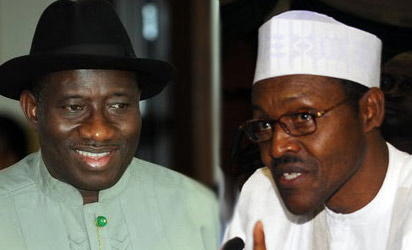
President Goodluck Jonathan and Gen. Muhammadu Buhari (rtd)
By IKECHUKWU NNOCHIRI
ABUJA— Congress for Progressive Change, CPC, yesterday, alleged before the Presidential election petition tribunal sitting in Abuja, that President Goodluck Jonathan used scores of armed policemen and soldiers to divert sensitive electoral materials that it said “caused compromise of the presidential election.”
The petitioner made this allegation on a day the five-man panel of justices on the tribunal, reserved ruling on an application by CPC, seeking leave of court to tender software evidence that it said would reveal how the April 16 Presidential election was rigged by the Peoples Democratic Party, PDP, in connivance with the Independent National Electoral Commission, INEC.
The panel, which was presided by Justice Kumai Bayang Akaas, reserved ruling on the application, sine-die (indefinitely), after it had listened to oral testimonies of seven witnesses who were brought to court by CPC yesterday.
Testifying in court yesterday, the witnesses, Mohammed Lawal Suleiman, Embarage Abbayi, Ibrahim Musa, Bito Martins, Bulama Waziri and Nwagbara Ogina Chijioke Eze, alleged that they saw security operatives thumb-printing ballot papers in Zamfara, Taraba, Jigawa, Abia, Cross River, Sokoto and Enugu states.
Tribunal rejects respondents’plea
Spirited efforts by counsel to the respondents to persuade the tribunal not to hear the oral evidence was rebuffed by presiding Justice Akaas, who gave the witnesses the nod to narrate their experiences.
In his statement on oath which was made available to newsmen yesterday, Ibrahim, who said he was a roving agent of CPC in Jigawa State, averred that “the presidential election took place in the country on April 16, 2011. That the third respondent who is the incumbent President and Commander-in-Chief of the Armed Forces of the Federal Republic of Nigeria, ordered a ban or unlawful restriction of movement and deployment of armed and civilian security outfits who equally ordered the use of the police and army transport equipment for the deployment of sensitive electoral materials without the participation of the petitioner which led to the interference by agents of the 3rd, 4th & 5th Respondent/intermeddling with these sensitive electoral materials that caused compromise of the presidential election.
“That the restriction on movement of Nigerians as ordered by the third respondent was a ploy by the third respondent to take umbrage under security cover for his agents to tamper with sensitive electoral materials in order to gain undue election advantage.
“That this statement is made in good faith conscientiously believing the facts contained therein to be true and correct in accordance with the oaths Act, 2004.”
The tribunal equally entertained arguments from the petitioner and all the respondents in the matter with regard to the propriety of admitting a fresh evidence sought to be tendered by CPC as exhibit, in view of the fact that the request is coming after the statutory pre-hearing session on the case had elapsed.
In opposition to the application, President Jonathan, PDP and INEC, urged the tribunal to decline the request, describing it as a subtle attempt by CPC to amend its petition.
They argued that the petitioner failed to establish an extreme circumstance that warranted it to file the application outside the pre-hearing session, even as the respondents relied on the case law in Okereke vs. Yar’Adua, 2008, 12 NWLR, part 1100, to insist that the application was unmeritorious.
Counsel to the CPC, Mr Dipo Okpeseyi, SAN, while moving the application, which was supported by a 55-paragraphed affidavit deposed to by the party’s national secretary, Mr Buba Galadima, 21 attached exhibits and a written address, pleaded the tribunal to extend time for the petitioner to call additional witnesses as well as to file additional witness statements on oath.
He maintained that the request was an aftermath of a ruling delivered by the tribunal on September 6, which barred the CPC from taking copies of any material used in the conduct of the presidential election.
According to the CPC lawyer, “at this point, we realized that we may not be able to produce the biometric data base of INEC or get other documents necessary for our defence owing to the ruling that was delivered by this court on the September 6th.
“This application is not to amend the pleadings in the petition but due to exceptional circumstances beyond our control such that we could not afford to be frustrated as a result of the ruling.
“The respondents have not shown this court what they stand to lose or suffer if this application is granted, we therefore pray this court to exercise its discretion in favour of the applicant”, he pleaded.
Counsel to INEC, Chief Adegboyega Awomolo, SAN, who yesterday adduced three reasons why it should be dismissed by the tribunal, vehemently attacked CPC’s application.
He said: “my lords, trial has already began in this matter and 18 witnesses have been called by the petitioner, under paragraph 47(1) of the First Schedule of the Electoral Act, this application is no longer an issue of right but a rare privilege. The frustration or whatever problem that prevented the petitioner from taking copies of electoral materials, was self-induced by them. The applicant was aware that it had no right to take copies of the biometric database if voters register in custody of INEC, since May 24, therefore it cannot be a ground of extreme circumstance as nothing was shown by the petitioner capable of swaying the discretion of this court in its favour”, he argued.
Specifically, CPC via a motion on notice it filed pursuant to paragraph 47 (1) of the 1st Schedule to the Electoral Act 2010 is seeking leave to tender a “Blog extracts from Lagos, GTUG, of Femi Taiwo (lead Software Developer) of INEC Open Voters Registration project (The soft ware used by INEC for voters registration)”, which it said would show how the INEC Chairman, Professor Attahiru Jega, manipulated the 2011 voters registration exercise with a view to ensuring that the ruling party, PDP, retained presidential power.
It is equally among other things, praying the court for “an Order pursuant to Paragraph 45 (1) of the 1st Schedule to the Electoral Act 2010 and/or the Court’s inherent jurisdiction granting leave to the Petitioner/Applicant for enlargement of time within which to file and use Additional Witness Statements.
“An Order granting Leave to the Petitioner/Applicant to amend its List of Documents pleaded as shown in the underlined portion of the Proposed Amended List of Documents Pleaded which is attached herewith and marked as Exhibit 21 by accommodating the additional documents stated in Paragraph 10 hereof as listed in the proposed Amended List of Documents Pleaded.
“An Order granting leave to the Petitioner/Applicant to rely on additional Witnesses Statements stated in prayer 2 hereof which is already filed and served exactly in terms of the Proposed Witnesses Statements (Exhibits 15, 16, 17, 18, 19 and 20 respectively) in addition to the ones already listed in the List of Documents pleaded and filed alongside the Petition.
As well as, “an Order abridging the time for the Respondents to file and serve their Counter-Affidavit and Written Addresses in opposition to this Motion, if any, in view of the exigency of time for the Petitioner/Applicant to prove its case as given in the rescheduling Order dated the 7th September, 2011.”
Disclaimer
Comments expressed here do not reflect the opinions of Vanguard newspapers or any employee thereof.