By Jimoh Babatunde
Many countries today sustain their economy from the proceeds of tourism. some African countries like Ghana, South Africa and Gambia are among the few in the continent that have generated a lot of tourists to boost their economy.
Nigeria efforts at attracting tourists have not yielded much result as the private sector is complaining of harsh economic environment to operate. Many tourists see Nigeria as expensive to visit, often arguing that hotels here are more expensive than many European countries.
But, the hoteliers often based the high charges on the high cost of doing business; the hoteliers say they have to do that to break even. “We are made to pay different taxes, we provide water, and we need to provide electricity and even security.” One hotel owner said.
For Chief Mike Amachere, owner of the Port Harcourt Tourist Beach, Funding of tourism has always been a critical element of the industry development over time in Nigeria due to the capital intensive nature and long gestation period of tourism projects.
This, he said, informed the calls by stakeholders in the industry for the floating of a tourism development fund as an incentive and encouragement for investors in the sector.
Amachere said tourism is capital intensive and for there to be real development that the sector requires low interest funds with long gestation, “which is not available presently in Nigerian Capital Market.”

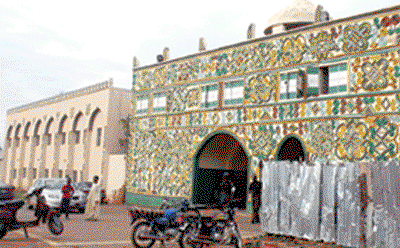
ZAZZAU PALACE: The ancient city of Zaria was established as the seat of the throne of Zazzau more than 700 years ago, while the whole kingdom is about 1,000 years old and is among the oldest and most populous kingdom in Northern Nigeria. Photo by Lamidi Bamidele
Members of the Federation of Tourism Association of Nigeria (FTAN), Samuel Alabi once told journalists that considering the role tourism can play in the creation of employment that it behoves on the government to put in place policies that would encourage investment.
Chief Amachere noted that he is aware that there was a technical committee that prepared modalities for the establishment of Tourism Development Fund (TDF) during the time of President Olusegun Obasanjo.
He noted that the committee agreed that tourism is capital intensive and its meaningful development cannot be met through budgetary allocations alone as it has to compete with other priority sectors of the economy.
The Chairman of the committee, Dr. Franklin Adejuwon, once told this reporter that when operational, the Tourism Development Fund shall be expended on various tourism projects emanating from state governments, organised private sector and individuals as soft loans repayable at much reduced interest rates.
“It will also support government efforts in the provision of basic tourism infrastructure, facilities, promotion and marketing of tourism products in and outside Nigeria.”
From the modalities for the establishment of tourism development as prepared by the committee, it was agreed that the government must initiate and lead by example by contributing 1% of overall allocation for capital projects in all Federal Ministries and parastatals to the fund annually.
The state and local governments are also expected to contribute same to the fund annually, just as the private sectors too.
“To secure the consensus of the private sector for the establishment of TDF, meetings were held with key stakeholders particularly the airlines, hotels as well as breweries and beverage sectors.”
Adejuwon noted that the international airlines had no objection to an addition to the airport tax to support tourism, “but, it was however suggested and agreed that in order to make Nigeria competitive, the existing fund as airport tax which was raised from at the instance of tourism and being held then by the Aviation ministry should assume a new sharing formula for tourism to have some.”
As for the domestic airlines, he explained that it was argued that the 5% VAT be transferred to the Tourism Development Fund as nowhere in the world that VAT is collected from the domestic airlines.
“It was agreed that the 5% being collected be transferred to the TDF as the domestic airlines contribution to tourism development in the country. This decision was considered reasonable and logical.”
He explained that the hospitality sector, the financial institutions and the breweries were to contribute to the fund as well as the telecom companies.
On the procedure for collection, it was explained that the government shall direct all payment of all funds due to the Tourism Development Fund account to the CBN as payment shall be specially monitored by an audit sector set up by the government.
“The disbursement of funds shall be based on the viability and priority of projects and shall be spread through all relevant sectors that may affect the development and promotion of tourism.”
Disclaimer
Comments expressed here do not reflect the opinions of Vanguard newspapers or any employee thereof.