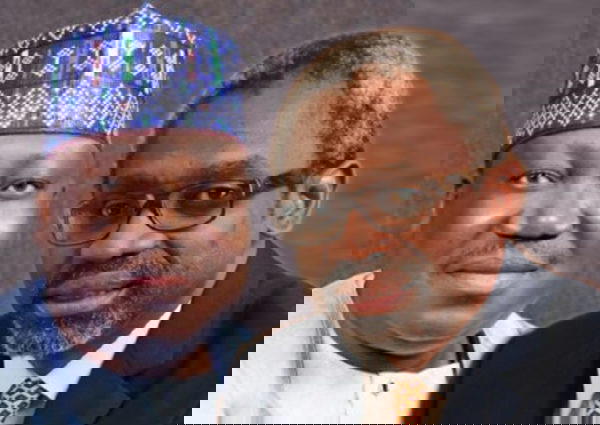
Lawan and Gbajabiamila
…We’ve already shifted from core issues of governance to attacks of personalities-Lawan
…slogan must not be abusive -Gbajabiamila
…Political communication must be couched to sustain Nigeria’s democracy -NILDS DG
…anti-corruption campaign no longer news; We need country that gives sense of belonging to all Nigerians-Kukah
…hate speech, misinformation embedded in campaign messages-Lai Mohammed
…We will abide by the law-IPAC/ADP presidential candidate, Sani
By Levinus Nwabughiogu-Abuja
Ahead of the commencement of the electioneering campaigns for 2023 polls, some mainstream politicians, critical stakeholders, and political leaders in the country have insisted that the presidential candidates as well as their spokesmen must run issue-based campaigns.
The leaders which included the President of the Senate, Ahmed Lawan, the speaker of the House of Representatives, Rep. Femi Gbajabiamila, the Director-General of the National Institute for Legislative and Democratic Studies NILDS Professor Abubakar Suleiman, Bishop of Sokoto Diocese, Reverend Father Mathew Kukah, the Minister of Information, Lai Mohammed spoke at a “High-Level Forum on Political communication and Issued-Based Campaign in the 2023 General Elections” organized by NILDS and the Kukah Center on Monday in Abuja.
We’ve shifted from core issues of governance to attacks of personalities-Lawan
Making his remarks at the event, the Senate President, Ahmed regretted that elections on Nigeria have always been characterized by divisive messages.
He said that already politicians have left the core issues of governance for attacks on personalities.
He said: “The emergence of presidential candidates for political parties and the appointment of media spokespersons has once again thrown up the question of how political messages should be
crafted and delivered and the consequence of messaging for the broader polity. Since independence, elections in Nigeria have been characterised by polarising rhetoric and deep-seated divisions relating to ethnicity, religion and other primordial sentiments. These are well captured in the literature on elections and governance in Nigeria that show the damaging effects of negative campaigning over the years.
“Against this background and ahead of the commencement of campaigns, this forum assumes an even greater significance. The proliferation of the internet and social media
platforms and the growing culture of fake news pose new dangerous and threats to our collective existence. Politicians at all levels must be cognisant of this and take measures to
mitigate them.
“We have shifted our focus from the core issues of governance to irrelevant and frankly nonsensical attacks on the personalities of the various candidates. By so doing, we, the politicians, have once again distracted Nigerians from assessing those who seek political
office based on the merit of their positions. Inadvertently, we are also exploiting primordial sentiments for political purposes, not minding the danger this poses to our democratic
experiment. I expect this forum to enable us reflect on the seriousness of governance and the need to
make our campaigns more issue-based. It is easy to dwell on trivialities and engage in a shouting contest. What should occupy our minds and discussions in the coming weeks and
months include tackling insecurity and building on the gains made by the present administration of President Muhammadu Buhari in this regard. Other issues include economic consolidation and diversification, addressing rising unemployment, especially
among youths, lowering inflation and managing diversity.
“The growing political awareness on the part of Nigerian youths who are disenchanted and angry at the ruling class means that we cannot continue with business as usual. We in the 9th National Assembly have taken deliberate measures to strengthen our democratic process particularly through the passage of the 2022 Electoral Act which makes
numerous innovations aimed at improving transparency and voter confidence. We have also ensured that the needed funds are provided to INEC to deliver a hitch-free elections. I
have personally championed a people’s-based lawmaking that responds to the actual need of Nigerians rather than the narrow interests of a few. Even on controversial issues and legislative proposals, we have insisted on holding public hearings and ultimately respecting the voice of Nigerians.
“I wish to passionately implore all stakeholders to be conscious of their messaging and focus on issue-based campaign that shuns violence and hate speech. As the most populous black
nation and the largest democracy in Africa, the burden is on us to deliver credible and peaceful elections”.
Campaigns slogan must not be abusive -Gbajabiamila
Also speaking, the Speaker of the House of Representatives, Femi Gbajabiamila also appealed to the political actors to keep their campaign languages moderate, saying they must not be abusive.
“As we prepare to commence campaign activities precisely nine (9) days from
today (statutorily for a period of 150 days before tolling day), it is critical
that we familiarize ourselves with the rules of the game and set ourselves a
basic standard of conduct mainly because of our place as leaders and weight that our utterances carry among our supporters and followers
“The Electoral Act 2022, one of the most significant legislations passed by the
National Assembly since 1999, contains critical provisions on the conduct of
political campaigns. Section 92 states that “a political campaign or slogan
shall not be tainted with abusive language directly or indirectly likely to injure religious, ethnic, tribal or sectional feelings’. Sub-section 2 is even more
direct in its prohibition of intemperate, slanderous or base language,
insinuations, or innuendoes designed or likely to provoke violent reactions or
emotions’. Other vital provisions prohibit the use of places of religious
worship, police stations and public offices for campaigns. The Act further
stipulates sanctions for a political party, aspirant or candidate that contravenes these provisions ranging from fines of up to N2 million or imprisonment for a term of twelve (12) months.
“The National Assembly, in its consideration of the draft legislation, took into account the historical political developments in Nigeria in the last six (6) decades and the vulnerability of our democracy to ethnoreligious rhetoric.
As a result, the legislature is keen on forestalling the tendency of the political
class to exploit cultural differences to further their political agenda. As you
are well aware, Nigeria is one of the most culturally diverse countries in the
world. This heterogeneity rests on ethnic, religious, linguistic and historical
differences. It is therefore critical that all policies and programmes of the
government, as well as the actions of politicians, especially at elections,
should be aimed at promoting national unity and cohabitation.
“Regrettably, some of the key provisions of the Electoral Act with regards to
political campaigns, as well as the provisions in INEC’s Regulations and
Guidelines for the Conduct of Elections, 2022, are already being flagrantly violated, particularly pertaining to the use of intemperate, slanderous and base language as well as insinuations or innuendoes that are clearly targeted at provoking violent reactions or emotions. It is easy to hurl insults at opponents, but it takes discipline, focus and political maturity to make our campaigns issue-based. Yet, this is the least that we owe our citizens. It amounts to a great disservice and even a disconnect from the grim realities of Nigerians’ challenges, focusing on frivolous and
inconsequential issues.
“The task of a responsible political campaign is the responsibility of all
stakeholders in our democracy. INEC must uphold and strictly implement the
provisions of the Electoral Act, 2022 and the Regulations and Guidelines. In
this regard, INEC’s messaging should be simple, direct and devoid of ambiguities. Only recently, the commission has had to clarify some reports that seemed to suggest that election results in the 2023 general election will be manually collated. In an era of fake news and misinformation meant to mislead and cause political upheavals, INEC is tasked with staying ahead in its messaging to forestall possible misrepresentation and confusion” he said.
The speaker also tasked the media on curtailing the spread of misinformation.
Political communication must be couched to sustain Nigeria’s democracy -NILDS DG
In his welcome address earlier, the Director General of National Institute for Legislative and Democratic Studies NILDS, Professor Abubakar Suleiman said that political messages must be tailored to sustain Nigeria’s democracy.
“Political campaigning is an indispensable tool in the context of the electoral process in any democratic environment. This is primarily because they create a platform and an
opportunity for political actors to reach out to the electorate and share their ideological and policy positions. They also shape citizens’ electoral choices and strengthen democracy by
promoting accountability to the electorate
“Despite these advantages, it is well known that campaigns can undermine democracy, particularly when they induce cynicism among the populace, undermine trust in government, decrease turnout and frustrate genuine attempts to engage the citizenry. Critics have raised significant concerns about recent developments in political communication, particularly because negative and personality-based ones are increasingly replacing informative, policy-focused campaigns. The lack of ‘substance’ in political debates means
that voters are often confused and unable to make well-informed decisions. Some studies have shown that negative political communication and campaigns push people to stay away from politics altogether.
“It is self-evident that the build-up to the 2023 general elections raises genuine concerns about the pattern of public communication among political actors, their publicity agents, and other related stakeholders, especially those actively engaged in media and communication.
“Experts have noted that communication by actors so far has been reactive
and not based on a clear enunciation of party manifestoes, candidates’ programmes and strategies for actualising such programmes. This high-level forum addresses some of these
critical issues to promote issue-oriented political communication. This has become more relevant due to the rise in misinformation and fake news, propagation and exploitation of
ethno-religious sentiments, upsurge in hate messages and the use of negative tactics that continue to escalate tension and potentially fuel political crises.
Technological advancements and the proliferation of electronic media platforms have revolutionised political communication and exposed our democracy to dangerous new
threats. New internet technologies challenge established institutions and principles of regulation of election communications. They undermine the ability of existing regulations
to maintain a level playing field.
“Therefore, we must engage in an honest conversation on how to preserve our democracy and guard against emerging threats. We expect these issues
to be comprehensively addressed at this Forum and culminate in a consensus by all stakeholders to focus on the substantive issues facing Nigerians. Election campaigns should centre on robust debates about the competency and programmes of candidates”, he said.
Anti-curruption campaign no longer news; We need country that gives sense of belonging to all Nigerians-Kukah
In his remarks, the bishop of Sokoto Diocese, Reverend Father Mathew said that in a saner clime, issues of religion should not dominate the polity.
According to him, Nigerians needed to be give a sense of belonging irrespective of their ethnic, political or religious beliefs.
He added that anti-curruption campaign message will not be fashionable in the forthcoming elections as Nigerians have seen it all.
“I hear conversations on the quality of campaigns and how this campaign should be conducted. A campaigner seeks to draw your attention and there’s nothing wrong with that. It’s not that politicians are bad people, this is not the issue. It’s like people who have won election will tell you. Maybe what we thought are the issues when we were outside, now we are inside it’s different. The challenge therefore almost like everything else life, it’s about readjusting and figuring out how to make things work.
“The greatest challenge for us is that our identity politics has not been well managed. The most important ingredient in politics is diversity. You have heard me in the last seven years or so, I have been relentless. I am convinced beyond reasonable doubt that had we developed the skills to manage diversity effectively and efficiently, that’s what is happening in other parts of the world.
“The question for every politician is what do I want to be known for? Nigeria has produced some dramatic politicians. There are people who can hold you spell bound. Every campaign must be characterized by a slogan. Nigeria politicians need to understand that wiping out corruption campaign no longer works. Nigerians are looking for a country they can believe in. Our identities are not a problem. Religion is not actually a problem. When you talk about issue based campaign, there has to be an aggregate of safety, how do you manage a country like Nigeria with so many religious and other differences. People have to get a sense that they are in this too. I think that when we talk about what the issue should be for 2023 election, it’s basically same thing we have been talking. Every Nigerian has looked himself in the mirror and ask themselves whether I’m a Christian or Muslim i am I better off now? Under saner moments we shouldn’t be talking about Muslim Muslim tickets. The questions Nigerians are asking are legitimate and it’s the responsibility of these politicians to deal with it. We need to re-image Nigeria, the Nigeria we have today is not something many of us can recognize. Nigerians don’t need a messiah this time. We can’t make the same mistake this time. We are the children, the last generation, we are the ones they left behind. The next election should ensure every Nigerian gets a seat in the tent”, he said.
Hate speech, misinformation embedded in campaign messages-Lai Mohammed
On his part, the minister of information, Lai Mohammed represented a director of performing arts, National Arts Council and Culture, Sam Agi intoned that hate speeches and misinformation were embedded in campaign messagea.
“Hate speeches, misinformation and other ways of messages manipulating messages are apparent. We should be concerned that whatever message that will be sent must be relevant. Most Nigerians reside in grassroots, so grassroots mobilization should be taken very seriously. If we can use medium that can enable us reach those people in the grassroots, the advocacy will be more receptive and effective. We will be happy to receive a communique that will come out of the event”, he said.
On his part, the Chairman Senate Committee on Media, Bashiru Ajibola said “it is very shocking that ahead of the general elections we are already getting it wrong.”
He added that “What we hear ahead of the election is status report on age, health, religion of candidates and so on other mundane issues. We should chanel our energy to get the democracy to work to lift our people out of the vicious cycle of poverty and so on.”
In his remarks, the Chairman of Interparty Advisory Council, IPAC and Presidential candidate of the Action Democratic Party, ADP, Yabaji Sani assured that they will run an issue-based campaigns.
Disclaimer
Comments expressed here do not reflect the opinions of Vanguard newspapers or any employee thereof.