By Chukwuma Ajakah
US based Nigerian-American artist and art educator, Prof Dele Jegede, has called on the art community and family of late renowned artist and administrator, Prof Yusuf Adebayo Cameron Grillo, to work at immortalizing the legend by collaborating with government and other relevant agencies.
In his keynote address on the occasion of the first anniversary of Grillo’s demise, tagged: “Yusuf Grillo, the Man, the Message, the Myth”, Jegede who joined the Art Talk session virtually from his base in USA, harped on the urgent need to immortalize the consummate through the establishment of a robustly funded Endowment fund that will involve top-level corporate bodies, the Lagos State Governor, politicians and business executives like billionaire businessman, Femi Otedola.
While commending the organisers, GRILLOArt Ltd, for kick-starting the initiative with a memorable memorial reception, Jegede proposed a “Grillo Project” that will be funded through a collaborative annual fundraising. He also suggested that a professorial endowment chair in honour of the legend be established at the Lagos State University of Education, LASUED and other tertiary institutions, running art programmes, saying: “I’m particularly interested in getting to have his name become synonymous with Nigeria and Africa. We should brainstorm on immortalizing him. Aside from being humble, he was a great family man and a religious person.” Grillo was a man of peace, love and goodwill.”
Art educator and veteran artist, Pa Timothy Fasuyi aka TAFAS of TAFAS Gallery, Ikeja, Lagos, a contemporary of the late sage, traced the history of their relationship to their first meeting as students of the Nigerian College of Art, Science and Technology, NCAST, Zaria in 1956, saying: “I was one of the first set and Grillo was one of the second set while Bruce Onabrakpeya was of the set.
“At the college, there were 3 specialisations- Painting, Sculpture and Graphics Design. Coincidentally, the three of us were in the painting section. Yusuf Grillo showed excellence in landscape painting and drawing. I was interested in pictorial composition, Bruce specialized in painting and printing.”
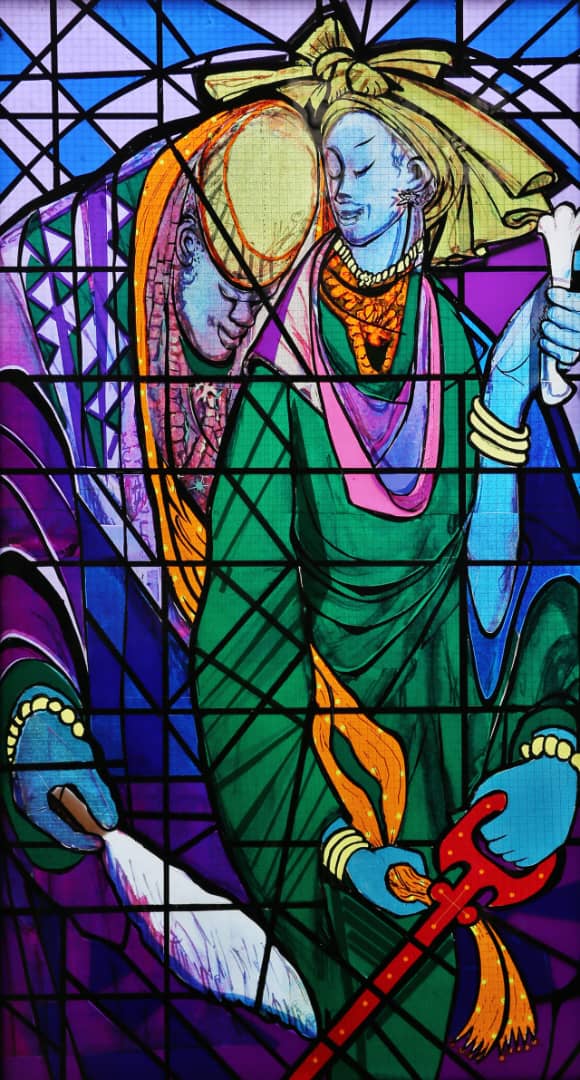
Fasuyi also commented on the demonstrable leadership roles Grillo had played in developing and promoting arts education/practice in Nigeria: “We were employed by the Federal Ministry of Education in Lagos. He was posted to the Yaba College of while I was deployed to Kings’ College, Lagos. Bruce who graduated later joined us in Lagos and was teaching at St. Gregory’s College, Lagos. The three of us became the founding force leading to the formation of the Society of Nigeria Artists in 1964. Yusuf Grillo became the President, I was the Secretary while Onabrakpeya was the Financial Secretary. Grillo got a lot of commissions, especially window glass painting in churches. I was at the Federal Ministry of Education headquarters where we formulated primary and secondary school art curricular.
Yusuf Grillo as HoD at Yaba College of Technology was instrumental to development of the department to a School of Art and Design.” The art connoisseur remarked that Grillo’s was outstandingly successful in his chosen field, ‘Grillo had a very flourishing professional practice and he made a lot of money from the sales of his art works and proceeds of his commissions. I’m mentioning this to educate young and upcoming artists. We need to supplement our talents with hard work to reach the top.”
Bernard Aina, a sculptor, former student and protegee of Grillo described him as a “Daddy” who was so humble that he stopped from his towering height as HoD (and later, Director) to relate with him, a first year student in a relationship that lasted for 50 years. Bernard Aina also spoke passionately on the works of Grillo and the legacies he left behind. He revealed that Grillo’s works were essentially etched in Yoruba culture in transit in the context of European civilization.
He remarked that the renowned artist was so worried about what would become of the Yoruba culture in the face emerging modern Western arts that he focused much on works with figures and images that echo the Yoruba culture and projected himself internationally as “a Yoruba, Nigerian and an African, in that order.” Aina added that some of the works express similar message with Gabriel Okara’s Piano and Drums.
Disclaimer
Comments expressed here do not reflect the opinions of Vanguard newspapers or any employee thereof.