By Ochereome Nnanna
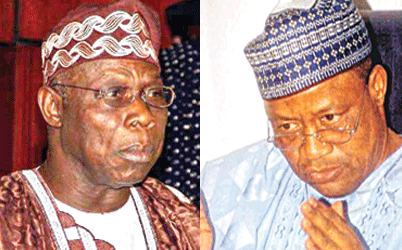
I NEVER really wanted to comment about General Ibrahim Babangida turning 70. Babangida is no longer news. He is history, and what comment I am making here today is based on IBB and history.
At the same time, I never felt like saying anything about General Olusegun Obasanjo, Nigeria’s former elected President over the lurid disclosures at the Senate on the failed privatisation programme. For me, Obasanjo and allegations of corruption are no longer news. They are matters tied up with the history of this unfortunate nation.
Babangida’s birthday fell on a week the probe at the Senate wound up without doing this country the favour of inviting Obasanjo to answer to allegations that he corruptly sabotaged the sale of Nigeria’s assets worth over $100 billion. I am aware that if such an invitation had been issued, OBJ would have found a way to politicise it rather than go to clear his name. People like Babangida and Obasanjo know this country very well.
They know that since the aborted Major Nzeogwu coup (which set out to stamp out a burgeoning neo-colonialism) and the civil war levied on the tribe of the coup plotters, Nigeria could never again be like Ghana and South Korea where the blood of evil rulers was used to clean the dirty stables to give the nations a new slate on which to resume the march to their today’s greatness.
Obasanjo even had the temerity to harangue the Egyptian military authorities for yielding to the will of their people to bring dethroned President Hosni Mubarak to trial in a “cage”. IBB and OBJ know such a thing could never happen to them.
Interviews in newspapers
What attracted me most to this topic was that in the interviews he granted the newspapers to mark his official Golden Age, Babangida took out time to assess Obasanjo’s eight-year tenure, which he dismissed as a “failure”. This I found rather interesting. IBB would usually tell you he would note contest against, or rate, his superiors in the military, especially OBJ.
He had always had this supercilious and patronising view of Obasanjo. Since his days in power, he had always reacted to OBJ’s holier-than-thou, higher moral ground posturing with the air of his own superior amusement and toleration of a slightly senile old man. These are the days of a self-rebranding Babangida who has allowed his jobless aides to talk him into commenting on national issues to “remain relevant”.
As far as I am concerned, as someone who has observed them and chronicled their activities for over two decades, I am of the considered opinion that these two “gentlemen” are two sides of the same coin. Even though a coin has the obverse and reverse sides, it is still made of the same material – copper, bronze, brass or what have you.
Even though Obasanjo was Babangida’s senior (he was a full General and military head of state 10 years ahead of IBB), the truth is that IBB actually made OBJ (especially the second stanza of the Owu chief) almost single-handedly. OBJ was partly an unwitting disciple of Babangida-ism and partly the nemesis of the political cult IBB built up in his eight years of political adventurism in Nigeria.
IBB was the one who convinced General Abdulsalami Abubakar to give power to OBJ (who was still languishing in prison where he was dumped by the late General Sani Abacha) as an appeasement to the Yoruba for the murder of Chief Moshood Abiola whose election as president of Nigeria he (IBB) annulled. He was not playing a national card in that venture. He merely saw it as a way of preserving this country’s unity while keeping power in the North.
Secondly, OBJ’s economic framework was essentially a continuation of the Structural Adjustment Programme, SAP, of the IBB regime, dictated by the Bretton-Woods institutions (International Monetary Fund and the World Bank). OBJ also administered the country’s democracy manipulatively; much like Babangida did and even also tried a tenure extension.
And just like IBB who, as he hurried out of Aso Villa, set up the short-lived Interim National Government headed by Chief Ernest Shonekan, OBJ after failing to grab a third term also put up the late Alhaji Umaru Yar’ Adua. He knew Yar’ Adua’s tenure would be short-lived, given the late president’s medical history. Just as Babangida appointed Shonekan to ensure power would return to the North within a short time, OBJ propped up Yar’ Adua to ensure that power would not stay in the North for long!
As far as I am concerned, OBJ has no justification anymore to claim a moral higher ground than IBB. IBB presided over a brief period of oil boom during the Gulf War of 1990/91. The probe panel headed by the late eminent economist, Dr Pius Okigbo, reported that the estimated $12.5 billion realised from the boom was frittered away and indicted the Babangida regime for the squandermania. IBB later claimed he used it to build Abuja, complete the Babangida Bridge in Lagos and carry out his aborted transitional programme.
In the same vein, OBJ ran eight years of unusual rises in oil prices from $20 per barrel in 1999 to over $90 per barrel in 2007. He raised the cost of petroleum products for a record six times from N22 per litre in 1999 to N75 in 2007. Apart from building up the external reserves to $42 billion and helping exit Nigeria from the Paris Club, OBJ presided over unprecedented infrastructural decay and spent over $16 billion on the National Integrated Power Project, NIPP, which a probe panel report “did not exist”. Every probe into the various activities of government during OBJ’s time has continued to turn up tons of corrupt deals.
Before I end this short reverie, I will not fail to point out where Obasanjo served the nation selflessly as compared to IBB’s quest for regional supremacy. This had to do with the use to which both leaders put the Nigerian Armed Forces, especially the Army. Babangida is a Northerner before he is a Nigerian.
Instrument of northern domination
He believes that Nigeria belongs to the North and what is good for the North is good for the rest of the country. His imposition of the Organisation of Islamic Countries, OIC, membership, his annulment of Abiola’s election and preparation of grounds for Abacha’s take-over as well as his selection of OBJ, a perceived pro-North weakling to serve the interest of the North and hand over power back to the North, said it all. Babangida built up the Armed Forces as an instrument of Northern domination of Nigerian politics.
But when Obasanjo was elected president in 1999, his first act of exemplary nation building was the removal of the Army’s capacity to intervene in our political affairs. So much have been documented about his sabotage of our democracy while in office; but OBJ will never be forgotten for his ability to keep the military in the barracks and re-lay the foundation for it to re-emerge as a truly national institution able to excel in its core professional duties as it has done in the Niger Delta, South East and now North East when duty called.
Between them, IBB and OBJ took away 20 years of Nigeria’s 50 years of independence. That we are where we still are, is evident that they have the lion’s share of the legacy of failed leadership. The burden – and verdict – of history are upon them.
Economic Team’s missing minister
ON Wednesday, August 17, 2011, President Goodluck Jonathan announced his 24-person Economic Team, which is headed by him and “coordinated” by the newly sworn-in Minister of Finance, Dr Ngozi Okonjo-Iweala.
It was gratifying to note that ministers in charge of works, health, agriculture, investment, national planning, education and petroleum resources are in the team. But I was unable to spot the Minister of Transport, Senator Idris Umar, on that list. Since Dr Okonjo-Iweala has declared the primary mission of the Team as “diversification of the economy and creation of jobs”, I would have expected that the minister in charge of the transport sector should be in the team because of the role the railways (especially) should be able to play in creation of jobs and movement of goods and people. If the railway masterplan which includes a new Lagos to Calabar line is a priority project, I think the Transport Minister should be a member of this “dream team”.
It is gratifying to note that Okonjo-Iweala has given us the major index with which to judge the effectiveness of this team.
Primary revenue
For instance, if in three years Nigeria is still heavily dependent on oil as her primary revenue, and we still import rice and other staples, then we will be able to declare the team (and the regime) a failure. Also, if little is done about the large army of unemployed youth (with attendant security problems) we will dismiss the team as another failed project.
We are hoping that the enormity of the job before them has dawned on them, and that the necessary political decision making will be summoned to do all that are waiting to be done.
Disclaimer
Comments expressed here do not reflect the opinions of Vanguard newspapers or any employee thereof.