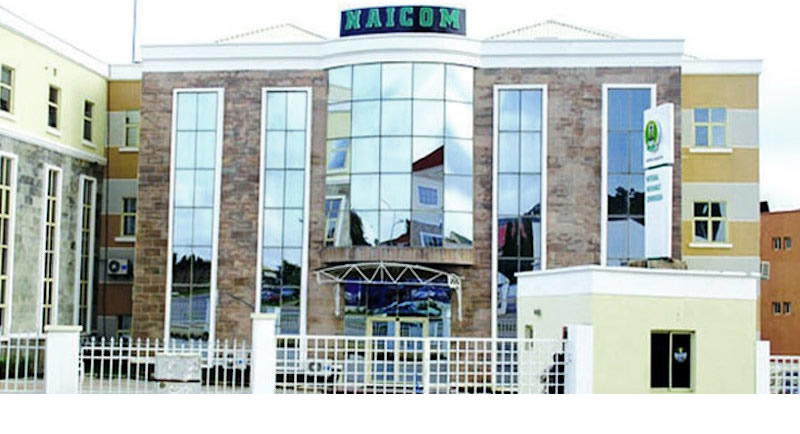
NAICOM
By Rosemary Iwunze
There are indications that the National Insurance Commission (NAICOM) may wind up some insurance companies as the industry regulator moves to sanitise the industry.
The affected insurance firms, Financial Vanguard learnt, are said to have been in many years of outstanding backlogs of defaults in meeting obligations to policy holders as well as non-compliance with its directives on revitalisation of operations and rendition of regulatory reports.
The affected insurance firms, it was further learnt, have already overshot the extended grace period given them by NAICOM to restore their operations to regulatory thresholds for safety of policy holders as well payment of long outstanding claims.
Specifically, an official of NAICOM told Financial Vanguard that the companies have been flagged for recording heavy operating losses yearly, inability to settle claims over a long period of time, and inability to raise further equity capital or attract new investors to meet minimum capital base requirement.
Vanguard investigations show that NAICOM has given some companies extended grace period to get fresh investors, against the stipulations of the Insurance Act 2003 which mandates NAICOM to close down defaulting companies after six months as well as evidence of five complaints of failure to pay claims promptly.
Speaking to Vanguard, a top executive in NAICOM noted that the regulator has decided to end the grace period given to some of these companies.
He said: “Despite the extended period of grace given to some of these companies to bring in new investors against the dictates of the Insurance Act 2003, many of them failed to do so as such are liable for liquidation.”
Insurance Act 2003 stipulates that NAICOM can cancel the license of registration of a company if, “The Commission has received and verified not less than five complaints of failure to pay claims promptly; the insurer has refused to submit to an examination of its books as provided for in this Act; the insurer has failed to comply with the provisions of section 26 of this Act which states that an insurer shall not later than 30th June of each year submit in writing to the Commission the following – (a) a balance sheet duly audited showing the financial position of the Insurance businesses of the insurer and its subsidiaries at the close of that year together with a copy of the relevant profit and loss account which the insurer is to present to its shareholders at its annual general meeting.”
Financial Vanguard findings show that some of the insurance companies that have not rendered annual financial reports to the regulatory authorities for many years now include Alliance and General Insurance, Goldlink Insurance, A&G Life Assurance Plc, NICON Insurance Plc, Nigeria Reinsurance Corporation, and Industrial and General Insurance Company, IGI.
Findings from the Nigerian Exchange Limited shows that A& G Life Assurance Plc was suspended from the stock market for failure to file audited financial statement since 2012, while the last time STACO Insurance Plc’s presented audited financial statement was 2018, Goldlink Insurance Plc and Standard Alliance Insurance Plc were in 2019.
Industry stakeholders also said that some of these insurance firms have huge backlogs of claims to settle.
For Goldlink, NAICOM took over the board in 2012 as part of moves to set the company back on track, but the move did not yield any tangible result.
For IGI, NAICOM restricted the daily spending to curb mismanagement of funds in the firm. The move was, however, not productive.
Also in 2012, NAICOM suspended Alliance and General Insurance Company Ltd and A&G Life Assurance Plc from transacting further business for six months, citing non-rendition of accounts, misrepresentation and non-disclosure of liabilities. It listed other offences of the companies to include non-remittance of premiums and commissions, and corporate governance abuses.
But NAICOM’s plan for interim managers to take over the management of both firms was met with litigation that dragged on for several years while the fortunes of the companies continued to nosedive.
For NICON Insurance which was the biggest insurance player some years ago, not only in Nigeria, but across Africa prior to its privatization under the Olusegun Obasanjo administration, saw the coming of businessman, Jimoh Ibrahim, who took over its ownership as well as Nigeria Reinsurance Corporation.
Although the two firms started well post-privatisation, they began to struggle to cope with competition midway.
Recently, both companies were in a legal tussle with the Asset Management Corporation of Nigerian (AMCON) over debt of about N69.4 billion, as NICON Insurance owes claims running into several billions of naira.
Speaking on the situation, Deputy Commissioner, Technical, the National Insurance Commission (NAICOM), Sabiu Abubakar, at an event in Lagos, said more companies may also face sanctions as part of moves to sanitise the industry.
He stated: “Recently two insurance companies’ licenses have been withdrawn. These are Niger Insurance and Standard Alliance Insurance. Though managing the death/failure of a financial institution is very demanding, nevertheless, more may still be liquidated in order to sanitise the insurance sector.”
He stressed that NAICOM has strengthened its regulatory oversight, imploring operators to settle genuine claims within reasonable time and discharge their obligations.
Abubakar noted that insurance regulation and supervision are always the bedrock of national economic development, even as he expressed hope that NAICOM’s reforms and regulatory initiatives will positively impact the insurance industry if achieved and that the industry will witness tremendous development and growth.
Disclaimer
Comments expressed here do not reflect the opinions of Vanguard newspapers or any employee thereof.