By Rita Okoye
Eminent academic and scholar at the University of Texas, Austin, Professor Toyin Falola has revealed that Nigerian cultural values are under threat.
Falola, who is the Jacob and Frances Sanger Mossiker Chair in the Humanities at the University of Texas at Austin, stated that except something drastic was done, the slide would continue.
According to him, “As seen in other African cultures, Nigeria has distinct cultural values and identities with accompanying pride and honour. Nigeria has more than 250 ethnic groups with specific cultures that control their daily activities and consciousness. In such a diversified society, cultural values and identities become important and defining, setting apart the people and their convictions. Precolonial Nigeria was not what we know it to be today, and those occupying this geographical area would never have predicted there would be a coalition to form a country. The cultural identity of each ethnic group in Nigeria was well-formed and unique, and their culture cut across all areas of life.
“Unfortunately, it seemed that at the early stage, the explorers were not comfortable with cultures so different from theirs or perhaps could not comprehend the idea behind them, thus they sought the means to display them. The colonialists and foreigners were not convinced that African cultures were good enough for the people; therefore, they believed that western civilisation must set in. These conclusions were not born out of a great desire for the progress of the continent but from an expansionist perspective of bringing Europe and its culture down to Africa.
“Despite the way Africans were described as people without culture and history, Nigerian and African historians have been able to prove that these descriptions were untrue and have shown how rich and advanced early African and Nigerian cultures were. In the precolonial periods, Africans believed so much in these ways of life that they would always identify with them. However, Nigerian societies started facing traumatic situations from generation to generation, which started to weaken the quality of their cultures, resulting in cultural loss and a lack of cultural identity among many Nigerians. The people faced different cultural traumas that transformed how they behave and react to things today. These traumatic experiences have defined their philosophies and systems and destroyed the path to the prevalent cultural identification in the precolonial era.
“Cultural trauma could be in different forms, such as physical displacement of people, a direct impact on language, styles, practices, histories, systems, social constructs, religion, economic and commercial contacts, communication, governance, and other relevant areas and sectors of society. Slave trade, foreign trades, missionary activities, colonisation, globalisation, and general civilisation have been significant agents of cultural trauma and transformation across Nigerian history. The effect of this kind of trauma is the creation of an alternative option to culture or the assimilation of a new culture to the old ones. These experiences are evident in Nigerian society, and history has shown evidence of their process. Today, Nigeria is largely different from the precolonial state of the nation. As a result, there is the challenge of the loss of cultural identity in the wild pool of these agents. Gradually, many Nigerians are beginning to disassociate themselves from their original ethnic groups and have failed to adopt or practice their cultures in their daily lives.”
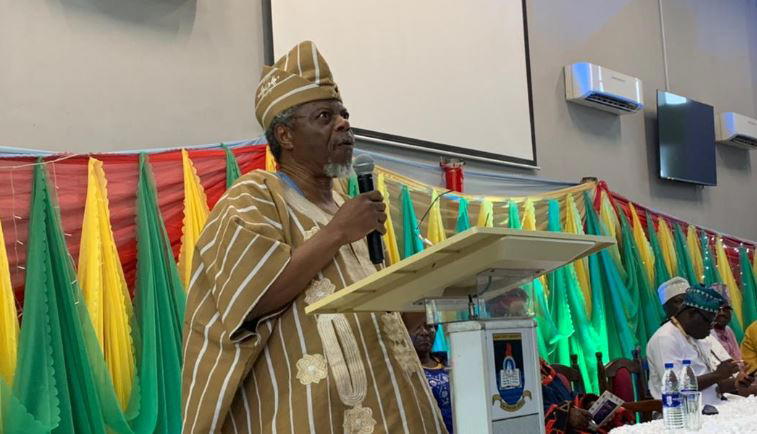
Falola, while speaking as the guest speaker at the second distinguished lecture series organised by the Department of History and International Studies, Lagos State University Ojo, on Wednesday, also touched on historical consciousness and nationalism as key drivers to nation building.
“Nationalism has always been a tool for nation-building in Nigeria and one of the many ways the country has responded to challenges against its integrity. Scholars have rightly described nationalism as a sentiment for one’s nation towards independence and development in a way that would shape the country or nation for transformation. Nationalism should not be underestimated because of its potential to contribute to nation-building and national development. The idea of nationalism arose in favour of one’s nationality and has been in place even before the coming of the Europeans. Precolonial Nigerians understood the importance of patriotism in their dealings with other societies and their responsibilities in their communities; thus, they took their roles in nation-building quite important.
“After the campaigns by Dan Fodio in establishing a caliphate, nationalism was one of the factors that transformed the strength of the Fulani rulership in northern Nigeria. Traditional nationalists who had resisted the British invasion of their territories and did not mind whatever punishment or perils they could face exhibited Nigerians’ nationalist persistence. The people and their leaders came out to challenge the invaders until they were forced to surrender. However, Christianity brought the idea of the modern nation-state and planted the seeds of modern colonialism in Nigerians. These concepts of an ideal society and nations, taught from the perspective of European development, became the hallmark of criticism and measurement of the commitments of the colonialists. The British administration was weighed by their political, economic, and social responsibilities from the perspectives of governmental duties. Thus, new faces, including revolutionists and nationalists, started springing up gradually to demand equality and independence for the country. The Christian educational system taught Nigerians modern nationalism, with the expectation of training a new set of people who would be responsible enough to reconstruct their society.
“Ade Ajayi believed that the Christian training that translated to nationalism aimed at convincing Nigerians to wish and reach for a nation that would grow to the level of European countries. To achieve this, they were told that Nigeria must develop three characteristics: Christianity must thrive, the country must be open to civilisation and reach the level of the industrial revolution, and smaller states must be merged to form a larger country. The missionaries passed these ideologies to their students because they believed that for Nigerian social and economic life to thrive like the Europeans, the country must not be developmentally too far from the European development process and systems. Therefore, at the initial stage of the second arrival of the Christian mission in Nigeria, the missionaries were particular about the spread of civilisation, commerce, and Christianity across the areas now known as Nigeria.
“To ensure that the people aim for an Africa that was as developed as Europe and to substitute Black missionaries with the whites, the missionaries had to go beyond teaching Nigerians how to read and write and exposed them to the teaching of history, which later facilitated their historical consciousness and nationalist spirits. The teaching of history that brought about national consciousness was as early as 1859 when the likes of Herbert Macauley were taught Latin grammar, arithmetic, philosophy, history, and other subjects. In 1878, the Methodist High School also taught History as part of its curriculum in Lagos. By the time the British government finally got involved in education in Nigeria, although the missionaries were largely major vanguards of education, they also ensured that history teaching was taken seriously. The administration made policies and established boards to ensure that history was well entrenched in the curriculum and its teaching was deliberate enough to influence the students. Nationalists like Anthony Enahoro later testified that the knowledge of history gained from these teachings raised his ambition in politics and a dream for a better Nigeria when he was in Kings College.
“The British government’s interest to continue to teach history in Nigeria raised the Phelp Stokes Commission, which made the Memorandum on Education Policy in British Colonies in 1925 and recommended more similarities between the colony’s subjects of studies and Britain’s. This report and others also made the British government introduce some African history into the syllabus. By the time the Yaba Higher College was established in 1932, the teaching of history was no longer strange as it continued to develop. This educational process, especially when most of it was in Sierra Leone and other returnees’ settlements, brought about the kind of orientation of the early modern nationalists who, rather than want Nigeria’s freedom from the colonialists, wished that England establish its government in Nigeria in order to bring civilisation and achieve the level of development they had seen and been taught. For instance, Henry Townsend (who was from Abeokuta), Henry Venn, and Ajayi Crowther were nationalists in their own rights, but their demands were quite different from those of the likes of Azikiwe who came much later.
“The scope of nationalism radiates around the desire for the development and freedom of one’s country or nation, and the way one believes is the best to achieve these are different. After the amalgamation of Nigeria in 1914, the philosophy behind what constituted nationalism began to take a turn to ideological and political participation of Nigerians and independence. Colonial Nigeria began to see the formation of more organisations ready to criticise government activities and the limitations in the participation and the involvement of Africans in administration. These organisations were led by people who had either schooled overseas, exposed to the weakness of the whites, and read widely about the colonialists to see no striking intellectual difference between Nigerians and the colonialists. In addition, they understood the depth of the Nigerian culture and knew the historical heritage of the country. Despite the assault, they realised that they were people with organised culture and self-determination before colonialism and, as such, saw that Nigerians had the capacity to determine their lives and also be involved in the decision-making process.
“This historical and intellectual awareness inspired the creation of organisations like the National Congress for British West Africa (NCBWA), which was founded in 1920 to increase the political relevance of Nigerians and educated individuals who considered themselves as capable as the European colonialists. The Nigerian National Democratic Party, Nigerian ; Movement, and others became effective platforms for the nationalist movements in Nigeria. The efforts of the Nigerian nationalists, coupled with the daily publications from newspaper companies like the Lagos Daily News, raised the citizens’ consciousness.
“Nationalism transcends beyond the struggle for the independence of a particular nation; it connotes loyalty to the developmental and progressive course of the country. In this sense, nationalism cannot be correctly classified as political; it could also entail social, economic, and academic struggle to maintain the integrity of the nation,” he said.
Chairman on the occasion was the Olota of Ota Kingdom, Ogun State, Oba Adeyemi Abdulkadir Obalanlege. Other distinguished personalities were HRM Fuankem Achankeng from Cameroon, academics, students and other members of the university community.
Disclaimer
Comments expressed here do not reflect the opinions of Vanguard newspapers or any employee thereof.