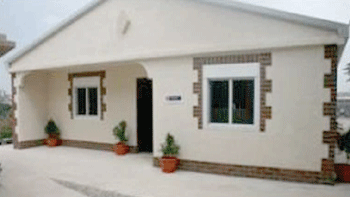
A Three-bedroom bungalow prototype of insulated building
*Says FCTA needs N150bn to resettle Abuja natives
*Seeks partnership with Gov Fashola of Lagos
By Oscarline Onwuemenyi
Stories are told of how husbands lost wives and how wives lost husbands on account of squatting in the Federal Capital Territory, FCT, Abuja. Those stories are not fiction.
The reason is simply because there was and continues to be an accommodation crisis in the FCT. To appreciate the ridiculously exorbitant cost of getting accommodation in the FCT, just imagine a two-bedroom, Festac-Town, Lagos, like apartment in Garki goes for between N1.2m and N1.5m. Try looking for the same apartment in Wuse II or Gwarimpa or Life Camp, you’ll need to cough out close to N2m. But, for high-brow Maitama or Asokoro District, N2.5 or N3m may be the asking price.
So, what to do? The FCT Authority is marching on for an expansion drive but money is creating a discount of its own.
FCTA has stated that it needs about N150 billion for the compensation and resettlement of Abuja natives – this, with a view to having more land area.
FCT Minister, Senator Bala Mohammed, who said this last Thursday in Lagos when he paid a visit to Governor Babatunde Fashola, also solicited for partnership between the government and the FCT Administration.
Senator Mohammed explained that this huge money is needed to compensate and resettle the natives, adding that the administration is bringing in the private sector to provide the basic infrastructure in several new districts, including Wasse and Katampe.

A Three-bedroom bungalow
The minister noted that Abuja and Lagos share distinct characteristics, adding that the sister-city relation has become necessary to share experiences on the metropolitan management of Lagos and Abuja for the mutual benefit of all concerned.
He revealed that as it is now, about 90 per cent of people working in Abuja are living outside the Federal Capital City and that the private sector investment in public transportation will no doubt yield immediate returns.
Senator Mohammed, who said the Abuja Master Plan was on course lamented that the FCT Administration is being challenged by the ever-influx of people into the city because of the opportunities that abound in Abuja.
The minister commended the Lagos State Governor on his efforts to provide solutions to the challenges of developing a mega-city by looking inward.
He said: “Gov. Fashola’s courage and leadership has given hope to citizens of Lagos State, and he has gained the respect and admiration of a lot of Nigerians. Because of his zeal and leadership, Lagos State is transforming into the ideal mega-city that it was originally meant to be.
“We look forward to a robust partnership with the state in our effort to create a model Federal Capital Territory that all Nigerians will be proud to call home. Already, we are doing a lot but more work needs to be done to keep the sanctity of the Abuja masterplan and develop the city and its surroundings to make living and life easy for all residents.”
Responding, Gov. Fashola appreciated the encomiums from the FCT Minister but said that even in Lagos a lot needed to be done.
Fashola saluted the leadership style and courage of Mohammed, adding that Nigerians only care about democracy dividends irrespective of party affiliation.
He noted that the state government was still facing the problems of rural-urban drift and welcomed Abuja to the club.
Stressing that nobody has the monopoly of wisdom, Fashola said he also copied from Abuja, especially the Abuja street signage as well as its cleaning and greening programme.
He said Lagos should be given a special status and be assisted to maintain the federal infrastructure left behind when Abuja became the political and administrative headquarters of the nation.
On revenue, the governor stated that it is only the government that can stimulate its increase by investing in infrastructure thereby creating wealth and employment which has a spill over effect on the internally-generated revenue.
The minister’s entourage and members of the Lagos State Executive Council later dissolved into groups to effectively share ideas and experiences.
Disclaimer
Comments expressed here do not reflect the opinions of Vanguard newspapers or any employee thereof.