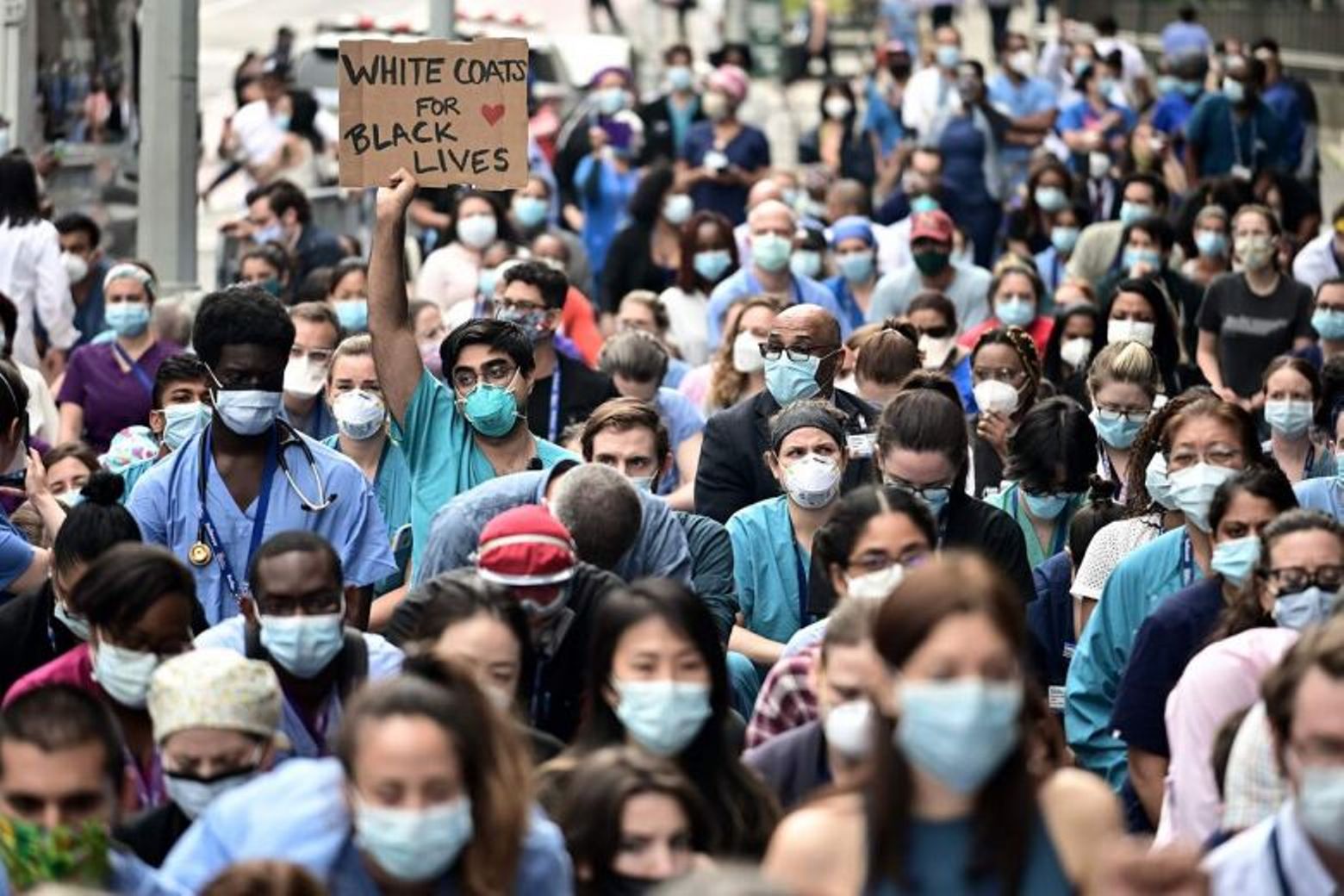
Nurses and healthcare workers attend a rally in front of Bellevue Hospital in New York on June 4, 2020. PHOTO: AFP
By Babajide Komolafe, Economy Editor
One in five workers says he is likely to switch to a new employer in the next 12 months, indicating that the ongoing widespread staff resignation across the world will persist for some time, said PwC in its global workforce survey.
The company in a report on the survey said: “The Great Resignation will continue apace in the year ahead as one in five workers says he is likely to switch to a new employer in the next 12 months.
“That was a key finding from PwC’s Global Workforce Hopes and Fears survey of 52,195 workers in 44 countries and territories – one of the largest ever surveys of the global workforce.
“The survey finds that 35 per cent are planning to ask their employer for more money in the next 12 months. Pressure on pay is highest in the tech sector where 44 per cent of workers surveyed plan to ask for a raise and is lowest in the public sector (25 per cent).”
Furthermore, the survey shows that while an increase in pay is a main motivator for making a job change (71 per cent), wanting a fulfilling job (69 per cent) and wanting to truly be themselves at work (66 per cent) round out the top three things workers are looking for. Nearly half (47 per cent) prioritised being able to choose where they work. Workers who are likely to look for a new employer in the next 12 months are less likely to feel satisfied with their current employer.
To address this phenomenon, Olusola Adewole, Partner, People and Organisation Advisory Leader, PwC Nigeria, stressed the need for companies to create a great employee experience.
He said: “In Nigeria, the Great Resignation is amplified by socio-political problems. People across all career levels are not just leaving their companies or industries, they are leaving the country.
”There is a global competition for talent- nations are competing for talent. Organisations must think about its Purpose- in terms of the social dimensions of ESG.
”Companies need to ask themselves if there is something they can do to create a great employee experience. We have an opportunity to move from the great resignation to exploiting the great opportunity. To do so, companies must reinvent their workforce strategy and build a HR function that is future ready.”
Similarly, Bob Moritz, Global Chairman of PwC, said: “There is a tremendous need for business to do more to improve the skills of workers, while being conscious of the risk of polarisation if opportunities to develop aren’t provided right across society. At the same time, workers are not just looking for decent pay, they want more control over how they work and they want to derive greater meaning from what they do.
“These are linked: by acquiring skills, workers can gain the control over the work they are looking for. Leaders have to adapt to build the teams needed to successfully deal with the challenges and opportunities of today and those yet to come.”
“The survey also found that 65% of workers discuss social and political issues with colleagues frequently or sometimes, with the number higher for younger workers (69 per cent) and ethnic minorities (73 per cent). While business leaders are sometimes nervous about people bringing these potentially polarising issues to work, the impact is net positive. 79 per cent of those who talk about social and political issues at work reported at least one positive consequence from that.
“With political and social issues alive in the workplace, the job for employers is to create a context which secures the benefits of open conversation while minimising the negative impacts – 41% reported a negative consequence of discussions about social issues. Both numbers were significantly higher for people who consider themselves part of an ethnic minority (84% positive and 59% negative),” said PwC.
Disclaimer
Comments expressed here do not reflect the opinions of Vanguard newspapers or any employee thereof.