By DAYO BENSON
SINCE he assumed office as the Attorney General of the Federation and Minister of Justice, Mr. Mohammed Adoke SAN, has tried to stave off controversies unlike his predecessor Mr. Micheal Aodoaaka.

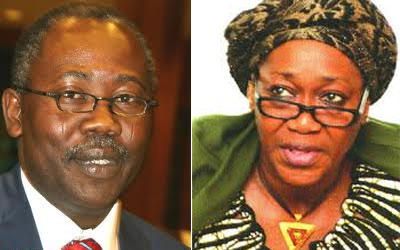
Attorney-General of the Federation, Adoke
But the more he strives to avoid public attention especially on issues concerning his office, the more he appears to be unconsciously getting into it. Indeed, his recent positions on some issues, particularly the federal government avowed war against corruption some-what suggests that the nation number one law officer is poised to thread the beaten path.
After the public opprobrium which Aodoaaka attracted to the office of the attorney-general especially during the twilight of late President Umaru Musa Yar’Adua’s administration, concerned Nigerians had looked up to Adoke to provide the soothing balm for the bruised on national psyche in the discharge of his duty.
Perhaps, a pertinent question to ask is: Is the current Attorney-General of the Federation living up to that billing? A related question to ask is whether the federal government’s much vaunted crusade against corruption is being conscientiously prosecuted? For watchers of the justice minister, not a few were surprised over the manner the Halliburton episode was handled. Given the public interest the Halliburton saga generated, many had thought that with the calibre of people alleged to be involved, it would be a test case to demonstrate government’s commitment to anti-graft war.
However, the attorney-general more or less exonerated all those mentioned. He said there was no sufficient evidence to prosecute them. The general perception was that the matter ended that way because those linked with it were untouchable. The same perception was held over the handling of the Vaswani Brothers matter. The use of plea bargain which is alien to Nigeria’s criminal justice system in cases involving some figure is another contentious issue concerning the attorney-general office.
But the most recent ones is the justice minister’s stance on the Independent Corrupt Practices and Related Offences Commission (ICPC) and the Economic and Financial Crimes Commission (EFCC). Observers are wondering whether Adoke is actually comfortable with the commitment of these agencies to the war against corruption.
Adoke at the ministerial screening before the Senate recently called for the merger of ICPC and EFCC.
According to him, “Most of our anti-corruption agencies lack the capacity to do thorough investigations. They lack capacity to collate evidence to sustain a charge and secure conviction in court and until we properly reform these agencies, we will continue to experience the problems we are experiencing today.
“More often than not, people are arrested before they are investigated, they are arrested even before there is evidence, they traumatised them and the people are dramatically tried on the pages of newspapers and at the end of the day, when they are unable to prove their cases, they end up blaming the courts.
“When we, the Ministry of Justice try to guide these agencies, they complain of interference. It will be appropriate to merge these agencies together so that they can effectively fight corruption,” he said.
However, in a swift response, EFCC Chairman, Mrs. Farida Waziri rose in defence of the commission and dismissed the suggestion. For Mrs. Waziri, it was unnecessary to call for such merger because the roles of the two agencies are clearly defined in the Act. In her words: “Our roles are clearly defined by the Acts; there has never been any conflict nor duplications as being alleged. Over $6.5bn bad loans were recovered and 1.5billion dollars were also recovered from Mrs. Cecilia Ibru alone.”

EFCC Chairman, Farida
Late last year, the Federal Government through Adoke had weilded the big stick in ICPC when its former acting chairman, Prof. Uriah Augulu was summarily removed when he attempted to press corruption charges against a former serving minister.
Barely a year into his appointment, Angulu, shocked everyone and even his employer, President Goodluck Jonathan,when he named a member of his inner cabinet and the then Minister of state for health, Mr Suleiman Bello, among persons he had penciled down for prosecution.
To show his seriousness, he went ahead and preferred criminal charges against the Minister before a Federal High Court in Adamawa.
In the processes he filed before the court, Angulu insisted that he had uncovered enough prima-facie proof of evidence that he said would secure the conviction of the former Minister.
On the day the Bello was to be arraigned in court, the Attorney General invoked his statutory powers of Noelle Prosequi, as enshrined in section 1 7 4( 1 ) (b) of the 1999 constitution, and ordered the ICPC to suspend the matter sine-die, insisting need to re-appraise the case-file with a view to deciding the appropriate actions to be taken on the issue.
On the heels of his recommendation when he appeared before the Senate, Adoke issued new regulations which observers said would make EFCC an appendage of the attorney-general’s office.
Although S.43 of the EFCC Act empowers the Attorney -General of the Federation to make regulations for the commission, the new regulations, according to analysts are too far reaching. S.43 of the EFCC Act provides that “The Attorney-General of the Federation may make rules or regulations with respect to the exercise of any of the duties, functions or powers of the Commission under this Act.”
However, the regulations in the gazette cover procedure of receiving complaints, investigations, arrests and granting of bail, entry, search, inspection, seizure, forfeiture and disposal of property, prosecution of cases, petition and grants.
The gazette was dated September 21, 2010. In section 10 of the fresh regulations, it is stated that where the EFCC conducts investigation in respect of a case or complaint which is serious or complex, it shall forward to the AGF the outcome of the investigation with its recommendations on whether there are sufficient grounds to initiate prosecution.
Adoke in this section explains that complaints that should be considered serious by the EFCC are cases that are above N50m, have international dimensions or involve ministries. In matters of this nature, the anti-graft commission is expected to report to the AGF before prosecution.
The gazette reads in part, “For the purpose of these regulations, a case or complaint is serious or complex if the case or complaint has a significant international dimension; involves money or assets of a value exceeding N50m; requires specialized knowledge of financial, commercial, fiscal or regulatory matters such as the operation of markets, banking systems, trusts or tax regimes; involves allegations of fraudulent activity against numerous victims; involves substantial and significant loss of funds by a ministry or department or a public body and involves an alleged misconduct which amounts to an act of economic sabotage.”
Section 22 of the gazette states further that no officer of the commission “shall enter into a plea bargain discussions with an accused person without the prior knowledge and approval of the AGF. Also contentious is Section 18 and 24 of the document.
Section 18 states that, “The AGF may designate legal officers from his office to work in the EFCC for the purpose of facilitating the prosecution of the commission’s cases.”While section 24 stipulates that the, “Chairman of the EFCC shall, within 30 days of the signing of receipt of any foreign aid or grant, inform the AGF of such grant with details of the terms and conditions of the grant or aid.”
The Justice Minister, however, explained in the gazette that the regulations are not to punish anyone. According to him, the regulations would ”provide for a procedure and process for enforcing and implementing the mandate of the EFCC in the whole or part of Nigeria”.
However, spokesman to the EFCC, Mr. Femi Babafemi denied knowledge of such a gazette. He said the commission had checked the AGF office and there was no such document. But even if such a gazette exists, the question is: What exactly is the Attorney-General of the Federation and Minister for Justice, Mr. Mohammed Adoke up to?
Disclaimer
Comments expressed here do not reflect the opinions of Vanguard newspapers or any employee thereof.