By Tunde Oso
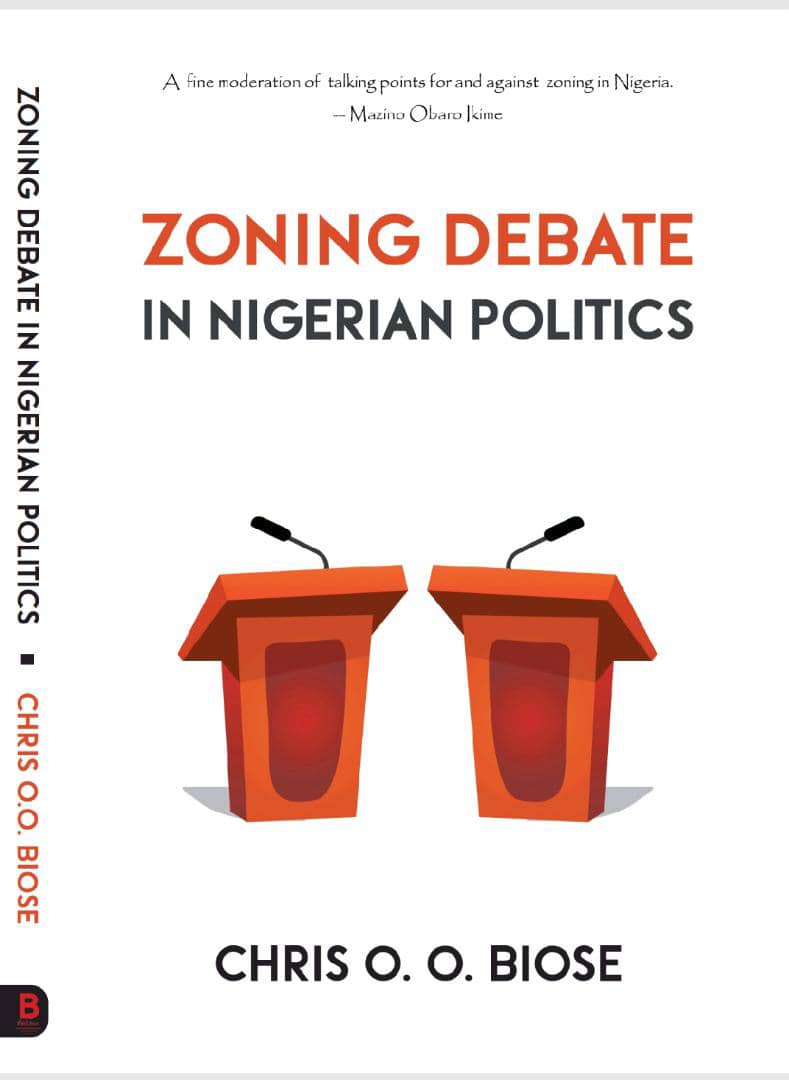
With this latest addition to his array of publications: Zoning Debate in Nigerian Politics, Chris O.O. Biose, in the 286-page book, lends his respected voice to the contentious issue of zoning, an electoral formula midwifed by the then ruling People’s Democratic Party (PDP) for choosing its candidates.
Biose’s intervention in authoring the book lies in the fact that as a patriot and detribalized elder statesman, there is the urgency to caution the nation’s political class not to elevate mediocrity over meritocracy in the choice of Nigeria’s leaders using zoning formula as an alibi.
READ ALSO:The textbooks Abracadabra
The book written in the most lucid and thematic style focuses on the undercurrents, diverse opinions and arguments for and against zoning, a political buzzword that gained currency in 2010 ahead of the 2011 presidential polls.
Relying largely on newspapers reports /articles, the book which is divided into 10 chapters, further amplified the role played by key proponents and exponents of the zoning debate which reached a deafening crescendo in 2010 ahead of the 2011 presidential polls.
Chapter 1 details the history of the gradual introduction of democratic institutions and the emergence of main political parties- National Convention of Nigerian Citizens (NCNC), 1944, Northern People’s Congress (NPC), 1951, Action Group (AG) 1951, Northern Elements Progressive Union (NEPU)1950, among others- during the colonial era. Also, the leading roles of the political parties in the struggle for Nigeria’s independence in 1960 were also highlighted.
Chapter 2 captures aptly the nomination of candidates from the first election in Nigeria in 1923, and those conducted by the colonial overlords before independence (1959) and immediately after independence (1960-1966).
It also dwells on the introduction of the Presidential system of government in 1979, the landmark June 12, 1993, presidential election and General Sani Abacha’s sole candidacy of five parties in 1998.
The same chapter which also covers the 1999 post military presidential elections, with available data, instructively reveals that for the first 70 years of Nigeria’s electoral history, zoning of electoral positions ahead of actual voting was non -existent.
In Chapter 3, the book focuses on the actual theme, the Zoning issue, detailing the genesis of the zoning doctrine in 1979, as well as x-raying the 1987 Prof. Robert E. Inikoro Report on the National Question and nomination of PDP Presidential candidates, the 1994- 95 Abacha midwifed National Conference. The chapter further discusses the issue of Power Shift in 1999, the nomination of PDP Presidential candidates.
Other issues in the chapter include the Zoning Doctrine and the 1998 PDP Constitution, which stated thus” In pursuance of the principle of equity, justice and fairness, the party should adhere to the policy of rotation and zoning of the party and public offices and it shall be by the appropriate executive committee at all levels.” Page 88 Chapter 4 essentially examines the intrigues, subterranean, Dr scheming and power play at the Presidential Villa, Abuja arising from the protracted illness of the then President Umaru Musa Yar’Adua, who eventually died on May 5, 2010.
Also, the Doctrine of Necessity was invoked by the National Assembly in 2010 whereby the then Vice President, Dr Goodluck Ebele Jonathan was sworn in as Acting President following Yar’Adua’s ill health, Jonathan’s historic interview in the United States of America (USA) on his suitability or otherwise to contest the 2011 presidential polls; ‘the zoning plot’ orchestrated by the military and PDP power bloc, were adequately discussed.
In Chapters 5 & 6, the author exhaustively exhumes the varied arguments in support and against zoning, detailing the unrepentant stance of some prominent Nigerians, mostly Northern leaders and other interest groups, including Adamu Ciroma: “PDP should keep to the agreement on zoning”; Alhaji Tanko Yakassi: “Zoning is a covenant with God,” Prof. Tam David West- “Zoning agreement is binding on PDP’’, Arewa Consultative Forum (ACF)- “Field only Northerners’’ Northern Political Leaders Forum (NPLF), among others, that President Jonathan should not contest the 2011 presidential polls, stressing that the North must produce the next president to complete the late President Yar’Adua’s second term.
Conversely, the same chapters discuss the counter-arguments of some PDP chieftains, faulting the Northern leaders’ posture that President Jonathan should not vie for the exalted office. Prominent among critics of the zoning formula in 2010 were Ijaw National Leader, Chief E.K Clark, former President Olusegun Obasanjo’s famous statement- ’’l did not sign zoning agreement’’, Ex- PDP National Chairman, Dr Okwesileze Nwodo “Zoning died in 1999’’, Chief Tony Anenih – ‘’Zoning no longer relevant’’, Chief Solomon Lar – “Zoning not a permanent arrangement in PDP.” The non-partisan, and largely neutral commentaries and opinions of some eminent and knowledgeable individuals in the raging zoning controversy are discussed in Chapter 7 under the title ‘Voice of Reason’. It examines in brevity form, the views of these icons who include, former US Ambassador to Nigeria, Dr Walter Carrington, Chief Richard Akinjide (SAN), Chief Olisa Agbakoba (SAN), Dr Walter Ofonagoro, Dr Samuel Ogbemudia, among others.
In Chapters 8&9, the author succinctly illuminates how the zoning controversy was temporarily resolved in 2011 with President Goodluck Jonathan getting the backing of diverse PDP interest groups, both in the North and the South, to contest the presidential election.
The issue of snide remarks and threats of violence which came in the form of bluffing, bullying, intimidation and false accusations by some prominent Northern leaders if Jonathan contests and wins the 2011 polls, forms the main focus of the two chapters.
Chapter 10 laced with statistics, gives graphic details of the politically instigated 2011 post- election violence which led to the death of over 800 persons in some Northern States – Kaduna, Bauchi, Adamawa, Gombe, Kano, Niger, Katsina, Borno, Jigawa, Yobe.
Though the book mainly relied on newspaper reports with sketchy opinions from the author, it is written in simple narrative and logical style, with minimal spelling errors.
However, despite the observed lapses, the book is informative and is a must-read. It is recommended to the academic community, the political class, aspiring leaders and all those who want to be abreast of the dynamics of power play in Nigeria.
Disclaimer
Comments expressed here do not reflect the opinions of Vanguard newspapers or any employee thereof.