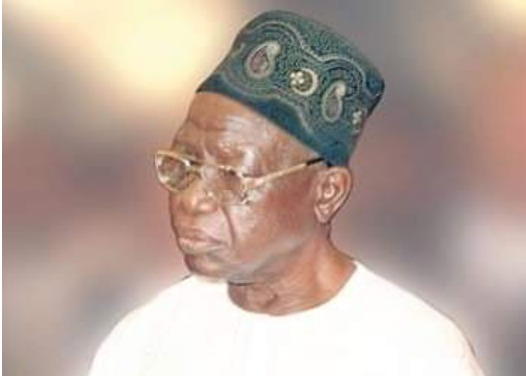
Great and visionary leaders are never forgotten for their indelible footprints. Exactly a year ago on 11th February, 2021, we lost a selfless and visionary leader. A quintessential politician and an administrator par excellence; the first civilian governor of Lagos State, Alhaji Lateef kayode Jakande. He set a legacy and pace with his style of leadership, a fine administrator whose name would continue to be remembered for generations. Lateef Kayode Jakande (LKJ) was a Nigerian journalist who was the governor of Lagos State, Nigeria from 1979 to 1983.
One unique thing about the man called Lateef Jakande is the fact that he was governor just for four years and three months but he headed an administration that spearheaded monumental development strides in Lagos State. His administration has been credited with the growth, planning and transformation of Lagos to a modern city, leading to the birth of infrastructures in all sectors of the state and no wonder some refer to him as the architect of modern Lagos.
He introduced housing and educational programs targeting the poor, building new neighbourhood primary and secondary schools and providing free primary and secondary education. He was focused more on the people under his watch, he lived in his own house as Governor of Lagos state, he drove his personal car at the time and ensured that his children attended public schools like other children in the society. Mr. Lateef Jakande was a metonym of directional leadership and a man who truly put governance over politics in just four years which made a generational difference.
He understood the power of education as the most potent weapon that can break the vicious cycle of poverty. He established the Lagos State University, a citadel that has become a fountain of knowledge that has produced great individuals in different field of endeavours.
Jakande’s government constructed over 20,000 housing units that gave a number of Lagosians the opportunity to own their own houses. He also started a metro line project to facilitate mass transit in Lagos metropolis. This project, if allowed by the military government that ousted his administration, would have made the perennial traffic gridlock that characterises the state today none- existent.
A critical assessment of the governor showed that he was not only a fine politician during his gubernatorial dispensation, as by the exemplary political roles he played in his party at the time, but he was also a man who understood the necessities of governance. Mr. Jakande having explored the characteristics of the Lagos society, knew so well that those that needed attention the most were the poor masses.
He did not join forces with other privileged individuals in the state to control power and resources, and impoverish the masses. He took up the governmental mettle by laying concerted blueprints in improving the lives of impoverished Lagosians.
There have been blatant scenarios where politicians have given out money, food, drinks to the electorates instead of manifestoes in order to get the people’s vote. The politicians do not have a clear foresight of what they wish to do for the people, they are more interested in getting to power and sharing the ‘national cake’.
But for LKJ, he took his already designed social programme by storm—firing from all cylinders with actionable steps. No wonder, he was dubbed the action governor. In the midst of the nation’s overwhelming political failure, Mr. Lateef Jakande was able to rise above those rubbles of the country’s dark second republic to set unmatched political standards that are very much relevant to this day.
In 1963, and more significantly, his writings and release of a pamphlet—A case for Lagos—was above else an indication in retrospect that his political aspiration was more deeply profound than anything that was thought of him at the time. What even became more remarkably profound about Jakande’s political motive was his context-specific political mind that appeared distinctively concentrated on Lagos state.
Beyond the pamphlet: A case for Lagos, which he wrote whilst in incarceration, a larger part of his career as a journalist was spent writing about the social and political condition of Lagos state. It was these agitations, perhaps that had enabled Jakande to imagine how Lagos could be structured to become a mega city, and how common people in the state can be supported through social reforms and development.
His political reasoning leaned more on welfarism—a yearning to lift the poor masses from their rubbles to the stable of a comfortable life. His agitation for social change in Lagos at the time should come as no surprising for a man who later became its governor. To put things mildly, the expression of Mr. Jakande’s political will debunks the notion of Lord Acton’s famous dictum: Power corrupts, absolute power corrupts absolutely.
How well can it be described that many African politicians venture into politics not knowing what the craft entails? How extensively can it be analyzed that these men are almost always preoccupied with cockeyed mindset on how power must be managed.
The point remains that politics in Africa is perceptively driven from a deceptive perspective and mired with exploitative tendencies. Over the years, only a few African politicians have had the need to objectively serve the people they govern, while most have always seen the opportunity to serve as a catalyst to embezzle public funds and enslave their subjects.
This is particularly true in the Nigerian political space where new breeds of politicians suddenly assume power much to the fancies of enriching themselves and family. This culture of mediocrity has been the most dominant in the country’s political fabric since it became a republic in 1963.
It must be said that the quest for power struggle in the country largely stems from the desire to spend public funds recklessly, rather than to serve the masses in a much fulfilling capacity. This particular leadership lacunae often than not have been part of the main reasons why Nigeria has struggled to progress in aspects of social reforms and human capacity growth—and has also been one that has dubiously enabled the development of few selfish men, while leaving many other men in wretched forms at the dead end of a vastly rich but struggling country.
There is no doubt that Nigeria will take a flight of progress whenever it decides to get its politics right. And to achieve this will be by getting people who genuinely love the citizenry like Lateef Jakande to be in charge of affairs; people who will put governance over politics. There is no gainsaying that Mr. Jakande ran an exemplary government that lasted the test of time.
The statesman did not only lay down the marker in government in one of Nigeria’s darkest republics, but he was also able to set a precedence in rather distinguished way that remains unmatched in Nigerian politics to this day.
It perforce follows that the solutions to Nigeria’s strands of bad politics does not reside in foreign lands or in the western world as many political analysts will want the rest of us to believe after their citations of several political examples from other nations.
Thus, the stewardship, programmes and policy directions of Mr. Lateef Jakande during his time as the governor will in several respect serve as a template for contemporary Nigerian politicians especially as we geared up for 2023 general elections.
Mr. Lateef Jakande whom I will personally describe “as a man of clear vision” gave us a clearer insight of what governance from a modern African state should be like and he will continue to be remembered by generations as a reference point in good governance, welfarism, visionary leadership, selfless leadership and transformational leadership.
In all, Mr. Jakande is at a best one of few quintessential paragons in Africa that has efficiently driven the pragmatism of governance in the continent.
May the soul of Baba Jakande continue to rest in perfect peace.
From Yomi Akinfesoye (a beneficiary of Lateef Jakande free education program in Lagos State)
Email: [email protected]
Instagram: @yomiakinfesoye
Disclaimer
Comments expressed here do not reflect the opinions of Vanguard newspapers or any employee thereof.