By Elizabeth Osayande
The Lagos State, Honourable Commissioner, Ministry of the Environment and Water Resources, Mr. Tunji Bello, has stated that the state was the most vulnerable city proned to the impact of climate change in Nigeria.
Adding that a recent report on climate risk assessment, conducted by the Ministry with the support of the United Nation Development Programme , UNDP abserved that a total of 6,983 buildings/ infrastructure are susceptible to the threats of flooding across the State; implicating that many people may either lose their residence or businesses.
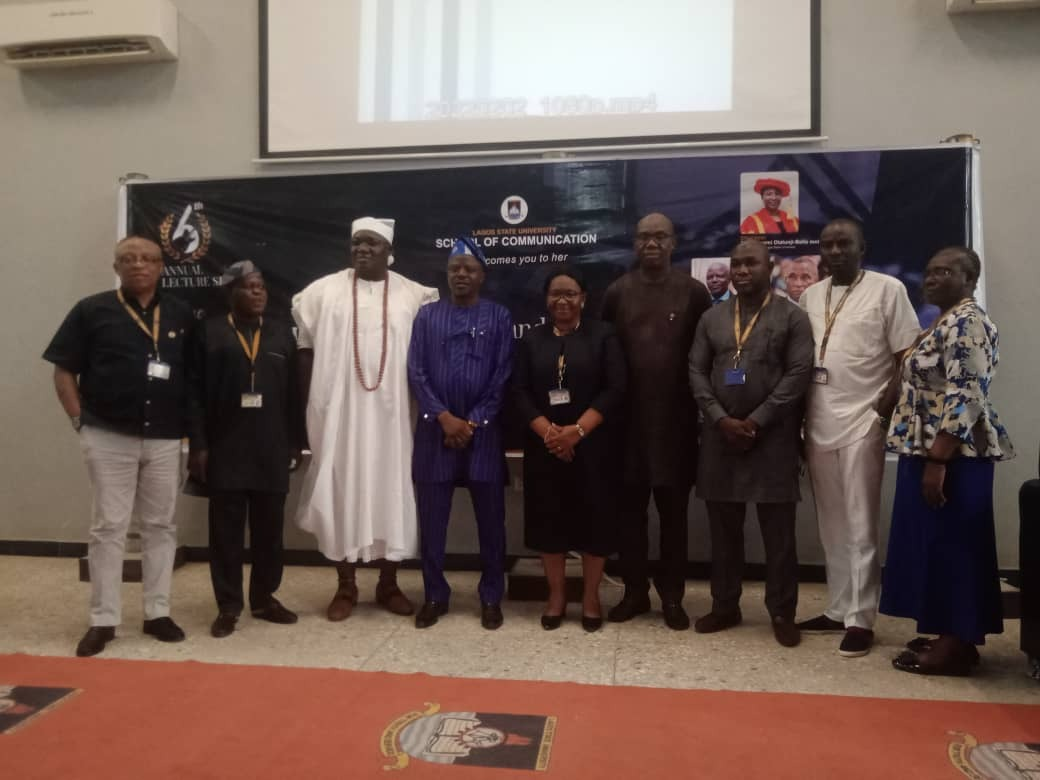
The Lagos State Commissioner of Environment and Water Resources, represented by the Assistant Director/Head Climate Change and Environmental Planning Dept, Mr. Bankole Michael disclosed this on Wednesday, at the 6th Annual Lecture Series organized the School of Communication, Lagos State University, LASU Ojo.
Mr. Bello who spoke as the guest lecturer on the theme: “Climate Change, Urban Renewal and Environmental Challenges of Megacity: Role of the Media,” explained that the media has a collective responsibility in holding public officers accountable to addressing issues of climate change.
Part of his lecture: ” It is a fact that climate change has far-reaching effects on our planet, from increasing the frequency and intensity of many extreme weather events, including flooding and drought, to changing sea temperature, ocean acidity, and sea level.
“Lagos is not spared the impacts of climate Change. There is no doubt that Lagos with the smallest landmass in Nigeria, is the commercial nerve centre of the Nation. It is a home to over 75% business concerns, a gateway to the economy of West Africa and a cosmopolitan city.
“The coastal city of Lagos has had its own fair share of the consequences of global climate change. The impact of the sea level rise has caused extreme ocean surges and the increase intensity of flooding events occur in most part of the city. Thus, Lagos is the most vulnerable city to the impact of climate change in Nigeria.
“Today, it is estimated that Lagos is home to more than 25 million people, majority of who are poor and living on the fringes of the society. A large percentage of the population of Lagos is also extremely poor, thereby lacking the required strategies to combat the effects of climate change.
“In addition, a strong and sustained growth of Lagos population and economy has resulted in the vast increase in the urbanized area, and attendant land use change. A 10 year review of the land use analysis of Lagos State by Prof Fabiyi (2018) revealed that major ecosystems have slightly changed from 351,081.72 Hectares in 2006 to 347,951.88 Hectares in 2016. This shows how unsustainable we are managing our environment.
“It is also imperative to state that the Climate Risk Assessment conducted by the Ministry with the support of the United Nation Development Programme (UNDP) also revealed that a total of 6,983 buildings/ infrastructure are susceptible to the threats of flooding across the State. The implication of this is that many people may either lose their residence or businesses.”
The Hon. Commissioner who noted that most infrastructures in Lagos were in a state of comatose due to lack of proper maintenance culture and the impacts of climate change; noted that urban renewal was crucial to the transfomation of the environment, and that all stakeholders must incorporate sustainable infrastructural systems.
Reiterating that the picture of Lagos state was not all doom and gloomy, the Environmentalist added that the state government has been proactive in addressing climate challenges by putting certain measures in place.
These measures according to Bello included: the hosting of eight editions of Lagos State International Climate Change Summit;
the Eko Atlantic City and the installation of groynes and accropodes at the shoreline of the bar beach; the greenery programme by converting all open spaces, verges and median into a green corridor, parks and gardens; institutionalizing July 14 of each year as a Statewide Tree Planting Day; , the planting of over 7Million trees since the inception of the Tree Planting in Year 2009, among other initiatives.
Bello added that the state has put in place Lagos Climate Action Plan that identified 5 goals and 26 high potential actions which form a comprehensive strategy to mitigate risks, increase adaptive capacity and build resilience towards climate change. ” One of the major adaptation goals of the Climate Action Plan is to promote resilience of urban spaces to climate change. ” He added.
Calling on collective efforts to addressing climate change impacts in the state, the Commissioner for Environment and Water Resources, reiterated that all stakeholders especially the media must work towards sustainable urban development plan.
His words: ” The media must hold people in power accountable. This means, the media must fact-check and press public officials to answer what they are doing to combat the climate crisis. The media must sharpen public understanding of climate change.” He added.
On his part, the Dean School of Mass Communication, Lagos State University, LASU Ojo, Prof. Sunday Alawode stated that the essence of organising the lecture series was to bridge the gap between the town and gown.
He added that the theme of the 6th lecture series: ” Climate Change, Urban Renewal and Environmental Challenges of Megacity: Role of the Media,” was to seek ways in addressing challenges that come with living in a Megacity.
His words: ” Megacity comes with challenges. So, the question is how can media help mitigate these, and bring about attitude change or behavioural change messages to the society. So we are happy that participants got to know the implications of their actions as it relate to pollution, waste disposal, ocean surge among others.” Prof. Alawode added.
Disclaimer
Comments expressed here do not reflect the opinions of Vanguard newspapers or any employee thereof.