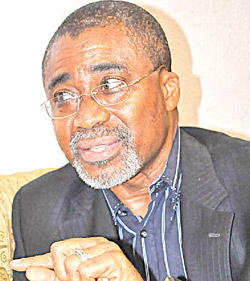
Abaribe
A former Deputy Governor of Abia State and two time Senator in the Upper Legislature, Senator Enyinna Abaribe in this interview expresses his views on the on-going screening of ministerial nominees by the Senate and other burning national issues. He spoke to Okey Ndiribe
How do you think the screening of ministerial nominees would be done by the Senate this time around?
Let me put it this way; the Senate is an organic institution which is also sensitive to the feelings and reactions which come from the public. As elected representatives of the people, our role is to reflect what the people think. Each and everyone of us are aware that the public is not comfortable with our screening process of the past. I think that the public is not aware of the limitations that the Senate has with regard to the screening of potential ministerial appointees of the President. The President sends the ministerial list without an indication of the portfolio in which they would serve. Once there is no portfolio, then the Senate is reduced to asking questions on general competence; and for those who belong to certain professions like the legal, engineering or medical fields which would suggest that such nominees could be sent to serve in certain ministries, you can only ask general questions.
If the President had been sending his list with portfolios attached to them, then you would see that the grilling would be much more intense, because people would now ask the nominees questions on the likely ministries they would be appointed to head.

Abaribe
But let me also say that the President is under no obligation to send the ministerial list with the portfolios attached and the reason is that the law does not stipulate that is what should be done. Therefore, we are faced with this dilemma; how far can you go with a nominee if you don’t know in which ministry he will eventually serve. For instance, if you ask a nominee who is not in the petroleum industry why the cost of kerosene is very high, you cannot expect the nominee to reasonably answer such a question.
I think that what would happen this time around whenever the list is sent is that those who have been ministers before would likely face a more intense grilling than the new appointees. This is because for those who have been ministers before, the questions they would be asked would pertain to how they handled the ministries they presided over in the past. Again, this would be because we already know that having occupied certain positions in the past they are more likely to more conversant with the problems of those ministries.
In case you get a nominee who can’t recite the national pledge or national anthem as was the case with a certain ambassadorial nominee who couldn’t do that in the past, how would you handle such a case?
Well, we do not expect that any nominee would not know things like that. This is because we believe that everybody who is a patriot or at least a citizen of Nigeria ought to have those things ingrained inside them. A nominee who is not able to recite simple things like that would not scale the screening process because what it means is that such a nominee is actually not involved in Nigeria. I don’t think we would waste time on such a nominee.
Given the background of the credible elections that were conducted by the Independent National Electoral Commission (INEC) in the recent past and the fact that you were a member of the Electoral Committee of the last Senate, would the National Assembly claim the credit for laying the foundation for the electoral feat that was performed by the electoral body?
Definitely the credit goes to everybody who worked within the parameters that were set for him. In the first place, the credit goes to the President who didn’t interfere; secondly, the credit also goes to the National Assembly which appropriated much and gave backing to the timing and letters of the law with regard to what INEC wanted.
The Electoral Act which was amended in 2010 was done in conjunction with suggestions from INEC in order to make their work easier. Then of course, lastly, credit must be given to the institution of INEC itself for trying very much to deliver a credible election.
I am sure you are aware that some civil society groups have continued to insist that unless the Justice Mohammed Uwais report on electoral reforms is fully implemented, the nation would not have a strong institutional foundation for transparent elections. What is your reaction to this position?
What I have to say is that the Uwais Report is not a cure-all for credible elections to be held in this country. If we adopt the Uwais Report fully the way it was written, we would not have elections at all. There are so many areas of the Uwais Report that do not conform to what we are supposed to do, there are areas that conflict with the Constitution.
The Uwais Committee did a good job but to a large extent , it was a report that was done by those who had not been involved in the thick of elections before; who have never contested elections in the past. They looked at elections from the prism of an outsider. The question of having a credible election in Nigeria is very simple in my own view. The fact is that the human element affects results that come from an election. What I mean is that going by the process by which we cast our votes here, after a ballot paper is thumb-printed and the vote is cast, it has to be transported from one point to the
other. At every of those points, there is a human element involved and it is through this human element that the problems come. If INEC wants to improve on what it has already achieved, it is not the adoption of the Uwais Report intoto that would enable them achieve this. It is the technical part of the process of elections. They now have to make such that when a vote is cast, it is transmitted automatically to a centre where you can no longer manipulate that vote.
With the virtual abandonment of the zoning formula by the PDP, do you think the South-East zone of the country stands a chance to clinch the Nigerian presidency in 2015?
I don’t see what stops an Igbo man from vying for the presidency of this country in 2015. I don’t see how you can run for any election and people would concede it to you and allow you to run alone. The more democratic the country becomes, the more people would present themselves for election into offices no matter where you come from.
How do you characterize the present odd arrangement whereby the Vice-President, the Senate President and the Speaker of House of Representatives are all from the North?
I don’t think there is anything that has happened to zoning. What I think is that once an election is done and we have a President, the Constitution prescribes that positions should be shared among all the constituent parts of the country at the federal level and the same principle applies to the states. This is captured under the federal character provision in the constitution.
This was enshrined in the constitution to ensure that at any given time, the entire nation is carried along and not just one section dominating the entire country. President Jonathan had every right to run for election. This is because, you don’t tell an incumbent to step down for a nebulous idea. What you should do is that the incumbent President should be allowed to run and if he wins , then you rearrange positions in the party so that everybody else is carried along.
As for what happened in the House of Representatives, I think it was an expression of the realities on the ground in the House of Representatives. You couldn’t insist that a section of the country that had voted overwhelmingly for a minority party should be compensated with a major office.
But the South-East was there and that zone voted overwhelmingly for a minority party. Why was the Speaker not taken from there?
If you look at what happened at the floor of the House , it was based on reality. Aminu Tambuwal’s camp had many votes and they were able to convince the other people to support them. The South-East did not have a candidate of their own and so, they went into an alliance with the North-west who had more than enough members .
Disclaimer
Comments expressed here do not reflect the opinions of Vanguard newspapers or any employee thereof.