Muhammadu Buhari
By Dirisu Yakubu
The Peoples Democratic Party, PDP, has dismissed claims by the federal government as presented by Information and Culture Minister, Lai Mohammed that it has done enough for Nigerians in line with its electioneering promises.
The main opposition party in a release by its spokesman, Debo Ologunagba said the performance claim by the All progressives Congress, APC government “can only be a product of delusions of grandeur; a joke of the year, as the word on the street where the real Nigerians are, is completely at variance with the fabricated lies and imaginary performance indices contained in the report.”
On economy, the PDP noted that the federal government has become “so addicted to falsehood that it had forgotten that Nigerians are aware that the PDP government handed over a $550 billion economy (largest in Africa and 26th globally) and a diversified economy to the APC in 2015.
“Today, our nation has become the poverty capital of the world due to the mismanagement, corruption and recklessness of the APC government.
“In 2015, Nigeria’s external debt was $7.3 billion. Today, under the clueless APC government, in just over six years, the external debt has reached over $38 billion and counting, with no corresponding investment in the economy or infrastructure.
“Today, the poverty rate in Nigeria is 71 per cent as against 32 per cent when the APC government took over in 2015. Between January and September 2021, over $1.8 billion dollar was expended on debt services, yet the APC government can shamelessly claim to have performed in 2021.
READ ALSO: BREAKING: Buhari signs 2022 Appropriations Bill of N17.127trn into law
“It is self-evident that only the APC gangsters can claim to have performed in the face of life discounting experiences of the ordinary Nigerians. Thankfully, Nigerians now know them for who they are.”
Still on the performance claim, Ologunagba added that the President Muhammadu Buhari-led government “has nothing to say to the fact that under its watch, the naira has collapsed from N198 to a dollar handed over to it in 2015 to over N500 today; that the pump price of fuel has risen from N87 per liter in 2015 to N165 per liter today; that unemployment has risen from 7.3 per cent in 2015 to over 33 per cent today and that price of food items have so skyrocketed that millions of Nigerian families are no longer able to afford their daily meals and other basic necessities of life.”
In the same vein, Senior Advocate of Nigeria, SAN, Mike Ozekhome has had his way on the issue in an exclusive chat with our correspondent.
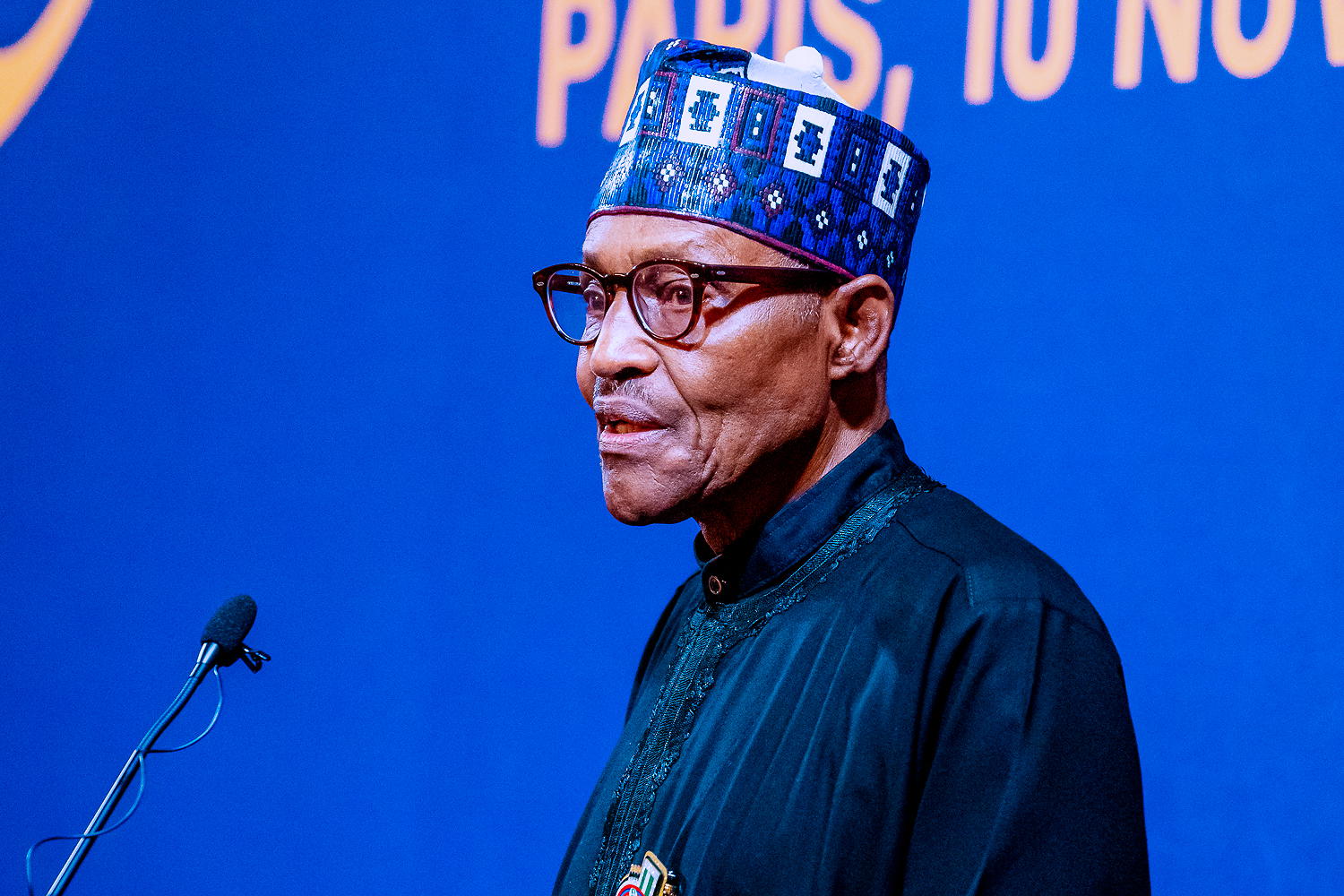
Apart from the Information Minister, President had recently stated in Paris at the Nigeria International Partnership Forum, NIPF that his administration has succeeded in revitalizing the nation’s economy, built infrastructure and uplifted the living standards of Nigerians since he assumed power in 2015; a claim dismissed by the legal luminary who in a chat with Vanguard, described the state of affairs in the land as hopeless.
According to Ozekhome, the performance claims “must be in President Buhari’s dream utopian world of fantasy, make-belief and ‘Ali Baba’s’ tales-by-the-moonlight. It is certainly not the Nigeria I live and work in. There exist grinding poverty, abject penury, dismay, hunger, thirst, helplessness and hopelessness.”
The human rights activist further noted that compared with the successive administrations of the Peoples Democratic Party, PDP; incumbent government fared poorly, stressing that it made Nigerians poorer than they were before 2015.
He continued: “Poverty has never been so grinding. Inflation has never been so high. Governance has never been so opaque. Corruption has never been so monumental. Insecurity has never been so ravaging. The economy has never been so parlous and recessionary. Innocent blood has never been so wantonly spilled. Nigerians are currently living in dire horrific circumstances of pains, pangs, sorrow, tears and blood. 2015 look like an eldorado. And the President is saying he has performed? This is the surest proof that President Buhari’s legendary disconnect with the people he presumably governs has reached unmanageable proportions.”
On his part, Executive Director, Civil Society Legislative Advocacy Centre, CISLAC, Ibrahim Rafsanjani, Buhari’s performance claims are at variance with the realities on ground.
In a chat with Saturday Vanguard, the CISLAC boss said: “Nigeria still has a huge infrastructure deficit. While major bodies like the International Monetary Fund, IMF, and African Development Bank, AfDB, estimated that the infrastructure gap would require $3.0tn to close, the 23-year National Integrated Infrastructure Master Plan, NIIMP, budgets a $2.3tn expenditure over 23 years (2020 – 2043) to close the gap. Despite possible sources of funding, financing remains a concern, especially in light of the administration’s penchant for borrowings and the country’s rising debt profile.”
He continued: “The significance of private sector participation cannot be over-emphasized. It would enable access to increased funding and improved maintenance culture considering these projects would be revenue-generating to help investors recoup investments. There have however been laudable schemes like the Road Infrastructure Development and Refurbishment Investment Tax Credit Scheme, which is a public-private partnership intervention that enables the federal government leverage private sector capital and efficiency for the construction, refurbishment and maintenance of critical road infrastructure in key economic areas in Nigeria. There would be tremendous infrastructure gains if this is adopted and adapted at the sub-national level, through Tax-to-Service agreements between administrators and registered businesses and associations like market associations for instance. Resolving the infrastructure challenge would significantly help to improve prospects of achieving the economy’s potentials.
“The current standard of living for the average Nigerian is worrisome. In 2020, Nigeria’s Gross Domestic Product, GDP per capita stood at $2,097.09 ranking 17th on the list of African countries. This tells you how prosperous a country feels to each of its citizens. In the same vein, Nigeria’s Gross National Income, GNI, per capita for 2020 was $2,000, a 1.48% decline from 2019. According to the United Nations Development Programme, UNDP, Nigeria dropped three spots to 161 in 2019 from 158 in 2018 among 189 countries in the 2020 Human Development Index, HDI.
“According to the World Poverty Clock, 105 million Nigerian citizens, are in extreme poverty trap and that is just over half of the population. The rising spate of insurgency, banditry, kidnapping has decelerated growth. Prices are soaring- food inflation is currently at 19.57%, the increase in electricity tariff, and increase in the price of Petroleum Motor Spirit , amongst other growing financial obligations, Nigerians across various disposable income brackets, have been financially pressured and strained.
“We have a long way to go towards revitalizing the economy but the federal government needs to demonstrate the political will to at least ensure the transparent and accountable implementation of strategic and sustainable developmental policies,” he added.
However, Anthony Sani, immediate past secretary general of the Arewa Consultative Forum, ACF said Buhari deserve some credit for the great work he has done so far.
“I believe that the regime has contributed to the socio-economic development of the country with the resources at its disposal. Whether the progress made by the regime is good enough is for the people to pass judgement after diligent use of trend analyses of the progress made.
“This is very necessary because the good things of life are not inevitable but are attained through ceaseless hard work by both leaders and the citizens. The task of nation building is a continuous process. That is why challenges of nation building would always arise and the work of government is to confront them as they arise. That may explain why Jesus Christ could say ‘the poor would always be with you.’ Surely, the poor would always be with us but they would not be around and keep quiet. The poor are never docile,” Sani noted.
Disclaimer
Comments expressed here do not reflect the opinions of Vanguard newspapers or any employee thereof.