•1st college of health tech to offer full time online courses in Nigeria
•Tackling brain drain through skills acquisition
By Sola Ogundipe
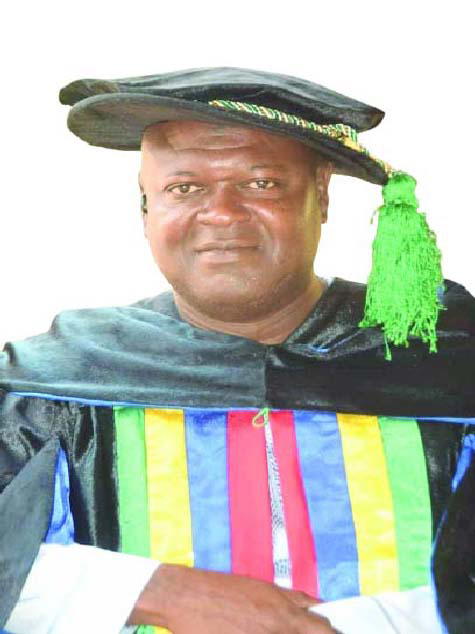
An encounter with Dr Moyo Kasim, Provost of the famous Lagos State College of Health Technology fondly called LASCOHET, is an interviewer’s delight.
There isn’t a dull moment as he goes down memory lane recalling the heydays of the renowned tertiary health institution and it’s current successes and contributions towards taking Nigeria’s healthcare sector to the next level.
Dr Kasim, a Lagosian that hails from Epe township, is the first bonafide provost of the institution since it was founded. Married to Rolake Olagbegi, Nigeria’s tennis sensation in the 80s & 90s, from the Royal family in Owo, Ondo State and one of the daughters of the famous Olateru Olagbegi, Olowo of Owo who was blessed with more than 50 graduates as children, Dr Kasim is also a sports enthusiast. He played volleyball up to professional level in France before concentrating on his medical career in the United States.
READ ALSO: Who is afraid of Buhari’s litmus tests for civil service?
From being the first medical health technology institution in Nigeria to offer full online courses to tackling brain drain through skills acquisition, Dr Kasim has positioned LASCOHET in the right direction.
In this interview with Saturday Vanguard, he speaks about the exploits of the College which is on track to achieve its dream to be a premier destination for excellent learning, producing world class allied healthcare professionals. Excerpts:
First in Nigeria
The Lagos State College of Health Technology is the first in the country. It was founded in 1920 by the late Dr Isaac Oluwole, long before many of the other tertiary health institutions. That was during the colonial era when we had the ‘wole wole’ or sanitary inspectors. They are now called environmental health officers.
Our vocation at the school of health technology is different because we deal with human life and this stands us out from the others. The College is a monotechnic because it focuses only on health. All of the courses that are offered here relate to health and healthcare delivery.
Students are admitted through JAMB and also through an entrance examination done at the College. Admission is strictly by merit. Applicants must have 5 credits at not more than two sittings and the courses are health based so that successful applicants must have Mathematics, English, Chemistry Biology and Physics.
Health-focused programmes
Currently, we are running programmes that include environmental health, pharmacy technician programme, community health programme, complementary health programme, morbid sciences, paramedics, equipment technicians programme, and medical laboratory technogy programme amid others. We have about 12 other programmes in the pipeline and also there are courses such as those for the first responders, utrasound, school of sonograpy, x-ray dental therapy, medical therapy technology, and a number of others that are all coming on board.
The state Governor, Mr Babajide Sanwo-Olu, through his Special Adviser on Education has been quite supportive of the College. The state government is constantly giving financial and moral support. In addition, the infrastructural development has really been tremendous,
Mr Govenor has given us much hope and we appreciate the effort, assistance and support. We have a lot of resources and constructions going on to enable expansion to introduce programmes that Lagos needs for its healthcare.
Upgraded system
When I came in as Provost initially, the College was running on a standard that I was not comfortable with. There were several challenges and one of the most glaring was that people, particularly outside the country, did not trust our transcripts, so when I came in, I decided that the grading system needed to be changed.
At that time, a score of 40 percent was the pass mark, but I was not satisfied with that. I said it was not right and argued that even though it was the accepted system at that time, it had to be changed. We eventually changed the grading system and this has upgraded the standard of the College.
Now, to earn a learned Grade A in any quiz or test, a student in the College must score 90 -100 percent. For a learned Grade B, you must score 80-89 percent; to earn a learned Grade C, a student must score 70-79 percent; and to earn a learned Grade D, the student must score 60-69 percent.
It is crucial that a student should not have too many “Ds” because in order to graduate from the College, your CGPA must be 2.0 and above, but if you are having more than two Ds there is no way your CGPA can measure up. As it is now, a score below 60 is an “F” and the student would have to repeat that course, or have a reference.
Initially the students protested when we changed the grading system, but through the intervention of the state Governor, this new system was gradually accepted, and now things have changed for the good.
Now we are having students from all over the world that are coming back to Nigeria and coming to thank the College for upgrading the grading system because it is now, the graduates of the College are more accepted than in the past according to best practices globally.
Core values intact
The work we do is very important. We deal with human life and so we want the best. We also introduced a system whereby if a student is having a CPGA of below 2.0, we write to such student a letter of academic warning and put him or her on probation. The way it works, if by the end of the 2nd year your CGPA is still below 2.0, you would get a letter of withdrawal.
Our mission is clear. It is to train competent and motivated graduates imbued with a sense of social responsibility in a conducive environment with renowned faculty employing state-of-the art technology to meet the evolving health care needs. Our core values are excellence, probity, and passion.
Tackling medical tourism
Another thing that we did when I first came in was that we asked ourselves why it is that the Nigerian elite usually prefer to go overseas for health care rather than utilise our own local services? Why is it that our elite do not trust our own healthcare system? The fact is that it isn’t too hard to know why things are like this.
We know that it has to do with the issue of not having well-skilled personnel to man the hospitals, and this is why we are trying to shift the paradigm so that there will be substance and assurance.
When we know that the people that graduate from this College are appropriately skilled, we the ordinary Nigerians, as well as the other set of people that patronise the General Hospitals and medical centres, as well as the elite that favour the overseas medical trips, will all be assured that we will meet the relevant skilled personnel in our local health institutions. This way, we will not have too many people seeking medical attention outside the country.
Pioneer of online learning
Well before the COVID-19 pandemic, a lot of different universities were online. Even today, there are many programmes online, For instance, you can be a student of Havard right here in Nigeria without ever having to visit Havard. This is because you can take some of their courses online and graduate.
We are the first college of health technology in Nigeria to offer full time online courses, now others have copied our lead. Six years before the COVID-19 outbreak, I implemented the hybrid online learning system.
The main reason I did that was because we had space constraint. Our campus in Yaba is small. We are sitting on less than one acre of land and we have teeming population of students and this also affects our accreditation.
Also, because it is the various accrediting body that gives the number of students that we can admit and to offer distance learning programmes, we had to do it. The point is that if you do not have the space, they will not increase your number of students you can admit.
So we thought outside the box and that was the genesis of offering courses online. It started with a hybrid system where they did certain aspects on campus and others online. And we have been running like that for about four years before the COVID-19 outbreak.
We didn’t have any disruption in our academic programmes, we just transitioned from hybrid to full time with ease. There was no interruption. It was business as usual.
We are the first College of Health Technology in Nigeria to offer full time online courses, and now others have copied our lead.
College of technology vs university
I have been trying to educate our parents about the benefits of encouraging their wards to embrace schools of technology. The university is considered the ultimate, however, the point to note is that it is not everyone that is eligible that can go to the university at the same time.
We are a professional institution, and you can come to our College and become a professional within two or three years. We offer both the ND and HND programmes and our students are eligible for the NYSC programme after they graduate.
The simplest contrast between university and the college of technology is that the students come in as professionals. In the College, it is hands-on training, and the majority of the acquired knowledge is obtained on practical skills.
Imagine someone who comes to the school to be a Community Health Extension Worker (CHEW) . Such person will do strictly practical work compared to someone who studies community health in the University. The difference is that the one that went to the university would not have that practical edge that is comparable to the one that went to our own institution. That is the basic fact.
The certificate that is given in the College is a professional certificate while the one given in the University is an academic certificate. With this kind of qualification, our students tend to get employment in a jiffy, because their technical skills are highly valued. If you are a pharmacy technician or a biomedical engineer, you would definitely get a job. It is guaranteed.
Disclaimer
Comments expressed here do not reflect the opinions of Vanguard newspapers or any employee thereof.