By Peter Duru – Makurdi
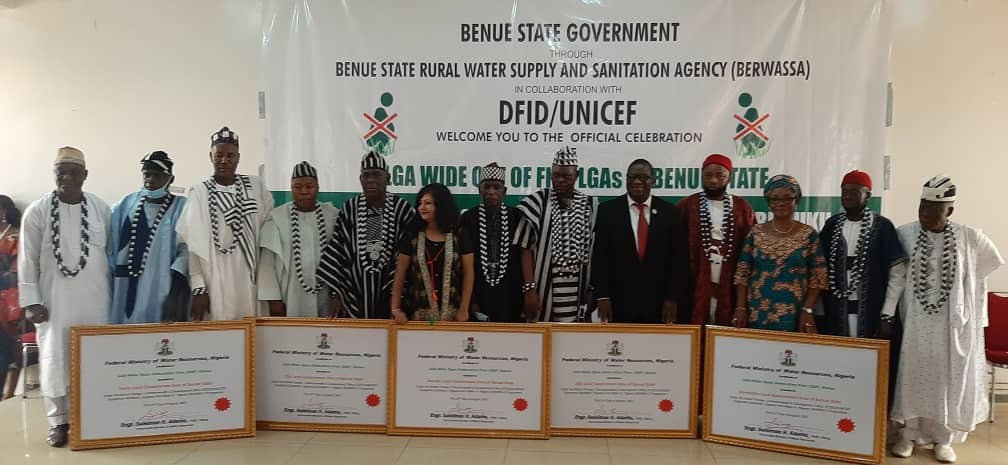
Five Local Government Areas, LGAs, in Benue state which were supported by the United Nations Children’s Fund, UNICEF, yesterday received certificates certifying them Open Defecation Free, ODF, by the Federal Ministry of Water Resources.
Issuing the ODF certificates in Makurdi to the LGAs which included Buruku, Konshisha, Obi, Oju, and Tarka, the Minister for Water Resources, Engr. Suleiman Adamu commended UNICEF for its interventions and successes recorded in managing the projects, and institutional structures at the State, Local Government and Community levels.
The Minister also commended the Benue State Government for the achievement and enjoined the people of the state to keep up the good effort by playing their part in sustaining the results achieved so far “as we work towards achieving a state-wide ODF status in the not too distant future.”
He said “accomplishing this feat will accelerate the State’s advancement towards universal access to Water Sanitation and Hygiene, WASH, services for its citizens and contribute to the national aspirations.
“As we are aware, most of the priority areas of President Buhari’s Administration which include enhancing social inclusion and poverty reduction, expanding business growth and entrepreneurship; and expanding access to quality education, affordable healthcare and productivity, are impacted in one way or the other by access to WASH services.
“I hereby enjoin all sub-national Governments to prioritise investment in WASH services as this is very strategic to development and improvement of the welfare of the populace.
“We all must work together in accelerating stakeholders’ engagement and community mobilization towards imbibing a culture of safe hygiene practice as we progressively move Nigeria from the unfortunate position of being at the top of the ladder of countries with the highest number of persons practicing open defecation, towards attaining the SDG 6 targets for water and sanitation.
“I wish to reiterate my Ministry’s commitment towards improved coordination, partnership and implementation of WASH programmes which is expected to address the water, sanitation and hygiene inadequacies in Nigeria, as we look forward to a country where all citizens have access to improved and sustainable WASH services, leaving no one behind.”
Governor Samuel Ortom in his remark said the state was committed to the WASH project hence the approval of funds to drive it.
Represented by the Permanent Secretary, Benue State Ministry of Water Resources and Environment, Mr. Godwin Tighir, the Governor said, “the programme has also done much in the Internally Displaced Persons, IDPs, camps and we are believing that by 2025 all the Local Government Areas in the state will be ODF.”
On her part, WASH Ambassador and First Lady of Benue State, Dr. Eunice Ortom who was represented by the Commissioner for Trade and Investments, Mrs. Ladi Ishiegbe commended the UNICEF for its intervention programmes in various sectors.
Mrs. Ortom charged Local Government Council Chairmen in the state to always collaborate with traditional rulers to ensure that the ODF status was maintained and sustained in the Local Government Areas.
Mrs. Ortom also advised the State Ministry of Trade and Investment to collaborate with the Ministry of Environment to ensure cleanliness and availability of toilets in Benue markets and business areas.
The Chief of Field Office, UNICEF Enugu Field Office, Dr. Ibrahim Conteh in his remark commended Governor Samuel Ortom for committing the sum of N250million as support to attain ODF status in the state which according to him was highly remarkable.
“We therefore commend the Governor for his support, his resilience and his efforts towards overseeing the welfare of his people.
“I must also commend the traditional rulers who have been working closely with the WASH units to ensure the actualization of ODF status in the five Local Government Areas.”
While also commending UNICEF partners from the Federal Ministry of Water Resource, Dr. Conteh said the presence of the Ministry at the event showed that “what UNICEF is doing at the state level is at the heart of the people at that level who also give their support to ensure that the programme succeeded.
“I must also commended all those who played one role or the other to ensure the success being recorded in the state,” he said.
Also speaking, the WASH Manager, UNICEF Field Office Enugu, Mamita Thakkar said the attainment of ODF in the five LGAs was achieved through collective efforts.
She said “We have come this far due to the collective efforts of everyone, because we galvanized as a team and shared a common vision, because we understood why sanitation, why ODF, the significance of becoming ODF, we shared the joy and pride of calling ourselves a clean community, a community of dignified individuals who will not go out to the open to defecate.
“The State has made significant progress in WASH, especially with regards to creating ODF LGAs. In a record time of 1.5 years, five ODF LGAs were achieved, despite the COVID restrictions and challenges. This is a remarkable achievement for the State.
“The State has launched the ODF Road Map, it has constituted the Inter-Ministerial Steering Committee on WASH and most recently allocated N250million for Partnership for Expanded Water Supply, Sanitation and Hygiene, PEWASH. This to me is a huge progress. We already have nine LGAs which are ODF in the State. With two more planned before the end of the year, we will soon reach the 50 percent mark.
“So, how can we achieve this? If we do the right things, we can gain the distinction of the first State to be ODF. Can we rise to take this challenge? We have big and medium towns like Gboko and Otukpo? What are the solutions for urban small towns?
“We need to change our perception of sanitation from being a stand-alone issue to one that impinges on several areas of our growth and development, including several of our SDGs.
“We need to accelerate our efforts to create a State with no Open Defecation. We need to recognize that investments in water, sanitation and hygiene pay dividends in public health, nutrition, education, employment, gender equality, and the environment.
“The cost of inaction is too high to neglect. This is especially true for children. The State is uniquely positioned to make a substantial impact in the lives, health and economy of its future generations through investments in water, sanitation and hygiene. Clean water and sanitation is not only about hygiene and disease, they’re about dignity, too. Many examples show that self-esteem begins with having a safe and proper toilet facility.
So what do we do, moving forward: Efforts at multiple levels: At the strategic level – make the ODF Road Map, the key guding document – it exactly explains the road to making the State ODF – including the investments required.
Prioritize the remaining LGAs for interventions – draw up a time line and budgets.
Officials/RUWASSA/HE and the First Lady to call upon the Chairmen- give them a time bound target, and support them. The models developed by these nine LGAs can be replicated.
Set up teams – do community mobilisation, trigerring on CLTS in the community, follow up.
“We need to strengthen the WASH Units in the local Governments, there’s a need to build capacities and deploy human resources, who are trained to mobilise communities.
Institutional linking is a necessity – for example, can the Ministry of Education and The Ministry of Health commit to make their institutions WASH compliant in the next few months.
“Today, as never before, we need to understand the interconnectedness of our actions. Sanitation has tangible returns on investments. In India, annual health gains from household sanitation are estimated to be worth US$ 402 per household. Total economic gains of achieving basic sanitation in India are projected to be worth 7.7% of the country’s Gross Domestic Product. This dialogue around prioritizing WASH is especially important now when governments need solutions to ensure water, sanitation and hygiene for all, including to improve economies, spare health systems, and protect populations from COVID-19 and future public health pandemics.
“As we move forward, lets not lose sight of global best practices – what lessons can we learn from India. A country with 1.3 billion population and approx. 540 million defecating in the open in 2014. In 2014, the Government of India launched Clean India Mission. The goal was to make rural India Open Defecation Free by October 2, 2019 – TARGET WAS SET. The government has reported 100 million toilets being built and over 500,000 villages declared ODF.
“This transformation was triggered by the so-called four Ps: Political leadership, Public funding, Partnerships, and People’s participation. Top-level leadership from the Prime Minister, backed by US$20 billion in funding, and human resources at various levels were key ingredients to the success.
“In summary, what we need to now focus on is Sustainability of the status of ODF – put use of toilets at the centre of our actions,” he added.
The Commissioner for Water Resources and Environment, Engr. Dondo Ahire who in his speech also commended UNICEF and stakeholders for the feat urged that the tempo should be sustained.
Represented by the Permanent Secretary of the Ministry, Mr. Godwin Tighir, the Commissioner said, “we need the commitment of all in that task so that by 2025 all the LGAs of the state will be ODF. That is our target and it is achievable through our collaborative effort,” he said.
Earlier in a welcome remark the General Manager of Benue Rural Water Supply and Sanitation Agency, BERWASSA, Mrs. Torkwase Ikyaator said the historic event marked another giant step on the journey to achieving an ODF Benue by 2025, with the hope of placing the State among others, on the Map of “Clean Nigeria; Use the Toilet Campaign” of the Federal Republic of Nigeria.
She said, “Benue State has a population of over 2.7 million people practicing open defecation. According to the Water, Sanitation, Hygiene National Outcome Routine Mapping (WASHNORM) Report 2019.
“One in every two persons in Benue State defecate in the open and do not have access to basic sanitation facilities. The reason for this high population of people practicing open defecation remains that 14 LGAs have wholly or partially received WASH intervention and nine LGAs are completely without any form of WASH intervention.”
She said Governor Ortom in realization of the health and economic risks associated with Open Defecation launched the “Clean Benue: Use the Toilet Campaign”; inaugurated the State Inter-Ministerial Steering Committee for the Revitalization of Water Sanitation and Hygiene, and Declared a State of Emergency on WASH in the State in 2019, being the first State to do so in Northern Nigeria.
“In a similar vein, the State through BERWASSA has developed and launched the roadmap to end Open Defecation in Benue come 2025.
“Meanwhile the State is in the last phase of review of the Benue WASH Policy to be launched soon. The five LGAs (Konshisha, Oju, Obi, Tarka and Buruku) under the UNICEF-SHAWN Project being celebrated at this occasion is a manifestation of the State efforts towards meeting the SDGs 6.1 and 6.2 in line the National Action Plan to end Open defecation in Nigeria by 2025.
“The milestone recorded today would not have been possible without the support of our major Development Partner — UNICEF and other sister Donor agencies like United purpose Nigeria, WaterAid and some domestic CSOs/NGOs across the State.
“Today, Benue State ranks 3rd as the State with the highest number of LGA wide Open Defecation Free. The state can boost of nine LGAs that have been declared LGA wide Open Defecation Free in line with the guidelines of the National Task Group on Sanitation (NTGS). Six of the LGAs are funded by the DFID/UNICEF-SHWAN Project and three from the WSSCC/GSF-United Purpose RUSHPIN Programme.
“We must at this juncture, commend the untiring efforts of our Traditional Rulers, Water Sanitation and Hygiene Committees (WASHCOMs) the WASH Units of the various LGAs and the Local Government Authorities who created a conducive atmosphere for the projects to thrive and yield fruits.”
Continuing, she said, “As we celebrate today and award certificates of ODF to the five LGAs under the SHAWN Project in the State, we must not relent in our efforts to sustain the tempo and momentum channeled towards this attainment. The Local Government Authorities and the State need strong political commitment to avoid relapses.
“The LGAs are encouraged to provide operational funds for follow up monitoring and invest in sanitation marketing for bullding of improved sanitation facilities among other sustainability measures.
“To effectively achieve our target of Clean Benue by 2025 as enshrined in the ODF Roadmap, all relevant stakeholders in the WASH Sector should live up to their responsibilities of providing latrines and Hygiene services in their domains; SUBEB should ensure WASH services are provided in schools, PHCB to ensure provision of latrines in health centres, the Head of Services to ensure provision of functional latrines in all government offices, ALGON can do well to construct toilets in all the twenty three LG Secretariats.
“The Ministry of Trade and Industry has a responsibility of ensuring that toilets are provided in all markets, motor parks and other public places. I call on the private sector to Join hands with the Benue State Government to participate actively in the journey to deliver Benue as an ODF State by 2025. This can be achieved through investing in the Water and Sanitation facilities through a demand driven approach.”
Disclaimer
Comments expressed here do not reflect the opinions of Vanguard newspapers or any employee thereof.