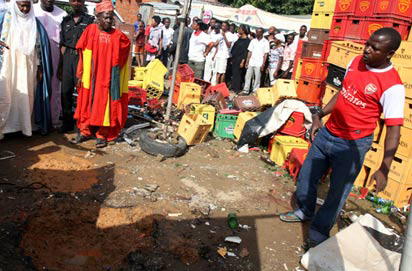
The scene of the bomb blast at the International Market Zuba in Niger State,recently.
*Blasts claim 2,000 lives in 25 years
* Falae, Ezeife, Odumakin, Okunniyi urge urgent solution
BY CLIFFORD NDUJIHE
DISTURBED by the regularity at which bomb explosions are now rocking parts of the country and the attendant loss of avoidable lives and property, some eminent Nigerians have urged President Goodluck Jonathan to find solutions to the problem if he wants socio-economic development to take root in the country.
Gradually, explosions are creeping in as a way of life in Nigeria raising questions on who and what are responsible for the blasts as well why the government is finding it difficult to address the problem.
For over 16 years, Nigeria was calm after the ear-shattering shelling of the Nigeria- Biafra civil war of 1967 to 1970. But the calmness was violated on October 19, 1986 when a parcel bomb killed Mr. Dele Giwa, the founding Editor-in-Chief of Newswatch Magazine, in Lagos. Since then, there have been over 30 explosions across the country in which about 2000 persons were killed.
In spite of massive security measures put in place by the Federal Government to forestall such explosions in readiness for the May 29, Democracy Day celebrations, the nation was shocked to her marrows the following day when bombs went off in Bauchi killing a dozen of persons. The security measures were to prevent a recurrence of the 50th Independence Day twin bomb blasts that killed 12 persons including 11 policemen and injured 36 others.
Prominent Nigerians, who spoke on the issue yesterday include Former Presidential Candidate and Secretary to the Government of the Federation, Chief Olu Falae; Third Republic Governor of Anambra State, Dr Chukwuemeka Ezeife; Maj General Muhammadu Buhari’s Spokesman, Mr Yinka Odumakin and Spokesman of the Pro-National Conference Organisations, PRONACO, Mr Olawale Okunniyi.
Falae said President Jonathan must make security his first priority if he wanted the country to survive.
His words: “When I was asked what I expected from President Jonathan administration, I said he must make ending crime and violence his number one priority. Violence has taken over the country-before, during and after the 2011 general elections. He must find a way of assuaging victims of past violence because people who lost relations in certain parts of the country might not be willing to return there. Unless and until we establish confidence in the people not much can happen in terms of national development. President Jonathan should sort out the problem immediately because it is the key to the survival of Nigeria.”
On his part, Ezeife averred that discussion and negotiation with groups that had claimed responsibility for some of the attacks might do the magic.
“People dropping the bombs are human beings. Why are they doing it? Is it perversion? It may be reasons that will not stand the test of reasoning and logic. They may have been brain-washed to embark on it. I offer myself to speak to Boko Haram leaders, to find out their anger and what offence the nation has committed against them so that we can find solution to the explosions. That is the best cause of action – meet with them, discuss and win them over,” he said.

The scene of the bomb blast at the International Market Zuba in Niger State, recently.
However, Odumakin said the government had demonstrated lack of will to address the issue decisively given its handling of the October 1 blasts in which the perpetrators had not been fished out seven months after and no one had been prosecuted.
His words: “It is unfortunate bombs now fly like bangers all over Nigeria. There is no effective security measure to stop the explosions. The Afghanistanisation of Nigeria is worrisome.
There is palpable fear and tension all over Nigeria. When it happened on October 1, 2010, a group claimed responsibility but the President said the group was not responsible. Till date, he has not told us who is responsible, nobody has been prosecuted, series of bombs had been exploded and many people had been killed. We need political will to deal with the situation. The government has demonstrated embarrassing incompetence to handle the security situation. They shut Abuja down for the inauguration day. But the following day, bombs exploded, which shows that security should be seen as an everyday affair, not for inauguration day only and it should be for all Nigerians.”
Pained by the upsurge of sporadic bomb blasts in the country, Okunniyi took a swipe at successive governments for encouraging sustained political acrimony in the country.
Assessing the state of the nation against the backdrop of 100 years of Nigeria union in 2014, he said the ongoing bomb politics in the country might not abate as long as the various people in the union found a basis to be dissatisfied with the political system.
Okunniyi advised the Federal Government to quickly encourage the diverse blocs of people in the Nigerian union to dialogue and negotiate for themselves a constitutional arrangement that was indigenous and suitable to their union since the Obasanjo’s National Political Reform Conference in 2005 failed to deliver the goods.
He said this could be achieved if the National Assembly amended Section 9 of the 1999 Constitution to enable it first give itself the powers to convoke a constitutional convention of the delegates of diverse constituents of Nigeria as it is ultra vires for the legislature to give the country a new constitution by the provisions of the 1999 constitution
“What is missing is the will of successive governments to dare the various powers that made them. So in an attempt not to rock the boat, successive governments have left the Nigerian people more incensed and disenchanted with their political conditions.
Today, various constituencies in the union either in the South or in the North all have excuses to react violently because they are fed up with the present political system foisted on them by the recycled power clique in the country,” Okunniyi said.
Litany of bomb blasts
Apart the shelling experienced during the Nigeria-Biafra civil of 1967 to 1970 as well as the numerous shattering of oil pipelines and facilities by Niger Delta militants, Nigeria has witnessed an avalanche of bomb explosions since 1986 in which about 2000 lives had been lost. They include:
*May 30, 2011 – Post Democracy Day blasts kill 12 in Bauchi
* April 15, 2011 – Blast in Maiduguri kill two
* April 8, 2011) – A suspected bomb blast rocked an INEC office in Suleja on the eve of parliamentary polls, killing at least five people at the start of a crucial vote period.
*March 3, 2011 – Bomb explosion at a PDP rally in Suleja kill 10
*December 31, 2010 – Explosions at Mogadishu Mammy Market, Abuja claim four
*December 24, 2010 – Bomb explosions in Jos kill 32
* October 1, 2010 – A twin Car bomb blasts kill 12, injuring 36 in Abuja.
* June 1, 2010. Two bombs exploded behind the perimeter fence of White Eagle Hotel in the Etegwe suburb owned by one Chief Nathan Ile and at the former Bayelsa Deputy Governor, Peremobowei Ebebi’s private residence in Yenagoa.
* March 15, 2010 – Bomb blast rocks Post-Amnesty Summit being organised by Vanguard Newspapers in Delta State with no casualty.
* December 22, 2009: A parcel bomb exploded in the premises of Superscreen, a private television station, in the Onipanu area of Lagos, ripping off the right hand of the conveyer of the explosive device.
* July 12, 2009 MEND attacks Atlas Cove, an oil facility in Lagos, with dynamite and guns killing 5.
* December 13, 2006. Thugs attack Delta State PDP Secretariat in Asaba with explosives.
* December 11, 2006. Thugs attack Ndudi Elumelu’s campaign office in Aniocha/Oshimili Federal Constituency, Delta with dynamites.
* December 5, 2006. Dynamites exploded at then Governor Goodluck Jonathan’s campaign office in Bayelsa State.
* Novemebr 28, 2006. A car bomb explosion killed one Godwin Aigbekhai in Owan East Local Council, Edo State.
* November 25, 2006. An explosion destroyed parts of PDP secretariat in Bayelsa State.
* January 27, 2002. An avalanche of bombs exploded at the Ikeja depot of Nigerian Army Cantonment, Ikeja,
killing some base staff and their families on the spot. It led to a stampede, which claimed more lives at a
Oke-Afa canal, Ejigbo. About 1,100 persons, in all, died.
* December 13, 1997. Lt-Gen Oladipo Diya escapes death at Abuja airport.
* May 12, 1997. Explosion rocks Ibadan in front of Federal Ministry of Works and Housing at Eleyele Road, near Jericho Hospital.
* April 22, 1997. Blast in Evans square claims 3 lives, injures several.
* January 17, 1997. Bus belonging to Nigerian army hit.
* December 18, 1996. Bus belonging to Lagos State Task Force on Environmental Sanitation hit.
* December 16, 1996. Bomb blast rock Colonel Mohammed Buba Marwa’s convoy.
* November 14, 1996. Explosion occurs at Murtala Mohammed Airport, claiming the life of the Chief Security Officer.
* April 25, 1996. Explosions shake Airforce Base, Ikeja.
* April 11, 1996: Ikeja Cantonment, Lagos.
* January 20, 1996. Explosion at Aminu Kano Int’l Airport, Kano.
* January 18, 1996. Durbar Hotel, Kaduna bombed with suspected bomber killed.
* May 31, 1995. Ilorin Stadium rocked just before launch of Family Support Programme.
* October 19, 1986. A parcel bomb killed Dele Giwa, the founding Editor-in-Chief of Newswatch Magazine in Lagos.
Disclaimer
Comments expressed here do not reflect the opinions of Vanguard newspapers or any employee thereof.