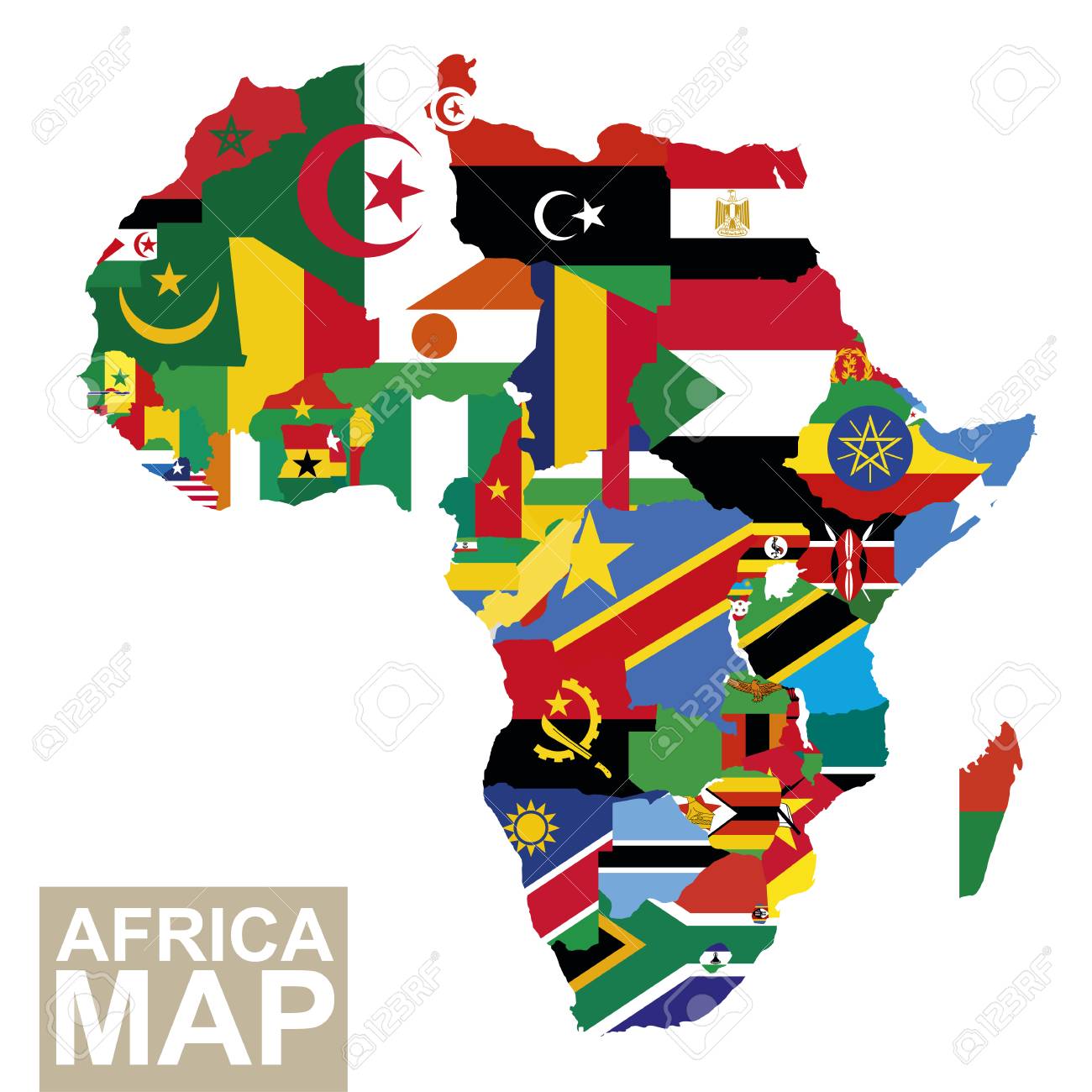
Africa map.
By Providence Adeyinka
African or Nigerian politics was initially devoid of military participation. The military in the concept of Mazrut then assumed the role of an idiot (Aristotelian language used to describe a citizen who is impervious to politics). The absence of any military insurgency in the continent then, prompted Claude Welch to refer to the entire continent as a political kingdom or the primacy of politics.
Paradoxically, this epoch was ephemeral as African armies jettisoned the tradition of the civilian control of the military popularized by Carl Von Clausewitz in his book entitled “On War” published in 1832. Therefore, the entire African Continent became a theatre of military intervention.
These are the words of an Associate Professor who lectures in the Department of Political Science, Lagos State University, LASU, Dr. Jimoh Bamgbose, in his book titled “Military Intervention In African Politics”.
READ ALSO: WORLD WATER DAY: Declare state of emergency in water sector, CAPPA tells Sanwo-Olu
The nineteen-chapter book with 266 pagination, considered cases of military intervention in Nigeria, Ghana, Gambia, Liberia, Benin Republic, Togo, among others with a view to unraveling the causes, the dramatis personae involved and the impact of those coups on these countries.
Bamgbose said: “Sight must not be lost of the unanimous decision by the African Union, AU, Economic Community of West African States, ECOWAS, Economic Community of Central African States, ECCAS, as well as the East African Community, EAC that under no circumstance should there be any change of government by the use of force regardless of what the coupists say. But the popular saying is that power flows from the barrel of a gun. Liberia remained under a democratic rule for 133 years but bowed to the military by April 1980. African countries of today should be careful and govern aright.”
Speaking at the book launch in Lagos, book reviewer, Prof. Sylvester Akhaine, said that the book is holistic in its approach to the subject and as well looks at the traditional African societies and their military organization to background the depiction of the military and its foray into politics.
Akhaine said the book overview military coups in Africa with a focus on countries like Benin, Ethiopia, Gambia, Ghana, Liberia, Mali, Nigeria, Sudan, Togo and Uganda, adding that it reawakens to political issues that are consequential but lost in the din of avarice of political actors and devaluation of scholarship by the proliferation of what Paulo Freire has called magical consciousness that seeks causation in the other-worldliness instead of objective realities.
“The book is didactic; it talks about the nature and dynamics of military intervention in politics and the factors that drive such intervention and he situated it within the background of pre colonial African history and our experience within the post colonial period. He wants us to understand these dynamics so that we can consolidate our democracies,” he said.
Earlier in his remark, Executive Chairman, Ojo Local Government, Hon. Idowu Rosulu, said African setting has suffered backwardly because most of the knowledge the forefathers had were not properly documented.
Rosulu who doubled as Chief Launcher, said the book would not only advance the frontier of knowledge, but those in politics would have something to gain to benefit mankind.
He said: “Military intervention has been more of backwardness than forward looking, our mentality has been militarized. Because some of our leaders have military background, they tend to be dictatorial, they are not democrats and that have affected us which makes the central government so powerful that the president could do and undo. Except we start jettison that military mentality, then we can move on.
“The late Alhaji Jakande, was about doing metro line for Lagos before military intervention, despite that we did not do the metro line, the fine that the International Court gave us made us to pay all the money to that company without any thing to show for it. Till date nobody could do it, that is a setback, I don’t think military has given us anything good, my opinion”, he said.
Also, Dr Ayo Bamgbose Jr, said the book was written to give back to the society, this is so because the author had a basic origin from military intervention in Africa and did his PhD and Masters in International Relations which as a result, gave him the fore sight to publish such book.
Bamgbose Jnr who said military cannot be separated from African politics stated: “You cannot separate military intervention from African politics; it has always been like that. Judging from history, it has always been coup d’état. There are a lot of shortcomings of military rule and which I say most of the problem we have in Africa today are as a result of the coup we had in history.”
Disclaimer
Comments expressed here do not reflect the opinions of Vanguard newspapers or any employee thereof.