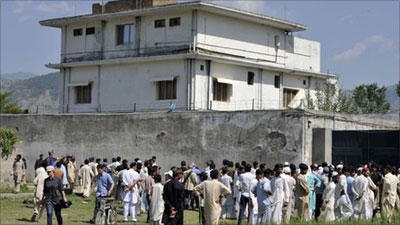
The compound was opened to the media on Tuesday (BBC)
THE Central Intelligence Agency, CIA chief, Leon Panetta, yesterday, explained why the US did not inform the Pakistani authorities before carrying out a raid on the compound of the late Al-Qaeda leader, Osama Bin Laden
In his first interview since commanding the mission to kill Osama bin Laden, Panetta said that U.S. officials feared that Pakistan could have undermined the operation by leaking word to its targets.

The compound was opened to the media on Tuesday (BBC)
Long before Panetta ordered Vice Admiral William McRaven, head of the Joint Special Forces Command, to undertake the mission at 1:22 p.m. on Friday, the CIA had been planning how to structure the raid.
Panetta said that the U.S. had earlier considered expanding the assault to include coordination with other countries, notably Pakistan, but that the CIA ruled out participating with its nominal South Asian ally because “it was decided that any effort to work with the Pakistanis could jeopardize the mission. They might alert the targets.”
He added that the U.S. also considered running a high_altitude bombing raid from B_2 bombers or launching a “direct shot” with cruise missiles but ruled out those options because of the possibility of “too much collateral.”
The direct_shot option was still on the table as late as last Thursday as the CIA and then the White House grappled with how much risk to take on the mission. Waiting for more intelligence also remained a possibility.
On Tuesday, Panetta assembled a group of 15 aides to assess the credibility of the intelligence they had collected on the compound in Abbottabad where they believed bin Laden was hiding. They had significant “circumstantial evidence” that bin Laden was living there.
Panetta said the residents burned their trash and had extraordinary security measures – but American satellites had not been able to photograph bin Laden or any members of his family. The Tuesday meeting included team leaders from the CIA’s counter-terrorism centre, the special_activities division (which runs covert operations for the agency) and officials from the office of South Asian analysis.
Lack of unanimity
Panetta wanted to get those aides’ opinions on the potential bin Laden mission, and he quickly found a lack of unanimity among his team. Some of the aides had been involved in the Carter Administration’s effort to go after the hostages held by the Iranians 30 years ago; others had been involved in the ill_fated “Black Hawk Down” raid against Somali warlords in 1993.
He noted: “What if you go down and you’re in a firefight and the Pakistanis show up and start firing? How do you fight your way out?”
But Panetta concluded that the evidence was strong enough to risk the raid, despite the fact that his aides were only 60 per cent _ 80 per cent confident that bin Laden was there, and decided to make his case to the President. At the key Thursday meeting in which President Obama heard the arguments from his top aides on whether or not to go into Pakistan to kill or capture bin Laden, Panetta admitted that the evidence of bin Laden’s presence at the compound was circumstantial.
He said: “But when you put it all together, we have the best evidence since (the 2001 battle of) Tora Bora (where bin Laden was last seen), and that then makes it clear that we have an obligation to act.”
Obama decided that Panetta’s arguments trumped two other options: striking the compound remotely or waiting until more evidence was available to prove bin Laden was there.
Panetta said: “If I thought delaying this could in fact produce better intelligence, that would be one thing. But because of the nature of the security at the compound, we’re probably at a point where we’ve got the best intelligence we can get.”
For weeks, Panetta had been pushing the National Geospatial-Intelligence Agency to try to get photographic confirmation of the presence of the bin Laden family. “NGA was terrific at doing analysis on imagery of that compound,” he says, but “I kept struggling to say, ‘Can’t you at least try to get one of the people that looks like bin Laden?’
Our early assistance helped in identifying Osama’s courier—Zardari
*Says Pakistan had no clue about Osama’s whereabout
Meanwhile, Pakistani President, yesterday, said his country provided initial help that ultimately led to al Qaeda leader Osama bin Laden, but he said it had no clue about the terror mastermind’s whereabouts and didn’t participate in the U.S. raid to kill the top militant.
Asif Ali Zardari, writing in a Washington Post op_ed column, said that the raid was not a “joint operation” and bin Laden “was not anywhere we had anticipated he would be.
And we in Pakistan take some satisfaction that our early assistance in identifying an al Qaeda courier ultimately led to this day.”
U.S. politicians and military officials have roundly criticiced Pakistan for not being more robust in the fight against al Qaeda, the Taliban and other militants who have a strong presence along the Afghan_Pakistani border.
But Zardari defended Pakistan’s anti_terror activities, saying there has been “a decade of cooperation and partnership between the United States” and his country that ultimately led to bin Laden’s death.
Zardari said he “endorses the words” of and “appreciates the credit” from U.S. President Barack Obama about Pakistan’s role.
In his announcement of bin Laden’s death, Obama said it’s “important to note that our counterterrorism cooperation with Pakistan helped lead us to bin Laden and the compound where he was hiding.”
Zardari said that “some in the U.S. press have suggested that Pakistan lacked vitality in its pursuit of terrorism, or worse yet, that we were disingenuous and actually protected the terrorists we claimed to be pursuing. Such baseless speculation may make exciting cable news, but it doesn’t reflect fact.
“Pakistan had as much reason to despise al Qaeda as any nation. The war on terrorism is as much Pakistan’s war as it is America’s. And though it may have started with bin Laden, the forces of modernity and moderation remain under serious threat,” Zardari said.
He emphasized that Pakistan “paid an enormous price for its stand against terrorism,” noting that the country lost thousands of soldiers, police, and civilians in the battle. He also mentioned his late wife, Benazir Bhutto, the Pakistani politician who was assassinated in 2007.
“Justice against bin Laden was not just political; it was also personal, as the terrorists murdered our greatest leader, the mother of my children. Twice he tried to assassinate my wife. In 1989 he poured $50 million into a no_confidence vote to topple her first government. She said that she was bin Laden’s worst nightmare __ a democratically elected, progressive, moderate, pluralistic female leader. She was right, and she paid for it with her life,” he said.
No Islamic rites were performed on his body——Clerics
Clerics in Saudi Arabia, a staunch U.S. ally and the country of Osama bin Laden’s birth, dismissed Washington’s assertions it observed Islamic rites in disposing of the al Qaeda leader’s body in the Arabian Sea.
Bin Laden, shot dead by U.S. forces in a raid on a compound in Pakistan on Monday, was placed in a weighted bag and dropped into the north Arabian Sea from the deck of a U.S. aircraft carrier, the Carl Vinson, the U.S. military said.
But many Muslims in Saudi Arabia and elsewhere in the Gulf Arab region, including opponents to bin Laden’s militant ideology, said the fact funeral rites were read for him did not diminish their shock at the way his body was disposed of.
“That is not the Islamic way. The Islamic way is to bury the person in land like all other people,” said Saudi Sheikh Abdul Mohsen Al_Obaikan, an adviser to the Saudi Royal Court.
In the past if a person died on ship and could not be buried on land for days, “then they would drop him into the sea with a weight,” he said. “Today the case is different. We have airplanes, freezers, and it is not necessary to get rid of the body in the sea in such a way.”
Bin Laden did not die at sea. His body was flown out to the ship after he was shot dead in Abbottabad, near Islamabad.
Washington said bin Laden’s body was treated with respect. He was reported to have been washed and covered in a white shroud in burial preparations that lasted nearly an hour, and religious remarks were recited before his body went underwater.
Issa al_Ghaith, a Saudi cleric and judge, said he believed Washington had made a mistake by burying bin Laden at sea, which he said was un_Islamic, adding it showed Americans “fear him even after his death.”
In Yemen, the 54_year_old militant leader’s ancestral homeland that is home to an active al Qaeda arm, critics said bin Laden’s body should have been turned over to his family.
“It is not enough to do prayers over bin Laden so as to lessen the anger of his supporters or even ordinary Muslims,” said Mohammed al_Ahmedi, a Yemeni journalist.
Washington said a sea burial was best because of time constraints, contending that transferring bin Laden’s body to another country for interment could have taken too long and noting that Islamic tradition prefers a quick burial.
In reality, it was unlikely that Saudi Arabia would have allowed a burial on its soil, analysts say. His family, which became rich from the Saudi construction boom, has disowned him, and he was stripped of his Saudi citizenship in 1994.
Saudi Arabia, which was subject to a 2003_2006 al Qaeda attack wave before the campaign was quashed, said on Tuesday that “an evil has ended” with bin Laden’s death, calling him an evil to himself, his family and Arab states.
Analysts said Washington may have also wanted to avoid any chance of having a known burial spot where sympathizers could visit and perhaps draw inspiration for future attacks.
“For them it is justified politically and psychologically. Because they don’t want him to have a shrine,” said Mustafa Alani, security analyst at the Gulf Research Center in Dubai.
“I think it is going to be an issue the way they handled the body for a good number of Muslims,” said Alani.
But others supported the U.S. decision on his burial.
“If there were a body, too much fuss would be made out of making a martyr of him and people would try to find him, or go to his funeral,” said Aya Abdullah, a Saudi in her mid_twenties.
Disclaimer
Comments expressed here do not reflect the opinions of Vanguard newspapers or any employee thereof.