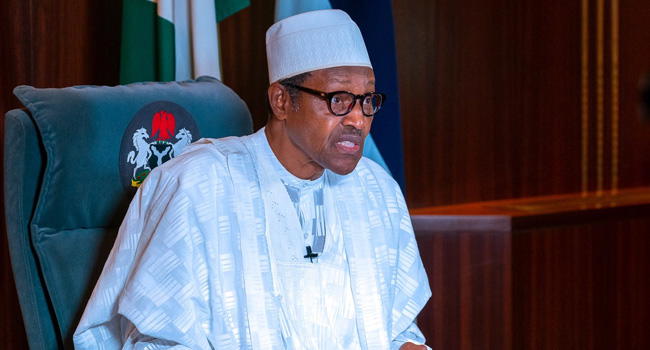
President Muhammadu Buhari
By Victoria Ojeme
The Centre for Democracy and Development (CDD), an Abuja-based policy advocacy and research organisation says President Muhammadu Buhari is complicit in his own corruption fight through the appointment of Abacha-era officials as members of his government.
Buhari in a recent publication in Newsweek had suggested that late General Sani Abacha, Nigeria’s late military Dictator, stole close to $1bn between 1993 and 1998. He also served under the late Abacha as head of Petroleum Trust Fund.
The Director of CDD, Idayat Hassan, said allthough President Buhari has appointed some capable technocrats to top jobs, he has also appointed many individuals of questionable integrity to key positions.
“For example, several members of his second term cabinet—particularly a few former governors and officials with close Abacha ties—are widely seen as lacking integrity. In 2017, Buhari controversially reinstated a top pensions official even though he was facing prosecution by the EFCC on corruption charges. Similarly, President Buhari did not timely suspend the former Secretary to the Government of the Federation, Mr. David Babachir Lawal from office, despite indictment by the Senate over alleged breachesin the handling of contracts awarded by the Presidential Initiative for the North East. The failure to timely suspend erring appointees pending investigations have been replicated in several instances,” the CDD said.
The CDD in the detailed report tagged “Buhari’ Corruption Fight: A Five Year Assessment” said “Buhari’s leadership, the APC has demonstrated the same toxic behaviours and corrupt norms that have characterised Nigeria’s post-1999 electoral politics.”
“Its modus operandi—both in governing and while campaigning—is indistinguishable from its predecessor. The APC has laundered the reputations of many corrupt politicians, some of whom President Buhari has personally endorsed and even campaigned alongside.”
“The President has asked few questions about how the APC funds itself, even though it is common knowledge that candidates depend on stolen public funds provided by political godfathers to fuel election campaigns. Ignoring the APC’s reliance on siphoned public funds to energise its expansive patronage networks, President Buhari has instead positioned himself as their main beneficiary,” the CDD said.
The report suggested that the President still have the tendency to condone corruption within his own ruling All Progressives Congress (APC) party as he “consistently turned a blind eye to malfeasance by some of his own appointees and resisted independent oversight of Nigeria’s most scandal-ridden agencies.”
READ ALSO: PDP spits fire, gives reason Buhari could not address Nigerians on May 29
While acknowledging these genuine achievements, it is clear that President Buhari’s overall anti-corruption record has been undercut by several significant shortcomings. Many stem from his government’s failure to actualise and systematise broader transparency and accountability gains over the last five years.
CDD specifically singled out the Nigeria National Petroleum Corporation (NNPC), and the Central Bank of Nigeria (CBN) as among the key agencies stinking with corrupt practices.
CDD also alleged that there is absence of transparency in the usage of security votes to further buttress it’s assertion that corrupt practices is well entrenched in the polity.
It noted: “Another shortcoming identified by the Five Year Assessment is the failure of the government to achieve the required reforms in the petroleum sector.
“President Buhari who doubles as the Minister of Petroleum Resources, the assessment avers bears personal responsibility for his government’s failure to undertake basic, and long overdue, reforms to the Nigerian National Petroleum Corporation (NNPC).
The report reads: “Widely seen as one of the most corrupt and mismanaged national oil companies in the world, the NNPC continues to conceal illicit financial outflows from public or legislative scrutiny, inflate internal administrative budgets and withhold oil revenues from the national treasury.”
Added to the other shortcomings outlined in the assessment, is the issue of declining fiscal transparency on the watch of the President. The assessment notes that the CBN exemplifies this shortcoming as it has become less transparent and more vulnerable to political influence on fiscal and monetary policy.
“The assessment bemoaned the situation wherein “the bank’s oversight role has diminished and the relationship between it and the nation’s commercial banks has become too cozy. Since 2015, sales of discounted foreign exchange to privileged recipients have become more opaque than ever before.”
On the vexed issue of opaque use of security votes, the administration gets the whip for the use of corruption-prone slush funds. Still on the issue of security sector corruption, the assessment knocks the President for failure to curb defence and security corruption. The assessment asserts that expenditures in the defence and security sector continue to escape public and legislative scrutiny, and mostly occur under emergency procurement processes that lack basic anti-corruption safeguards.
“The government was similarly called out over the continued the practice of awarding crude oil lifting contracts to middlemen firms, including those implicated in the 2010 fuel subsidy fraud scandal.”
The Buhari administration according to the assessment however achieved in the area of securing more corruption convictions. The report however inserts a caveat about the conviction figures; it specifically situates the claims of the EFCC that it recorded over 2,000 convictions since 2015. In giving the context for the figures, the report notes that in 2019 alone the EFCC won over half of these convictions due to a sharp increase in successful cybercrime prosecutions.
Equally noteworthy according to the report is the increased forfeitures of stolen assets to the government.
The assessment notes that in the period under review, the President regularly directed anti-corruption agencies to recover stolen or corruptly acquired assets. The assessment therefore commended the administration for the increasing use of “innovative legal tools to seize suspected proceeds of corruption from former officials who would be difficult and time-consuming to convict. As a result of this strategic shift, more stolen assets are being recovered than ever before.” The report however notes the need for greater transparency in the holding and management of recovered assets.
Among a raft of other recommendations, the report calls on the government to take practical steps to improve transparency and accountability in the budgeting, expenditure and contracting processes. Added to this is the call that government officials and ruling party politicians exerting pressure on anti-corruption agencies and judiciary over corruption cases involving them, to be decisively sanctioned.
To strengthen the processes, and deepen citizens’ engagement with the work of anti-corruption institutions, the report calls for the involvement of technocrats, jurists, and civil society experts as members of the governing boards of the anti-corruption agencies.
Government was equally called upon to submit legislation outlawing security votes at the federal, state and local levels.
The assessment further recommends a ban on the use of security votes, which should be accompanied by transparent and comprehensive budgeting procedures and criteria for security expenditures that meet international best practices and incorporate robust oversight mechanisms.
It also wants the government to mandate ministries, departments and agencies submit all documentation to the Auditor-General of the Federation.
Government was also called upon to invite respected citizen groups working on anti-corruption issues to be involved in interviewing candidates for key strategic positions in the anti-corruption agencies and provide written feedback to the administration on their suitability for such critical roles.
Disclaimer
Comments expressed here do not reflect the opinions of Vanguard newspapers or any employee thereof.