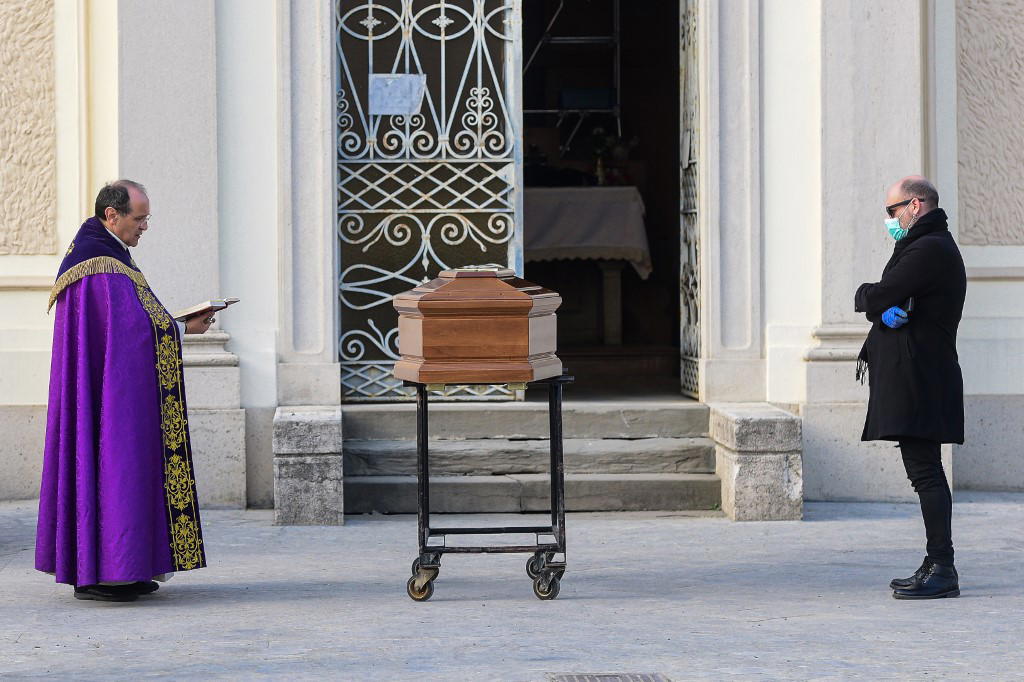
A man wearing a face mask (R) stands by the coffin of his mother as a priest reads prayers during a funeral service in the closed cemetery of Seriate, near Bergamo, Lombardy, on March 20, 2020 during the country’s lockdown aimed at stopping the spread of the COVID-19 (new coronavirus) pandemic. (Photo by Piero Cruciatti / AFP)
The coffins are sealed directly at the hospital morgue near the tiny Italian town of Revello on the French border.
Everyone in Revello understands it is safer that way since so many of those who have died across Italy’s pandemic-hit north first contracted the novel coronavirus.
The tradition of families passing by open caskets to say silent farewells to the deceased at churches or at funeral parlours has been abandoned.
“It is much more difficult, emotionally,” Revello’s funeral parlour owner Gianpiero Palmero told AFP.
Large funerals have been banned in Italy for more than a month because of the new illness that has officially killed more than 26,000 people in the Mediterranean country since February.
The real toll is unknown since many of those who pass away in old age are never tested for the virus.
The rushed funeral arrangements mean grieving families have almost no time to say their final goodbyes.
READ ALSO: South Korea’s big churches reopen with designated seats, size limits
Palmero takes it personally.
“We really are living in abnormal times,” Palmero says. “There is more demand for our services.”
Italy is cautiously approaching the moment when it is ready to lift some of its harshest restrictions on everyday life.
People might be allowed to walk the streets freely starting on May 4.
Mores stores and churches will probably reopen.
And weddings and funerals might soon again involve more than just the pastor and immediate family members.
But Italy is not there yet — and Palmero still collects his bodies at the hospital in nearby Saluzzo.
“The bodies are already wrapped in a shroud,” he explains. “We put the body in the coffin and seal it immediately.”
Social distancing measures are even observed at the crematorium. Only one person is allowed inside at a time.
Not catching or spreading the virus is the overriding consideration in Palmero’s business.
“There are no more real funerals,” he laments.
Disclaimer
Comments expressed here do not reflect the opinions of Vanguard newspapers or any employee thereof.