By Luminous Jannamike
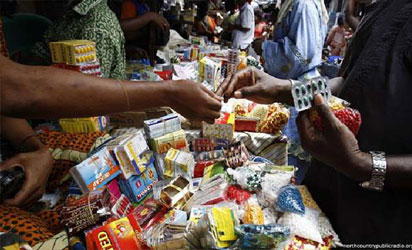
ABUJA – West Africa Health Organization, WAHO, has said up to 30 percent of medicines and treatment products circulating in Nigerian markets are falsified and substandard.
WAHO’s Director-General, Prof. Stanley Okolo, stated this at the opening session of the 3rd African Medicine Quality Forum, AMQF, in Abuja on Tuesday.
Okolo, who blamed the menace on Nigeria’s hitherto porous borders, made case for local manufacture of drug products as a panacea.
READ ALSO: NAFDAC calls for stiffer punishment for drug traffickers
He also lamented that 70 percent of drugs needed for the treatment of common ailments were still being imported into the country.
“We estimate that up to 30 percent of drugs in circulation are substandard and falsified. The chief reason for this has to do with the porosity of our borders.
“Added to this; is the fact that we import nearly 60 – 70 percent of drugs we require for common medical conditions,” the WAHO DG said.
In his keynote speech, Minister of Health, Dr. Osagie Ehanire, reiterated the Federal Government’s commitment towards ensuring only safe and efficacious drugs were available in the country.
To this end, he said medicine control laboratories were being established nationwide through the National Agency for Food, Drug, Administration and Control, NAFDAC.
The Minister said, “We operate, at present, seven medicine control laboratories under NAFDAC; four of which are ISO 17025 accredited.
“More laboratories will be commissioned in 2020 as we work towards achieving World Health Organization, WHO, pre-qualification of all of them,” he assured.
Also, Sen. Ibrahim Oloriegbe, the Senate Committee Chairman on Health, said
the establishment of Africa Medicine Quality Forum, AMQF, as a continental organisation to pursue the eradication of substandard and falsified medicines was a long awaited opportunity that must be seized by Nigeria and made good use of.
According to him, the coming together of the medicine control laboratories of the national regulatory authority in Africa would ensure collaboration in fighting substandard and falsified medicines across the continent.
Stressing that the quality of medicine used by the people to cure or manage ailments was key element in the nation’s healthcare delivery system, Oloriegbe assured that the National Assembly would continue to provide necessary support for NAFDAC to attain the required world standard as a regulatory body.
On his part, Inuwa Abdulkadir, the Chairman of NAFDAC’s governing board, urged the AMQF to not only develop a strategy to ensure quality control of medicines but to also look at the issue of illicit drugs as it affects internal security of States in Africa.
Disclaimer
Comments expressed here do not reflect the opinions of Vanguard newspapers or any employee thereof.