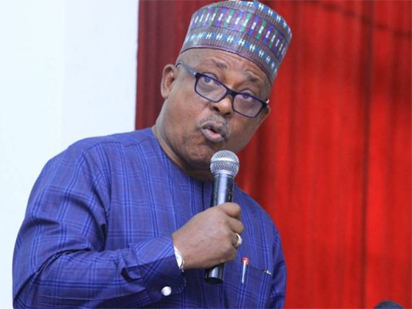
Uche Secondus
By Dirisu Yakubu
When in December 2017, delegates from the 36 states of the federation and the Federal Capital Territory, FCT, elected Prince Uche Secondus as national chairman of the Peoples Democratic Party, PDP; not a few expressed confidence in his capacity to reposition the party ahead of the 2019 general elections.
EDO 2020: Ize-Iyamu’s yawning defection to APC
An experienced party administrator armed with deep knowledge of the intrigues and characters that led to the defeat the PDP suffered in 2015; the chairman wasted no time in declaring publicly that the National Working Committee, NWC, he chairs, would be guided by strict adherence to rules and guidelines stipulated in the party’s constitution.
Wadata, the party’s national secretariat, he told whoever cared to listen, would have no help to give anyone, even as he enjoined all those seeking one elective office or the other to go back to their wards and interface with their people.
Not unaware of the failure of past leadership of the party, Secondus announced the death and internment of the twin evil of impunity and imposition, adding that for the party to move forward, internal democracy must be allowed to take its pride of place.
The elections have come and gone with different tales left on the lips of Nigerians but how did Secondus fare? Is the party he inherited stronger today than it was two years ago?
Reconciliation of aggrieved members
A few months on assumption of office, Secondus appointed Bayelsa state governor, Seriake Dickson chairman of the party’s Reconciliation Committee with a mandate to interface with aggrieved elements who for one reason or the other, left the PDP. From its formation in 1998, anyone who had a genuine reason for leaving the party must be listened to, Secondus charged the Dickson-led committee.
In sync with the Contact and Mobilization Committee chaired by former Cross River state governor, Liyel Imoke; Dickson and his colleagues made a success of their assignment, culminating in the return into the party’s fold of some of the leading politicians in the land. Former Vice President, Atiku Abubakar, the then Senate President, Bukola Saraki, ex-Kano state governor, Rabiu Kwakwanso, and business mogul, Datti Baba-Ahmed all returned home ahead of the 2019 polls.
Perhaps, the biggest harvest for the PDP was the home coming of Abdulfatai Ahmed, Aminu Tambuwal and Samuel Ortom, governors of Kwara, Sokoto and Benue states respectively. Having three states without a fight cemented Secondus’ place as a grandmaster of political engineering despite the challenges of competition for an opposition party in a developing democracy.
Presidential Primaries
Ahead of the Presidential primaries which held in Port Harcourt, the Rivers state capital, bookmakers had predicted an imminent implosion of the PDP, considering the calibre of personalities in the race. Apart from the former Vice President, Bukola Saraki, Rabiu Kwankwaso, Sule Lamido, Ahmed Makarfi, Attahiru Bafarawa, David Mark, Tanimu Turaki, Datti-Ahmed, Jonah Jang, Aminu Tambuwal and Ibrahim Dankwambo all vied for the sole ticket which was eventually won by Atiku.
A few days to balloting, feelers had it that the host, Governor Nyesom Wike had settled for his Sokoto counterpart, with analysts immediately predicting an outright victory for Tambuwal.
However, Secondus’ pledge of non-interference in the process, led to the emergence of Atiku in a delegate election described by local and international observers as one of the most credible in the political history of the nation.
North Korean leader ‘skips’ set-piece New Year’s speech
2019 general elections
Fighting a party in power, particularly in emerging democracies is always a challenging task. In “War, Guns and Votes: Democracy in Dangerous Places”, Oxford Professor of Economics, Paul Coulier, highlighted the challenges of free and fair polls in the context of the weak versus the strong party. Always ready to deploy state resources in its favour, opposition parties often realise at the eleventh hour that a level playing field is more an academic phrase than a practical reality.
Heading to the polls in 2019 with eleven states in the kitty, many expected the All Progressives Congress, APC, to make a clean sweep of the states, having been in power for four years. However, the PDP won additional states including Oyo, Zamfara and Adamawa, taking its total share of the states to 15. In a telling fashion, the party beat the APC in the Federal Capital Territory, FCT.
Presidential Appeal and Supreme Court judgments
In spite of its decent showing across the states of the federation, Atiku lost the election to President Muhammadu Buhari in the February 23 poll; a declaration that was rejected by the candidate and the party. In seeking redress first at the appellate and later at the Supreme Courts, the PDP advanced reasons to justify its position even as it called witnesses to avail the public of the manner elections held in disputed areas of the country. Apart from the election itself, the PDP challenged the President’s eligibility for the poll and raised questions for the umpeenth time, about his General Certificate of Education, GCE.
The PDP lost at both courts but counsel to Atiku, Levi Uzougwu, SAN, fired a parting shot when cornered by journalists, saying “the verdict has defined our electoral jurisprudence one way or the other.”
With the case over, Secondus’ called on party members and supporters nationwide to remain calm, urging them to be proud of their sacrifice and love for the country.
In series of meetings aimed at deliberating on the outcome of the Presidential petition, leaders of the party with Secondus as the arrowhead quickly resolved to look ahead to the next election cycle to again, stage a fight to return to the centre.
Battle of 2023
The next general elections are over three years away but for Secondus and his legion of army intent on returning to Aso Rock; preparations ahead of the big test has commenced in earnest.
Only recently, chairman of the party’s Board of Trustees, Senator Walid Jibrin told journalists in Kaduna that the PDP is set to commence a search for its Presidential flagbearer ahead of 2023.
Already, talks of retaining the Presidential ticket in the North are rife, even as the NWC insists it is yet to meet over the sensitive issue. Although Atiku had a great showing in 2019, pundits argue that retaining the ticket in the North is the surest bet for the PDP to return to the Presidential villa, as the APC appears to have resolved to look in the direction of the South following President Buhari’s two consecutive tenures, the second, expected to come to an end in 2023.
2020 Budget: Senate considers N232.8bn for FCT
The PDP national chairman is aware of the enormous task ahead and one of his first major challenges is how to tame the excesses of some governors who see themselves as being more powerful than the platform they rode to fame and national reckoning.
Disclaimer
Comments expressed here do not reflect the opinions of Vanguard newspapers or any employee thereof.