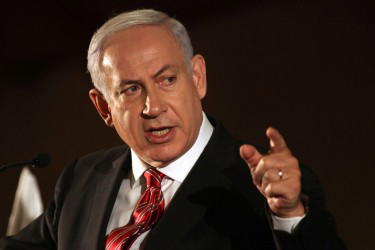
Benjamin Netanyahu, Israeli Prime Minister
Israeli Prime Minister, in a meeting with a senior United States delegation on Monday, mentioned that Iran is planning to launch precision-guided missiles at Israel from Yemen.
Netanyahu does not release much details on the discovery but this is a signal that the war-torn Gulf Arab country could come under pre-emptive Israeli attack.
Neither Iran nor the Yemeni Houthi fighters it sponsors had an immediate response to Israel’s allegation. The Houthis use missiles and drones in their war against a coalition led by neighbouring Saudi Arabia but there is a scant public indication they possess weapons capable of travelling some 2,000 km (1,240 miles) to Israel.
“Iran wants to develop precision-guided missiles that can hit any target in Israel within five to ten meters,” Netanyahu said in a speech in Jerusalem.
ALSO READ: Iran’s supreme leader wants further withdrawal from nuclear deal
“Iran hopes to use Iran, Iraq, Syria, Lebanon and Yemen as bases to attack Israel with statistical missiles and precision-guided missiles. That is a great, great danger,” he said.
Earlier, addressing reporters ahead of meetings with U.S. Treasury Secretary Steven Mnuchin and top White House adviser Jared Kushner, Netanyahu reiterated Israeli suspicions, shared by Washington, that Iran has been trying to refit the rocket arsenal of Lebanon’s Hezbollah with precision-guidance systems, Reuters reported.
“They seek also to develop that, and have already begun to put that in Yemen, with the goal of reaching Israel from there too,” said Netanyahu, who has urged the Trump administration to step up sanctions on the Iranians over their nuclear program and regional activities.
Aides would not elaborate on whether Netanyahu, in his remarks with Mnuchin at his side, meant to say that missile-conversion facilities were being installed in Yemen or that missiles capable of reaching Israel were already there.
ALSO READ: Netanyahu fails to secure majority coalition, door open for Gantz
An Israeli government source held out the prospect that Israel could take action. “This will cause Israel to be extremely vulnerable and this is something that we cannot just sit by and watch happening,” the source told Reuters.
With Israel in political deadlock after inconclusive elections in April and last month, Netanyahu has cited growing security concerns in urging his strongest rival, ex-general Benny Gantz, to form a broad coalition government.
“This is not a spin, this is not a line, this is a real thing that is happening as the power balance in the Middle East changes,” Netanyahu said. “We need a national unity government.”
Israel’s armed forces chief briefed Gantz about regional threats on Oct 16 and, last week, issued a public statement describing Israel’s northern and southern fronts as “tense and fragile and (liable to) deteriorate into conflict”.
ALSO READ: Facebook blocks Netanyahu’s chatbox for election violation
When Israel refers to its northern front, it means Lebanon and more easterly Syria. “Southern front” usually refers to the Gaza Strip, in the southwest, where Hamas and Islamic Jihad militants receive Iranian funds. Yemen is to Israel’s southeast.
A senior Iranian military official, Abbas Nilforoushan, told the Tasnim news agency on Sept 28 that Iran had “surrounded it (Israel) from east, west, north and south”.
Israel has signalled willingness to broaden its military campaign against suspected deployments by Iranian-fighters within striking distance of its borders. In addition to hundreds of Israeli bombing runs in Syria, Iranian-linked militias have accused Israel of carrying out attacks within Lebanon and Iraq.
Disclaimer
Comments expressed here do not reflect the opinions of Vanguard newspapers or any employee thereof.