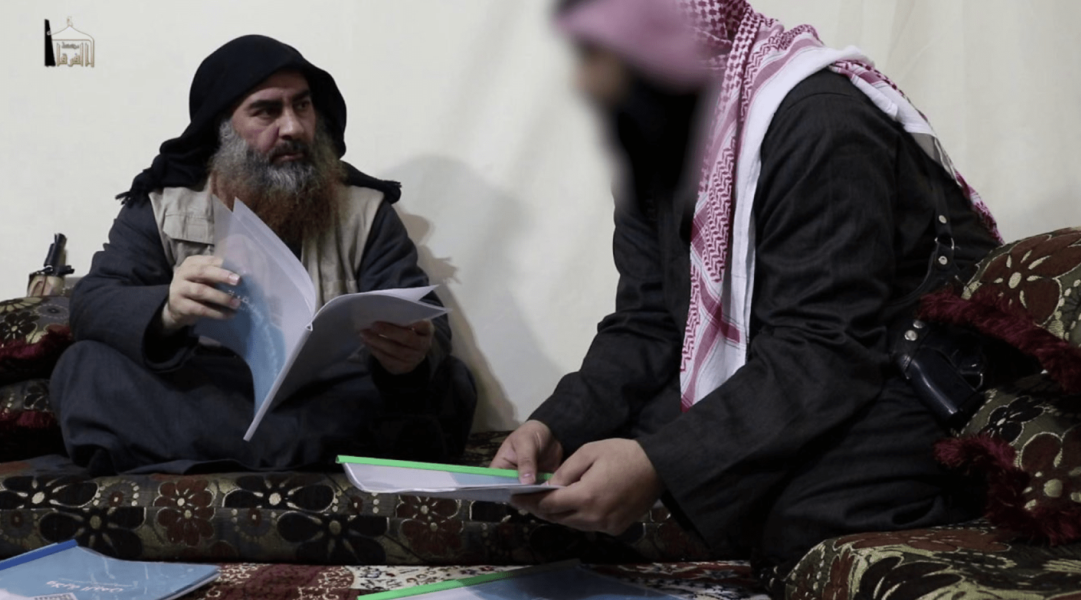
al-Baghdadi
Abu Bakr al-Baghdadi after many years of being erroneously killed was confirmed dead by the United States President, Donald Trump on Sunday.
Baghdadi although described by Trump to have died “like a dog” was reported to have killed himself by detonating a suicide vest after he was cornered in a dead-end tunnel in northwestern Syria, killing three children along with him.
“The thug who tried so hard to intimidate others spent his last moments in utter fear, panic and dread — terrified of the American Forces bearing down,” Trump said.
How did the onetime religious scholar and soccer player became a terrorist and ended up being the “much cleverer” leader of the ISIS group?
How ISIS started
The first thing to note for anyone interested in the history ISIS is knowing that it never started with the name. In fact, throughout its existence, the group has been called by different names including, IS, ISIL, and Daesh.
ISIS was a group started when an organisation called “al Qaeda in Iraq” was formed in 2004 by Abu Musab al-Zarqawi, a former member of Osama bi Laden’s al Qaeda Network.
The group was started with an agitation to displace Western occupation and replace it with Sunni Islamist regime.
ALSO READ: Kentucky special forces commander who led killing of ISIS leader, Al-Baghdadi
The leader of the group, al-Zarqawi was in 2006 killed by a U.S. airstrike after which a new leader was named to replace him. The new leader was no one but an Egyptian called Abu Ayyub al-Masri.
Masri renamed the group as “ISI” an acronym of “Islamic State of Iraq”.
Masri was killed in a US-Iraqi operation in 2010 after which Abu Bakr al-Baghdadi took over the role of leadership of the group.
Although founded in Iraq, the group took advantage of the civil war in Syria which started on 15 March 2011.
The group overpowered the Syrian forces to claim some region of Syria and in 2013 decided to rebrand as “Islamic State of Iraq and Syria (ISIS)”.
The new ruler and new law
ISIS in no time expanded its influence throughout Syria and Iraq. It focused on creating an Islamic state where sharia law is implemented.
Sharia law is a traditional Islamic rule often with stricter penalties for offences.
ISIS caliphate
A simple Google dictionary search of “caliphate” will return “the chief Muslim civil and religious ruler, regarded as the successor of Muhammad. The caliph ruled in Baghdad until 1258 and then in Egypt until the Ottoman conquest of 1517; the title was then held by the Ottoman sultans until it was abolished in 1924 by Atatürk.”
ALSO READ: Here’s how U.S. forces tracked down, killed ISIS Leader al-Baghdadi
In 2014, ISIS declared itself a caliphate after invading and claiming Falluja, Mosul, and Tikrit in Iraq.
ISIS fighters attacked a northern town in Iraq that was home to the Yazidis, a minority religious group, in August 2014. They killed hundreds of people, sold women into slavery, forced religious conversions and caused tens of thousands of Yazidis to flee from their homes.
The attack sparked international media coverage and brought attention to the brutal tactics employed by ISIS. Also in 2014, al Qaeda broke ties with ISIS, formally rejecting the group and disavowing their activities.
Baghdadi preparation for power
Frontline documentary explained how Baghdadi prepared himself for the role of ISIS leader and developed what the documentary described as “ISIS playbook: fomenting sectarian violence among Muslims, stepping in to take advantage of power vacuums, and broadcasting brutality far and wide on the Internet.”
It all started in a U.S. prison in Iraq during the early days of the American occupation. The prison contained Iraqis captured by the U.S. troops. It is the same prison referred to as “jihadi universities” later.
In prison, Baghdadi was “able to network with other committed jihadists, capable jihadists that were attached to major organizations like Al Qaeda in Iraq, and he begins to network with these men, many of whom he would rise with through the ranks of Al Qaeda in Iraq, later the Islamic State,” Will McCants, author of The ISIS Apocalypse, told FRONTLINE in the film.
ALSO READ: ISIL appoints ‘Qardash’ new leader after Abu Bakr al-Baghdadi’s death
After his release, Baghdadi moved up inside Zarqawi’s organisation, drawing on what he had learned in prison. Once American forces left Iraq in late 2011, what was left of Zarqawi’s group — then isolated in northern Iraq — began to rebuild under Baghdadi’s leadership. And soon, as the film traces, Baghdadi secretly sent agents into Syria to help fuel civil war, carrying out a wave of bloody car bombings that announced the insurgent group’s presence.
“He wanted to establish the caliphate now. He wanted to take over towns, villages, and then cities. The border between Iraq and Syria could disappear if his organization controlled both sides of the border,” Richard Clarke, author of Against All Enemies, told FRONTLINE. Baghdadi succeeded, taking the unprecedented step of declaring this new territory a caliphate — with himself at the helm.
ISIS publicity
ISIS became recognised around the world for carrying out heinous acts of violence, including public executions, rapes, beheadings and crucifixions. The group has earned an nefarious reputation for videotaping brutal killings and displaying them online.
One of the first widely publicised acts of ISIS violence happened in August 2014, when a few of the group’s militants beheaded U.S. journalist James Foley and posted a video of the bloody execution on YouTube.
ALSO READ: Revealed! See 7 ISIS members responsible for Sri Lanka bombing
About a month later, ISIS released another video that showed the beheading of U.S. journalist Steven Sotloff. A series of gruesome videos showing the beheadings of kidnapped journalists and international aid workers followed for the next several months.
In February 2015, ISIS released footage of Jordanian military pilot Moath al-Kasasbeh being burned alive in a cage. The same month, an ISIS video showed militants beheading 21 Egyptian Christians on a beach in Libya.
Images of a man being thrown off a building in Syria were made public in March 2015. ISIS claimed to have killed the man because he was a homosexual.
Numerous other videos and images documenting brutal executions have been released and attributed to ISIS.
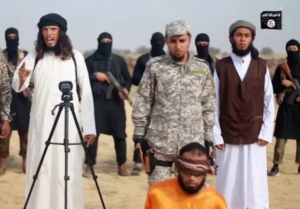
Islamic State militant group (ISIS) fighters threaten Palestinian militant group Hamas in this screen-grab from a recent propaganda video. The Egyptian wing of ISIS has declared war on Hamas for failing to stop President Donald Trump’s Jerusalem declaration. PHOTO: Site Intelligence
Chronicle of ISIS attacks
ISIS has also claimed responsibility for hundreds of terrorist attacks in the Middle East and around the world. Some of the most well-known attacks on Western soil that were linked to ISIS include:
- November 2015, Paris Attacks: In a series of attacks, bombers and shooters terrorized the streets of Paris, killing 130 people.
- December 2015, San Bernardino Attack: A married couple opened fire at the Inland Regional Center in California and killed 14 people.
- March 2016, Brussels Bombings: Bombings at Brussels Airport in Belgium and a nearby Metro station killed 32 people.
- June 2016, Pulse Nightclub Shooting: A gunman opened fire inside a gay nightclub in Orlando, Fla., and killed 49 people.
- July 2016, Nice Attack: A terrorist driving a truck mowed down a crowd of people in the French Riviera town, killing 86.
- December 2016, Berlin Attack: A man hijacked and drove a truck into a Christmas market in Berlin, killing himself and 11 others.
- May 2017, Manchester Attack: A single suicide bomber killed 22 people during an Ariana Grande concert at the Manchester Arena in England.
ALSO READ: Buratai’s soothing balm and the courage to fight on
Historical sites are not spared
Since about 2014, members of ISIS have destroyed numerous historical sites and artefacts throughout Iraq, Syria and Libya.
The group claims cultural monuments, statues and shrines are idolatrous and shouldn’t be worshipped. However, several news investigations have revealed that ISIS has sold and profited from many of these artefacts.
Some of the cultural sites ISIS has attacked or destroyed include:
- Ancient ruins, monuments and buildings in the cities of Hatra, Nimrud, Khorsabad, Palmyra and others
- Iraq’s Mosul Museum and the Mosul Public Library
- Various churches, temples, mosques and shrines throughout the Middle East
ISIS Funding
ISIS has been called the richest terrorist organization in the world. While estimates vary, the group was said to have made $2 billion in 2014 alone. Much of ISIS’s money has come from seizing control of banks, oil refineries and other assets in the territories it occupies.
ALSO READ: ISIS target believed to be Abu Bakr al-Baghdadi reportedly killed in Syria
The group has also used kidnapping ransoms, taxes, extortion, stolen artifacts, donations, looting and support from foreign fighters to fill its coffers.
However, a report released in 2017 by the British International Centre for the Study of Radicalisation (ICSR) revealed that ISIS financial revenue has dropped dramatically in recent years.
War Against ISIS
In response to ISIS violence, various countries including the United States, France, the United Kingdom, Russia, several Arab nations and other countries initiated efforts to defeat the terrorist group.
In 2014, a U.S.-led coalition started airstrikes against ISIS targets in Iraq and Syria. That same year, the Pentagon announced a program to train Syrian rebels to fight against ISIS. However, this initiative was nixed a year later when only about 150 rebels were recruited.
The United States has primarily used targeted airstrikes and special operations forces to fight ISIS. In 2015, President Barack Obama announced that the U.S. had launched nearly 9,000 airstrikes on ISIS.
The United States military dropped its most powerful non-nuclear bomb on an ISIS compound in Afghanistan in April 2017.
ALSO READ: As ‘caliphate’ ends where is its leader Baghdadi?
Reports have suggested ISIS has weakened both militarily and financially. The group has lost control of large amounts of territory in Iraq, and several of its leaders have been killed or captured, including the May 2018 arrest of five top ISIS officials in Syria and Turkey.
While notable gains against ISIS have been made, international efforts to control this powerful terrorist organization will likely continue for many years. Why?
ISIS renamed new leader
Within 24 hours of the death of its leader, al-Baghdadi, ISIS has reportedly named a new leader, Abdullah Qardash.
Qadash is nicknamed “The Professor” or “The Destroyer”. He is believed to be a former officer in Saddam Hussein military and forged an alliance with al-Baghdadi in prison before becoming his enforcer and chief policymaker.
[Contribution from: History, Frontline and DailyMail]
Disclaimer
Comments expressed here do not reflect the opinions of Vanguard newspapers or any employee thereof.