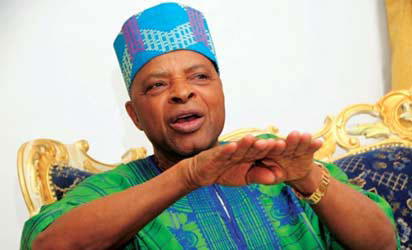
Lt-Gen Alani Akinrinade
Gowon not tough on commanders
Debate over 2023 sign of looming trouble
Elder statesman, Gen Alani Akinrinade, retd, who is 80 today, in this interview, reflects on his stewardship to Nigeria, ponders the state of the nation and expresses fears about what the future holds. Akinrinade, a civil war hero, gives the untold account of real reasons his terms as the Chief of Army Staff and Chief of Defence Staff were short. If you want to know why certain things happened during the Nigeria-Biafra War, read this account of a man, who alongside Gen Alabi Isama ,retd, authored the strategy that ended the war
By Charles Kumolu, Deputy Editor
What does becoming an octogenarian mean to you?
If you go through a few bumps in life, you will start appreciating life. Clocking 80 is a real blessing to me.
You escaped death during the civil war and the regime of the late Gen Sani Abacha. You are 80 today. Did you ever entertain the fear of not clocking 80?
Every soldier is always prepared to check out at any time whatever the circumstances are. When I said clocking 80 is a blessing, I meant that I crossed many hurdles in life like the ones you mentioned. I spent nine months in the hospital because of a bullet wound I sustained at the war front. I went through eight corrective surgeries and when I came out of it, I didn’t feel like I lost anything. It is a way of life for soldiers and every soldier should know that the possibility of losing his life anytime is there. What one should pray is that even if he loses his life, it should be for a good cause, not incidents like getting killed by armed robbers.
General Alani Akinrinade
What have you not told anyone before about why opted for the Army?
If I say that becoming a soldier was deliberate, I am being economical with the truth. As a young person, I loved Boy Scout. In primary school, our teachers taught us that a Scout is to be trusted. I used to see my uncle, who went to Burma and I admired him. He was a hunter and looked like a brave man to me. The things he told us he saw in Burma made me admired his bravery. After the Second World War, soldiers used to move around in our village. Their smartness left an impression on young people at the time. We felt that if they could be that smart, we could be smarter. In secondary school, my life was an outdoor life. When I left secondary school, I was at UTC Ibadan and saw some young officers who were shopping. I summoned the courage to talk to them to know who they were. They were just very smart. I was at the Ministry of Agriculture when I saw an advert for recruitment in the newspaper and felt that joining the army would not be a bad idea. It was not just a deliberate thing. In the advert, they stated that we would be trained in Nigeria and abroad. It was also stated that we would earn six pounds per annum. If it had not made it, I would have gone back to sit for my A-Level. For me, there was really nothing to lose, it was a gamble that was worth it.
Of the 35 who went for the military training, 15 made it and you were among. How was it possible for you to be among them?
The selection board was very strict. I can say that I was better than the 20 who didn’t make it. I think it was because we had only 15 vacancies. Five people were sent to Sandhurst while 10 were sent to Mons Officer Cadet School. There were people among the 20 who could have made good officers. There was also a chance for those who failed to go to the army as corporals because of the training they had. I don’t think many of them stayed. They all went back to school.
In your days in the Army, you were recognised as a master strategist. You were credited to have advised the federal troops against crossing the River Niger and other missions. What is it about you?
It was not because anyone is smarter or cleverer. When issues came to a head, I stood my ground. Where we all differ was that some people were not able to stand their ground. It is not because they didn’t know but the risks of certain things attached to doing so, scared them away. During the civil war, we were too young for most of the things we were doing. I was only a major when I was already a brigade commander. I should be commanding a company as a major, not even a battalion. But that was the situation we found ourselves. Experience is one thing, knowledge is also very important. Most of us involved in the prosecution had enough knowledge but lacked experience. Some people were not strong enough to stand their ground. I think that was the only difference between others and I. There were a lot of my peers who could have done much better. The problem I had then was that most of the people who could not stand up to speak were my seniors. I considered it as lack of guts. If you know what should be done, stick to it and suffer the consequences. But in my case, most of the people who could have been hard on me were my friends. Even when I left my base for Lagos to meet the Commander-in-Chief (Gowon) he didn’t drive me away. He could have done that. Most of the people making the major decisions then were not properly instructed. We had a hierarchy but the people at the top either in the Army Headquarters or the Supreme Headquarters were not tough on us. They were not putting their feet down to say that people ought not to have done certain things. People just did what they liked at the war front. That was the atmosphere that pervaded at the time.
During your time, did you envisage that soldiers would be in power for a long time?
The Army and politics do not even mix. There was no such thinking. There is a big wedge between the military and political governance.
As someone who played active roles in the Nigeria-Biafra War, could the civil war have been averted?
The soldiers are the worst people to have handled the confused situation we found ourselves at the time. It was a situation that could have been handled through political maneuvering. When the military got involved, they started using force instead of talking to the civilians. The soldiers were in charge when things became very bad and they made the wrong decisions. Those wrong decisions made the war last longer than expected. The problems of that time were political problems that ought to have been solved by politicians. The closest I had gone to a politician before 1964, was when a friend of mine who was a lieutenant and I, visited an uncle of his who was a politician. He also had another uncle who was a parliamentary secretary. One of them had a car which we usually borrowed from him to go to the night club. We did that three times but on the third occasion, we got drunk after partying and slept off at the officers’ quarters. In the morning, our adjutant saw the car which was not a registered car in the barracks. When he made his findings and found out that we parked the car, we were punished. That was the closest I had been to a politician before military incursion into politics. The country would have been different if there was no military rule. The soldiers are not supposed to leave their barracks. It is only when the Police are incapable of performing their functions that the Army would be called to temporarily restore order. We were not trained to sit down in the State House to govern the people. We are part of the people that should be governed.
Apart from the things in the public domain, is there anything you have not said about the shortness of your tenure as the Chief of Army Staff?
It was the Nigerian problem. There was this thing about people looking for who they know and who they can trust. There was the argument that a Yoruba man should not be made the Chief of Army Staff at the time.
Was that also the reason, the late Brigadier General Ogundipe did not succeed Gen Aguiyi Ironsi as the most senior military officer at the time?
It was the confusion that drove the politicians out of governance and brought the military. There was a continuation of that struggle. It was a struggle between the Yoruba, Igbo, and Hausa. Later they said it was Hausa-Fulani. It was just a continuation of the mistrust among the people at the time. The armed forces hemorrhaged more than any other institution at the time because of that problem.
Talking about the surrender of Biafra, what led to it? And how true is that Major Tomoye and you, were the ones Biafrans surrendered to at Amichi, not Obasanjo?
Gen Alabi Isama’s account was correct. Alabi was in the 3rd Division but things became tough. Both of us decided to leave the 3rd Division because we had enough of Adekunle. We also thought that leaving him there was unfair because Adekunle fought so hard and was so dreaded. But the law of diminishing returns naturally set in and he started getting irrational. When you are commanding human beings, each time you make a mistake, it costs human lives. That kind of mistake is even worse than a political mistake. That was the reason we decided that if the Commander-in-Chief was not removing us, we would leave. We now persuaded the Commander-in-Chief to change him and bring Gen Obasanjo. We went to Ibadan to convince Obasanjo to take over the 3rd Division from Adekunle. We told him that if anyone else who is not Yoruba took over the 3rd Division, the person would not succeed. Unfortunately, that was the setting at the time. These are dirty stories. Gen Obasanjo agreed and came. I think he was scared to have Isama and I with him. He knew me a little better than Isama. He asked that Isama be posted out. That was how Isama left for the 1st Division.
Ending the war
The tactics we finally used in ending the war was a document that Alabi Isama and I prepared. We spent days and nights preparing it because the last time we were with Adekunle, he showed that he was becoming distrustful of us. He was not happy with some of the things he thought we were doing. He felt that we no longer believed him. That was how he posted us out of his headquarters. Alabi Isama was in the 3rd Sector while I was in the 2nd Sector. That was another mistake he made. The two sectors were adjacent to each other. Alabi Isama was in Uyo, I was in Aba. Ayo Ariyo, who was our classmate but much older than us was in Calabar. He put someone else in the 1st Division. The person was our senior but we didn’t get along with him. I served with him in the 2nd Division. When I quarreled with my GOC he was there sitting down and said nothing. They were just sitting down and allowing the GOC to do whatever he wanted. When he ended up in the 3rd Division, I didn’t want to do anything with him. What they didn’t know was that we had stabilised our side. It was the work both of us had done that we used in ending the war. We told ourselves that finishing the war was not difficult. We presented the plan to Adekunle. Whether he studied it or not, we were not sure. All he wrote on the plan was “this is tactics lesson one, when are my expecting the next tuition?” That was how we left him and returned to our sectors. It was the plan that we brushed up and we didn’t tell Obasan that we were going to execute it. We went ahead to execute it because we were tired of being in the front. It was a war that should have lasted for one year. But it lasted for 30 months. That was why he knew so much about what we did even though he (Obasanjo) was no more there. Tomoye was there.
As an actor, what were the lessons you learned from the war?
War should be the last thing on anybody’s mind. Recently I read articles where some people said they want Yoruba nation while Indigenous People of Biafra , IPOB, said it wants Biafra. Why can’t we sit down and discuss the contentious issues? Telling me that they want to fight a war is unbelievable. I don’t know of any country that survived two civil wars. Did they see the carnage brought by the last one? Are they saying that things won’t be worse than the last one if we start another war?
When you retired at 41 in 1981 one of the reasons you left the Army was your disappointment over what you termed the failure of the Shagari government to foster a better relationship between the Army, Air Force and Navy. You said it is the responsibility of the Chief of Defence Staff to moderate what was happening in the armed forces. Today, there are reports about rivalry among the leadership of these major components of the armed forces to the detriment of the security of lives and property. What can you say about that?
I think they cooperate among themselves. I know they have task forces. They are efficient to the extent of equipment and training they get. I was the first Chief of Defence Staff. Things ought to have been laid down. It is the first line to advice the Commander-in-Chief. The Commander-in-Chief has free access to all his service chiefs. In the case of then-President Shehu Shagari, he was not an ex-soldier. He was never in the armed forces. It would be bad if his Chief of Defence Staff does not protect it. It was important for his Chief of Defence Staff to know what was really going on to be able to make decisions that would make everyone live safely. The Chief of Defence Staff was supposed to regulate other service chiefs but for him to start calling the chiefs by himself and buying equipment for them, was something that could lead to a wrong result. These are the jobs of the Chief of Defence Staff. Saying that because you have a personal relationship with the Chief of Army Staff, you would bypass the Chief of Defence Staff is wrong. If he comes to you at night and says that he wants to buy three hoes and five cutlasses? Would you accept that because he is your boy? I don’t like to sit back and watch things go the wrong way. I couldn’t have done that or assumed that it is their business. It is the business of all of us. When the trouble starts, all of us would be in trouble. Sometimes, civilian governments feel their Chief of Staff is very pompous. There was even the feeling that one was an Awolowo boy. I had the time to appropriately inform all of them that I was leaving. I went to the house of the Commander-in-Chief to inform him that I was leaving. He said no and asked people to persuade me to stay. I really didn’t know why I had to stay. He finally agreed and said he was not happy that everybody he sent to me did not succeed in convincing me. Nobody was there when I decided to join the Army, why should you make it your business when I decided to leave? When Shagari told me that he was not happy I was leaving, I also told him I was not happy.
On Shagari
I told him that I saw them as a band of people who want to get together and commit suicide. I added that I was not ready to commit suicide with anybody. I thought that would have opened the vista for a big discussion between both of us but he didn’t ask any question. On the day I was leaving, he graciously gave me a luncheon that had the National Party of Nigeria, NPN, chieftains in attendance. I asked him if he would permit me to make a remark and he obliged. I wrote a three-minute speech because I wanted it to be documented. I thanked everyone and told him that I enjoyed working with him. I told him that I delivered on the mandate he gave me. I succeeded in keeping the soldiers in the barracks. I said the only thing that was going to keep them in that barracks was good governance. Some people were not too happy I said such a thing but I felt that there was no need holding anything back.
In 1976 when Dimka killed the Head of State, Gen Murtala Mohammed, you made a statement that foiled the coup. You were credited to have said that what was happening in Lagos didn’t affect other parts of Nigeria. How were you able to do so during those tensed moments?
I feel one should be able to live with his conviction. If that is what people call courage, I don’t agree. It is a matter of me telling you where I stand on any issue. There were a lot of stories about the incident that people didn’t actually get right. I was in Lagos for a conference and the event was to start at 10 am on the day of the coup. Alabi Isama and I were supposed to make a presentation at the conference because he was the Principal General Staff Officer in the Army. I was only a GOC in Kaduna. He was to make the presentation but he asked me to work on the script. I had seen the draft and we agreed that I would be in the office before 6:30 so that we can conclude. That was the reason I was in his office that morning. The office was located in Marina. We were there in the morning when we heard a voice on the radio announcing the coup. When we listened carefully, Alabi Isama said: “that is my officer, Dimka.” We knew him very well. We tried to make calls but it was not possible we had to wait till seven. The Chief of Staff arrived early because he was to sit at the conference and needed us to brief him about what we were going to present. We went to his office and told him that there as a coup. He had a radio in his office and heard the news. At that point, he said we needed to get out of the place. There was a debate on whether to operate from the headquarters. We agreed to get out so that we can go and take over the units. The nearest was Bony Camp. Some said we should get into our cars and fly our flags. We felt all the coup plotters would do was to shoot all of us. We decided to go to Bonny Camp. already fed up with him. Now, on the Dimka coup, were there any feelings that some officers could strike against Murtala Mohammed?
No! I was around at the time. I was not around when the first and second coup in 1966 happened. I was not in the country. I was in America, sitting in the classroom without knowledge of what was happening in the country. The day the second coup happened was the day I was supposed to arrive in the country. I had already boarded Pan American Airlines only to find out that we could not land in Lagos. We were not given any reason. Those of us going to Lagos were asked to disembark the aircraft. I found myself on the street of America with my briefcase. Even as we were abroad, we had the feeling that something was going to happen against Ironsi. What it was, and when it would happen were things I didn’t know. For Murtala, we were just settling down. Much had not happened, except that some of us were scared that we were decimating the civil service. Even the armed forces itself was beginning to suffer. But there was no such feeling that our Commander-in-Chief was doing the wrong thing. Some of us felt that it may end up with bad results because we can’t do without a good civil service.
Supreme Military Council
Eventually, the Supreme Military Council was forced to do a recording of all the things that happened. A committee was set up to know why some people were thrown out of office overnight while others were retired. The committee was about to submit its report when Murtala was killed. The report was never made public. I think Gen Obasanjo didn’t like the findings of the committee. A lot of people lost their jobs and positions for no reason but it is better not to kill one man unjustly. On the Gowon coup, his removal was possible because the soldiers in the barracks were fed up and were crying that they had been neglected. That was the reason, not corruption or other reasons adduced. If they are talking of corruption, which Gowon was involved in corruption? If people were pilfering under him, that was a different thing. But Gowon was not given to hammering peoples’ heads. I used to tell him that I know he is the son of a priest but he should also remember that God himself destroyed Sodom and Gomorrah. He is too nice.
What was the tension between Murtala and Gen Bisala?
I don’t know but both of them were classmates. They were my seniors at Sandhurst. They had spent one and a half years before I joined them. I only spent my first two terms with them. I am not too sure. I heard some things like promotion and better appointments.
What about Obasanjo’s appointment as Chief of Staff, Supreme Headquarters?
I think he got there because Murtala was a northerner, while he is a Southerner. As usual, merit was not considered. It was the same nonsense practice of using a Christian and a Muslim without considering merit. I was not around when he was appointed. I missed that coup also.
Your time as a minister in the regime of Gen Ibrahim Babangida was short. Why was it so?
There was the Council of Ministers and the Armed Forces Ruling Council, AFRC. The highest decisions were made at the AFRC which was a body of soldiers. When the AFRC was making its decisions contrary to what the Council of Ministers would want to stand for, those who have respect for themselves decided to leave. That was when I left. I am too close to Ibrahim, IBB, his wife, and other family members to be quarreling with him. I couldn’t have been going to his house to be quarrelling with him every day. That was why I left. That was why Bola Ajobola left also.
What is the problem of Afenifere?
Afenifere is still what it is. It is still a collection of people of all ages from all walks of life, who are speaking Yoruba. Part of the problem is that we are not breaking out of a cocoon and getting entangled in a philosophy that is difficult to realise. For instance, I was in Kaduna in 1979 when Chief Awolkowo came to campaign for the presidency. I just came back to Kaduna from the Staff College. I was interested in catching up with what was happening. He was asked where he was going to get the resources to fund the free education that he was always talking about. The old man said if the population of Nigeria at the time should be brought to America and the American population brought to Nigeria, our country would become like America in five years. He said that was the value of the population. I also know that because of politics people are saying that there should be free education at all levels. Apart from Cuba, no country has ever done it. We are just leaning on a philosophy that cannot work in the present time. It was possible at the time of Awolowo because the population was small and the earning of the Western Region could sustain it. Where are the philosophers? The old man who started Afenifere was a philosopher and a realist. He looked at his people in the face and told them what should be done. Ibadan opposed free education, making Awolowo say that it was no longer compulsory. If you are nudging people in one direction and you are hitting a brick wall, you should change direction. That is why some people are not playing active roles.
On Obasanjo
He was my senior in the army and he is also older than me. We were both farmers. The only advice I have for him is that he should stop writing letters. He should not be making public statements that could be inflammatory. He was there before. Let him check his records. He should do that before throwing stones.
Going by the utterances of some northern political leaders, it seems the north is bent on retaining power in 2023. What do you make of such maneuverings and what may be the likely effects if power does not shift to the South in 2023?
If the intention is for real service, I don’t think we would be having this conversation on power shift. In real service, everything one has is dedicated to it. I don’t think all these politicians would be making that kind of noise. I just hope that we would get out of the woods one day. To get Nigeria moving, someone has to come out to stop ethnicity and religious sentiments. Does the religion or tribe of a President matter? The moment the argument started, I knew we are in a big trouble. We are in for a long night.
like us facebook
Disclaimer
Comments expressed here do not reflect the opinions of Vanguard newspapers or any employee thereof.