By Soni Daniel, Shunyi District, China
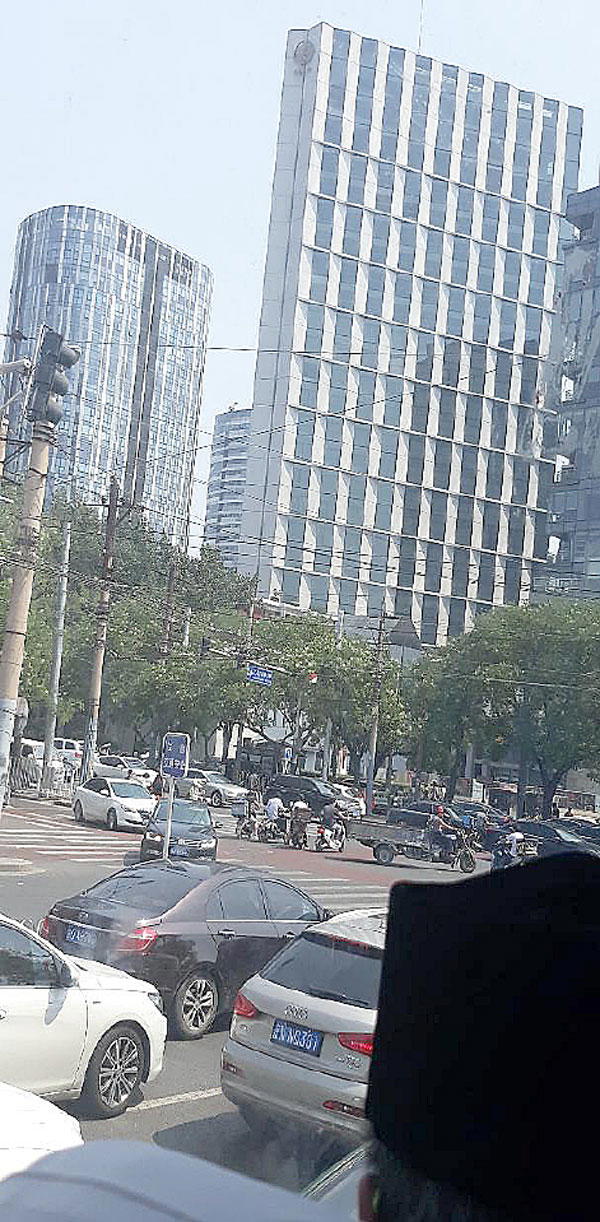
Skyscrapers everywhere
The spectacle is ubiquitous! The beauty charming! And, as the big bus screeds to a halt, more than ten Android phones are desperately jostling to get the whole frame of the sprawling edifice, which houses one of the most iconic companies in China,
Alibaba, the online business leader in China, which has brought fortune and fame to the country and its owners. Skyscrapers constitute one of the single most domineering structures which define the Chinese landscape and skyline.
As they take prominence, they also unconsciously add boundless beauty and elegance to the country’s picturesque. Skyscrapers are everywhere in China and they come in different shapes, styles, height, colours and occupy varying spaces. Like human beings who are everywhere in the country, skyscrapers welcome visitors and citizens anywhere they turn to in the world’s most populous nation.
The tall structures, which have become an integral part of the Chinese culture and daily living, stretch from town to town, district level to municipalities and dominate physical state of the country. Although Wikipedia puts the total number of skyscrapers in China at 1400, it is doubtful if the number of the towers can easily be counted. This number outclasses the figure in the United State, which is put at 700 plus and that of Japan at 230 plus.
Topping the list as the tallest building in China is the Shanghai Tower with 128 floors hitting a height of 2037 feet or 632 metres, which was completed in 2015. The Ping An Finance Centre in the city of Shenzhen with 115 floors and 599 metres or 1965 feet which birthed in 2016, comes second followed by the Guangzhou Finance Centre in the city of Guangzhou taking the third place with 111 floors with a height of 530 metres or 1740 feet. This was also completed in year 2016.
These amazing structures can sometimes blur one’s vision as many of them stretch from street to street. In some cases, the rows of skyscrapers can stretch for up to two kilometres with same colours, designs, height and width. As one moves on or goes about China, the towers appear as if they are coming towards them or fading away from their sight depending on whether they are in a car, in a train or flying. From the moderate towers of about 10 floors which appear to be average height, one comes across the very tall ones of 100 plus floors kissing the skies and looking heaven-bound. One thing defines all of them: class and elegance and they bear the marks of modernity. No decrepit buildings are in sight anyway in Beijing and they are well spaced. None of the towers is built haphazardly or made to obstruct a road, water line or electricity facilities.
Spectacle with plants and flowers..
One clear feature around each tower is that there are expansive woodlots that effectively compete for space with the high-rise buildings for the use of the community. The woodlots provide natural spots for relaxation, sports and endless engagements with nature and escape from searing temperatures.
Even more beautiful is how the trees are planted on a measured straight line and flowers of different colours are used to design attractive patterns around some major highways, streets and public squares. The ornamental decorations around the Beijing Olympics Square, which can aptly be described as one of the world’s most beautiful sites, speak eloquently about what the Chinese can use trees and flowers to accomplish.
The men and women who tend the flowers work with such level of commitment and dedication to the job as if all their lives begin and end with flower. They just don’t seem to be tired removing weeds, planting new trees, pouring water, or trimming flowers all day. And without mincing words, they have successfully made a spectacle with plants and flowers on every roadside, public square and institution. The resultant effect of this aggressive grooming of flowery plants and trees is that China has consciously been transformed into a country with vast swath of woodland anywhere one goes. Thus, our visit to the Chinese Agricultural Museum brought us face to face with the story of the country’s long standing quest for food sufficiency, the pioneers of its agricultural revolution and the avalanche of its rich food and plant stock as well as its value chain.
Work over religion even on religious days in China…
A typical Chinese pays more attention to their work than religion. It was on Sunday that we were taken to both the Beijing Olympics Square and the Great Wall and nobody talked about any religion or even mentioned any of the temples that abound in the country throughout our visit to the two sites that were brimming with tourists from all parts of the world. The workers at the two sites were actively attending to visitors, selling their wares, including alcohol, artefacts and Chinese delicacies as if there would be no tomorrow. All through our visit to many cities in Beijing and other districts, we did not come across anyone preaching on the street or any religious sect or group mobilising their faithful for any form of activity as is the case in our dear country, Nigeria.
Effective technology-driven security system…
Security is tight and working in China. The system is technology-driven and for that reason hardly does a policeman come out with gun to the street. After my stay in China for the first ten days, I was only fortunate to see a neatly-dressed policeman in his immaculate blue and white uniform standing at attention at the Tencent Headquarters in the city centre where we visited on Thursday. He looked smart and stern but eager to act in case of any threat even though he was not wielding any weapon as a Nigerian policeman. Then, I came across some junior police officers at the Pearl Market, a huge arcade for cheap silk goods the previous day. Again, they were unarmed but made effective use of their walkie talkies and could be seen moving spiritedly from point to point checking the output from their ubiquitous Close Circuit television sets to determine if there was anything to worry about or not.
Noodles eaten with passion, communal spirit
The Chinese love and consume noodles with unbridled passion. In every hotel and restaurant in the city of Beijing and the other districts, the food serves as a staple, the equivalent of foofoo and vegetable soup, amala and ewedu, tuwo etc in Nigeria. It is a delight to watch a Chines family eat noodles. They come in groups to enjoy themselves. It is rare to see a Chinese enter a restaurant alone to eat or drink. As if it is a rule, they prefer to come as family members or as a group of friends or social category to enjoy themselves. They eat very fast with the chop stick which we found very difficult to master despite many of them trying to assist us to use the device. And they eat good portions of food, taking a long time to do so. The other day, we watched with admiration and awe how a family of four relaxed and effortlessly ‘demolished’ a large pot of shrimps pepper soup, which goes for 110 Yuan plus other side meals including noodles and assorted vegetables in a typical Chinese restaurant.
When that pot had been cleared, they ordered for another set of food and drinks and we had to leave them behind as their discussion continued just as the food kept coming for them. But we really loved the way they ate and discussed various issues even though we did not understand the topic of their discussion.
The following day, two Nigerian and one Sudanese journalists, who were thrilled by the way the Chinese family enjoyed their meal, opted to eat the same portion of meal but we could neither finish the delicious pot of shrimps nor were we able to ‘deploy’ the chop stick instrument effectively despite the previous day’s lesson the family had taught us.
Warm embrace of Chinese people
The Chinese love visitors, especially, people of colour unlike what obtains in other climes, where blacks are held in contempt and disdain. As we walked along the streets or visited public institutions, the Chinese showed enthusiasm in welcoming us and posing with us to our greatest delight and surprise. One woman actually tapped us at the Olympic Square and asked his Kung-fu-loving son to take pictures with us. And as we made to leave, she requested us to take pictures with her; and we did. This was the trend all over the other places we visited in the country.
All we could muster to the Chines was: Xiexie, which is translated: Thank you!
Disclaimer
Comments expressed here do not reflect the opinions of Vanguard newspapers or any employee thereof.