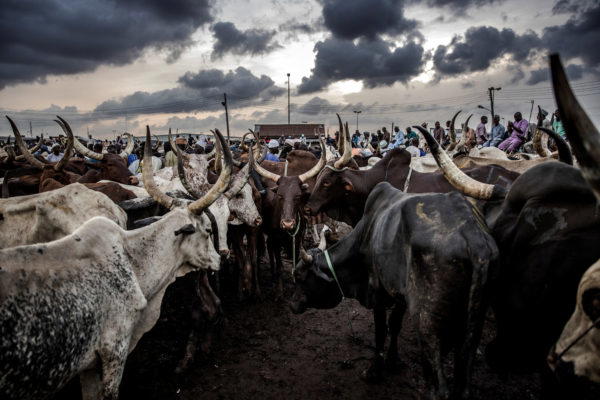
File photo: Herdsmen along with their cows wait for buyers at Kara Cattle Market in Lagos, Nigeria, on April 10, 2019. – Kara cattle market in Agege, Lagos is one of the largest of West Africa receiving thousands of cows weekly due to the massive consumption of meat …. (Photo / AFP)
Emma Ujah, Abuja Bureau Chief
It has come to light, how the National Livestock Transformation Plan (NLTP) was bungled by the Permanent Secretary of the Federal Ministry of Agriculture and Rural Development, Dr. Mohammed Umar’s haste to implement it.
A top sources at the ministry, who was part of the NLTP from its policy formulation stage, told Vanguard in Abuja, yesterday, that the haste to implement the plan was what has given rise to the current controversy surrounding it.
According to him, there was supposed to be a wide consultation and public enlightenment on the modalities, with emphasis on voluntary participation on the part of state governments, before the commencement of its implementation.
The source said that the Otobi, Benue State project was not even designed to be a Fulani Ruga but a damn which was expected to attract Benue indigenes who were interested in cattle business to establish private ranches, around the damn, which could be replicated in other parts of the state.
He said, “We told Governor (Samuel) Ortom, that given the stiff opposition to the open grazing of cattle in the state, we could establish damns in various parts of the state and then encourage individuals to establish ranches around those damns. This is meant to attract the people of Benue State and of course when people see the success of it, more people would build more ranches around other damns.”
The plan, as learnt was meant to be implemented basically in the North and not throughout the country as some government officials have claimed.
It was also learnt that even in the North, only states that chose to participate would be part of it , as no state government would be forced to provide land for the scheme.
The source explained that the “Ruga” programme was adopted by the National Economic Council where the governors acceded to it because it was considered “closest to ranching” and would eliminate roaming of cattle, thereby creating conflicts between herders and crop farmers.
It was also designed to create opportunities for adequate water and grass for the cattle in an area where there could be shared facilities such as veterinary clinics, milking palours, abattoirs, meat and leather processing facilities.
As learnt, with cattle and their herders restricted to specific areas, the problem of cattle rustling would be eliminated as it would be difficult for the rustlers to steal other herders’ cattle and take them away.
The model would equally create opportunities to process agricultural wastes such as rice and maize stocks and cassava leaves into feeds for the cattle, while using the dung to generate power in addition to using it as manure for crop farming.
The official said , “Government recognizes that the era of cattle roaming around is over, across the world. Nigeria cannot be an exception. Our target is to eliminate roaming and the attendant conflicts between herders and crop farmers.
“We want to stop rustling and kidnappings by young Fulanis who wander around in the guise of herdsmen.
“We want to improve the breed of cattle through artificial insemination. This has been done successfully in Brazil, Argentina, Tanzania, Pakistan. Even Ghana started it last year. That is the way to go.”
On Ruga in the South, the source insisted, “There is no intention to go to the South with this plan. Niger State alone is about three times the size of the entire South East. No mischief intended as it is for the overall good of all Nigerians.”
As learnt the Bobi Damns in the state are being build to provide water for a large expanse of land covering an equivalent of about 31, 000 football fields.
In addition, the federal government has a large expanse of land at Paikon Kore, near Gwagwalada , in the Federal Capital Territory, that could take between 10 to 15 years to be utilized by herders under the programme.
With a successful Ruga programme, culminating into full blown ranches, the official said, “not only that the conflicts between herders and farmer would end, Nigeria will stop milk importation. What does a cow need? Water and grass. With damns, we can provide our cattle adequate water and grow enough grass, as well as feed to make the business more profitable, not only for Fulani herders but for other Nigerians interested in livestock business.”
Disclaimer
Comments expressed here do not reflect the opinions of Vanguard newspapers or any employee thereof.