IGP
By Charles Kumolu,
Deputy Editor
No party can do it alone. We critically need a common ground, indeed, a covenant of decent and civil behaviour that will inspire style and substance across the aisle. What we are doing now is not sustainable. It is not even politics. At best it is a triumph of tactics over strategy, with very transitory benefits.”
IGP
These are not the postulations of one of the proponents of the concept of bipartisanship, neither were they spoken by a Congressman.
The quote is that of a Nigerian, who had been a major player on the political scene where mundane conflicts over who gets what overrides national interest.
He is none other than the late Ojo Maduekwe, who had served as a minister in two different capacities, before becoming an envoy at the time he died.
The remark wasn’t one of those rare unwitting rational comments Nigerian public office holders make.
The message was as deliberate as the forum where it was delivered in Lagos.
Maduekwe, who distinguished himself as one of the few cerebral politicians of his time, made the remark when he delivered a lecture titled: The Bipartisan Imperative: Leading from the Future.
Though he made the assertion in 2014 at the unveiling of a book written by Chidi Amuta titled: Writing the Wrong, the message is still relevant in today’s interface between political parties in the National Assembly, NASS.
Commit national suicide
Virtually every paragraph of the thought-provoking paper spoke to the issues that still drive national engagements at the NASS.
Simply put, the speech still offers timely lessons about the price of deep-seated political polarisation.
Consider these excerpts from the speech: “If we as leaders cannot diligently and consistently push for a common ground that can inspire national unity, we could inadvertently end up with the unintended consequence of a killing ground that can consume all. History is full of examples of how nations that were determined to commit national suicide by failing to locate a common ground were allowed their wish. We must begin to address the wide disconnect between the conduct of politics and goals of governance. Our nation is hurting today from deep divisions caused by extreme partisanship.
“A fractious political class disputing over mundane issues of who gets which office and patronage, rather than over ideology and programmes, which compounds its intellectual and spiritual barrenness by lack of visible demonstration of any unifying vision, could also be perceived to be a clear and present danger to the society at large.”
Extreme divisiveness
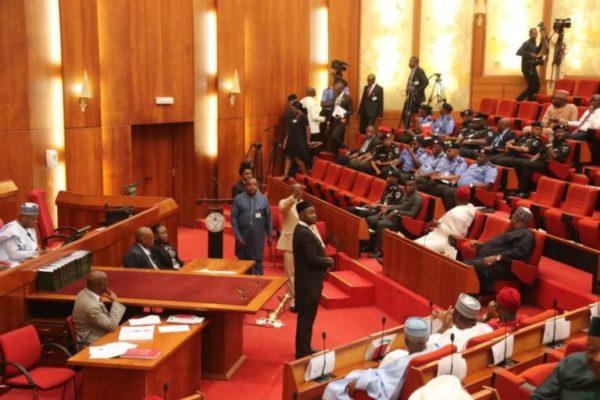
As senators and members of the House of Representatives resume next Tuesday, Sunday Vanguard believes the prospects of extreme divisiveness highlighted by Maduekwe are not entirely unlikely.
This is irrespective of the fact that the composition of votes garnered by the Senate President, Sen Ahmed Lawan and House of Representatives Speaker, Femi Gbajabiamila, was bipartisan and could ordinarily stir the spirit of bipartisanship.
Given the level of brinkmanship that marked the Eighth NASS, the possibility of a legislature with common grounds on statecraft should excite anyone any day.
But analysts are cautious about extreme optimism in that regard, even after the Senate President had sounded reassuring on that last week.
Cautious optimism
Senator Ahmed had said: “This Senate is bipartisan, senators consciously decided to work for us and we take that very seriously. What that means is that we are going to make progress for Nigeria.
“What we have done is to be patriotic and we belong to various political parties, but since we are here, Nigeria is our constituency.
“The Senate is going to be united in the conduct of its oversight. It is a Senate that will work for Nigeria. We are going to do everything possible to stay united in a bipartisan way and remain focused.
“Since the challenges against Nigeria are enormous, we need to enhance our security. We need to make sure the economy works for everyone. For those at the lowest ladder and those at the top, this is necessary. I don’t believe that hostility will yield any positive result.
‘’I have witnessed how rancour undermined national development, I also witnessed a very peaceful and cordial relationship that at the end of the day, produced the kind of outcomes that Nigerians desire.
“We are here to follow the path of peace, but we are going to be very serious and systematic in our oversight.”
Without bias to the hope his remarks intend to inspire, findings by Sunday Vanguard showed that the handling of the security situation in the country, possible reintroduction of Electoral Act Amendment Bill and Constitution Amendment Bill; confirmation of appointees, membership of standing committees and some executive communications, may at some point put the inter-party bond among the lawmakers to test.
For instance, a NASS source told Sunday Vanguard that some PDP lawmakers, who voted for Lawan and Gbajabiamila in return for juicy committee positions, may likely revolt if the APC camp fails to honour its part of the deal.
“Some of the PDP senators and members of the House of Representatives are expectant of the reward for voting contrary to their party’s instruction. The harmony that Nigerians witnessed didn’t come on a platter of anything. If eventually they are not rewarded, no one should expect them to stay in the marriage of convenience. We can only tell if the honeymoon would last after the formation of the standing committees,” the source explained.
This position, however, reinforces the following scepticism: Will bipartisanship last in the Ninth Senate? How possible are bipartisan deals? Are lawmakers willing to sacrifice to make bipartisanship work?
Notwithstanding, the essence of building consensus on key national concerns, can’t be overemphasised, as history is replete with instances where bipartisanship triumphed for the common good more than partisanship.
A former US congressman from Nebraska, Chuck Hagel, captured the significance succinctly when he said: “History has shown that a country most effectively speaks with one voice, when nationally elected officials work together, build consensus, and provide leadership.”
In the same light, a former US Secretary of State, Senator John Kerry, in his statement on the 2005 State of the Union Address, admonished:” The best way to begin bipartisanship is to work together on the real crises facing our country, not to manufacture an artificial crisis to serve a special interest out of touch with American people.”
Thus, amid the growing politics of identity in Nigeria, Sunday Vanguard notes that the common grounds enunciated by Hagel and Kerry, exist.
Therefore, it is incumbent on the Ninth NASS to find such grounds by choosing national interest over group considerations that hugely defined the Eighth NASS.
Disclaimer
Comments expressed here do not reflect the opinions of Vanguard newspapers or any employee thereof.