Buhari
By Yinka Kolawole, Nkiru Nnorom, Johnbosco Agbakwuru & Naomi Uzor
Manufacturers Association of Nigeria, MAN; Lagos Chamber of Commerce and Industry, LCCI; and other stakeholders, yesterday, concurred with the committee set up by President Muhammadu Buhari to asses the impact and Nigeria’s readiness to sign African Continental Free Trade Agreement, AfCFTA.
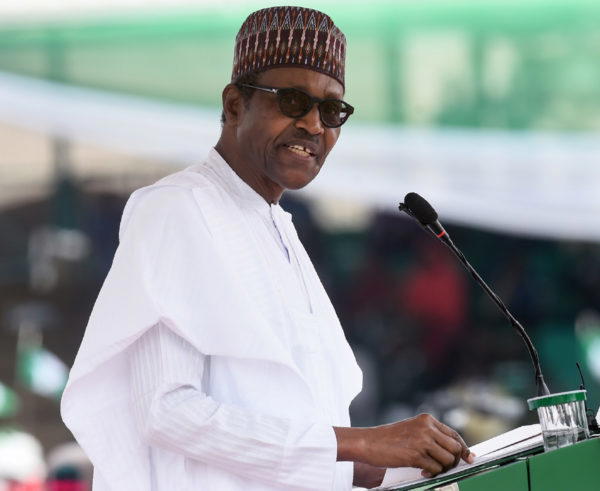
The committee, headed by Desmond Guobadia, had while submitting its report to President Buhari at the Presidential Villa in Abuja, recommended that the president should sign the agreement to enable Nigeria to join the AfCFTA.
But President Buhari stated that the government will ensure that all negotiated agreements created business opportunities for Africa’s manufacturers, service providers and innovators.
He also said that signing the AfCFTA would have both negative and positive impact on Nigeria’s economy.
Presenting the report, Guobadia said they proposed policies, programmes, projects and interventions, which may position Nigeria adequately for the AfCFTA.
He said: “It is envisaged that the trade liberalisation offered by AfCFTA will make African goods more attractive and potentially cheaper than similar products from outside the continent.
“The AfCFTA, therefore, provides immense opportunities for Nigeria’s manufacturing and service companies to expand to Africa. Today, many Nigerian companies have developed capacity in some of these sectors and have long desired to expand to Africa but have been constrained by trade barriers which AfCFTA is expected to remove.
Risks impacts
“Our study has shown that AfCFTA is not without major risks and undesirable impacts. The most significant of which is the potential rise in smuggling and abuse of rules of origin. The risk is that it will provide an incentive for traders to disguise goods imported from outside the continent as made- in-Africa goods, to qualify for duty-free treatment.
“This risk is high for Nigeria considering that 92 per cent of Nigeria’s imports come from the rest of the world and smuggling, under-reporting of imports and other forms of abuse of rules of origin already constitute major challenges faced by Nigeria in ECOWAS.
“The risk is further complicated by the lack of capacity, resources and ‘will’ on the part of some African countries, to enforce their borders. Tackling this threat will require collective efforts at the highest level of ECOWAS and the African Union.
“Our report recognises that there will be significant adjustment costs to manage the negative impacts and to take advantage of the opportunities.” He stressed.
“Our reports show that on the balance, Nigeria should consider joining the AfCFTA and using the opportunity of the ongoing AfCFTA Phase I negotiations to secure the necessary safeguards required to ensure that our domestic policies and programs are not compromised.”
We are in sync with FG – MAN
Reacting to the report, yesterday, MAN said it was in agreement with the Federal Government’s approach to the continental agreement.
Director-General of MAN, Mr Segun Ajayi-Kadir, told Vanguard that MAN was a prominent member of the Presidential Committee and made input into the report submitted, yesterday, adding that most of the measures requested to be taken have been dealt with.
He stated: “MAN was a prominent member of the Steering Committee of the Presidential Committee on Impact and Readiness Assessment of the AfCFTA. We equally participated actively in its various Technical Working Groups that produced the report that was submitted today (yesterday. The President of MAN and I were also there as members of the Steering Group and the Technical Working Group respectively.
“MAN had advised the government to ensure adequate consultation with the relevant stakeholders and to conduct a detailed study on the implication of the AfCFTA on the manufacturing sector in particular and the Nigerian economy in general. We equally counselled on the need to put in place structures and measures that would mitigate identified risks on the one hand and support the local economic actors to take advantage of the opportunities on the other.
It makes sense to sign – LCCI
Director-General of LCCI, Mr Muda Yusuf, said the recommendation to sign the agreement is a welcome development.
He stated: “I believe it makes sense to sign the AFCFTA. To influence the structure of the agreement, it is important to be part of it from the beginning. The agreement is not cast in stone. It should be seen as work in progress.
“If we can function within ECOWAS, I believe we can function in AFCTA. Of course, there will be challenges, just as we have in ECOWAS. But that is not enough reason to walk away from the continental trade protocol.
AfCFTA’ll favour Nigeria in the long run — Uwaleke
Prof. Uche Uwaleke, Professor of Capital Market, said the advice to the Federal Government to join in the AfCFTA was in good taste, saying that since smaller countries were not afraid to join, there was no reason Nigeria should shy away from it.
He argued that the agreement would favour Nigeria in the medium to long term, saying that implementation is in stages.
AfCFTA should create jobs —Buhari
Receiving the report, President Buhari said: “The AfCFTA we aspire to have should, therefore, not only create wealth for investors but also jobs and prosperity for our vibrant and hardworking citizens. The benefits of economic growth must be prosperity for the masses.
“For AfCFTA to succeed, we must develop policies that promote African production, among other benefits. Africa, therefore, needs not only a trade policy but also a continental manufacturing agenda. Our vision for intra-African trade is for the free movement of ‘made in Africa goods’.
‘’That is, goods and services made locally with dominant African content in terms of raw materials and value addition.
“If we allow unbridled imports to continue, it will dominate our trade. The implication of this is that coastal importing nations will prosper while landlocked nations will continue to suffer and depend on aid.”
He said henceforth, all negotiated agreements must create business opportunities for Africa’s manufacturers, service providers and innovators.
“As I stated during the inauguration of this committee, many of the challenges we face today, whether security, economic or corruption are rooted in our inability, over the years, to domesticate the production of the most basic requirements and create jobs for our very vibrant, young and dynamic population,’’ Buhari added.
He promised to consider the report of the committee which he said will form part of the consideration in government’s decision on the next steps on the AfCFTA in particular and on broader trade integration subjects.
He noted that it had been over a year now since the African Union Heads of States adopted the Phase I Agreement on the AfCFTA at its 10th Extraordinary Summit in Kigali, Rwanda, on 21st of March 2018.
“Since then, a lot has been said about Nigeria’s decision to conduct a detailed study on how this agreement will impact us as a country.
“Let me state unequivocally that trade is important for us as a nation and to all nations. Economic progress is what makes the world go around.
“Our position is very simple, we support free trade as long as it is fair and conducted on an equitable basis.
“The AfCFTA will have both positive and negative effects on us as a nation and on our region.
“As Africa’s largest economy and most populous country, we cannot afford to rush into such agreements without full and proper consultation with all stakeholders.
“As you mentioned in your report, intra-African trade is only 14% of Africa’s total trade. Our consumption is mostly of goods imported from outside the continent.
“For AfCFTA to succeed, we must develop policies that promote African production, among other benefits.
“Africa, therefore, needs not only a trade policy but also a continental manufacturing agenda. Our vision for intra-African trade is for the free movement of “made in Africa goods”. That is, goods and services made locally with dominant African content in terms of raw materials and value addition.”
Disclaimer
Comments expressed here do not reflect the opinions of Vanguard newspapers or any employee thereof.