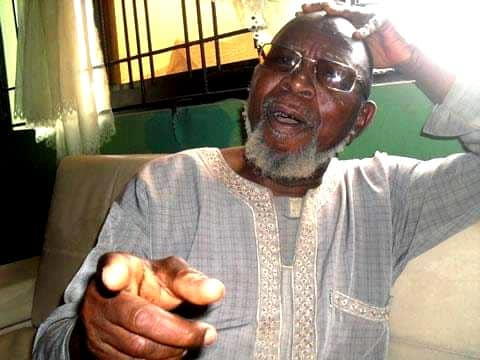
Animassaun
For 19 years Alhaji Kola Animasaun held sway in Vanguard first as Chief Sub-edtor and later as Chairman of the Editorial Board. He was variously in Tribune, Sketch and was already an editor with Daily Express as far back as 1964. Alhaji Animasaun passed on Thursday morning. He was 79 and would have been 80 in July. He was an exceptional journalist who mentored many people in the profession. As part of our tribute we bring you excerpts from his book, 1939. He told part of his story this way: August 28, Saturday 2004:
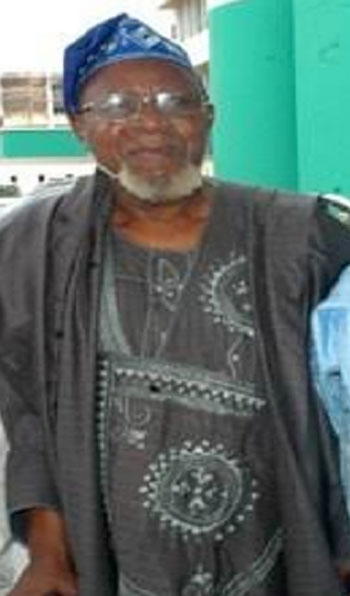
Kola Animasaun
Honestly, my wife’s complaints make me angry, husband tells court(Opens in a new browser tab)
I had wished I never had to perform the duty I performed on this day. It was an environmental sanitation day in Lagos and immediately it was 10 o’clock I jumped into the car and headed to the Anthony Village home of a man I had come to regard as an elder brother; my colleague and senior. Samson Oruru Amuka Pemu, is the substantial owner and publisher of Vanguard titles. We fondly address him as Uncle Sam because of the special place we hold him. He is a very remarkable man – in his disposition to people generally and to his friends especially.
A man of solid loyalty, he would not hurt a fly if he has his way. He does get angry no doubt but his anger never lasts than seconds. When he had occasion to get angry with his editorial staff they were occasioned by professional lapses. He would be angry with space wastage; even with economizing the same space where pictures demanding attention, were used miserly. A man with the mastery of the English language; in his time he was known for his short but precise language, even then they were picaresque. He gained his spurs mostly from his immortal column – Sad Sam – in the Times.
That solid reputation he has carried with him till today. In 19 years of work, Uncle Sam was angry with me, not directly, once. And even that was vicariously. Sam Tsewina, a sub-editor under me had used a picture badly – and it is easier to get the red of his eye doing that than wanting to steal a kiss from his girl.
He came into the sub-desk smoking – he would not find me and left instructions for me to see him. I rode into the storm of his anger: “Kola,” he asked, “you mean you do not know how to crop a picture?” He hardly allowed me to explain it was my lieutenant before the expletives came “fxxx you, fxxx you”. Even when I got him angry with my columns, he would call me as he did on an occasion: “You are costing me some of my friends,” he would quietly lament.
Uncle Sam has been most generous to me. He had given me all sorts of gifts – impromptu. He had given me sandals in the wake of my automobile accident in 1998 when he thought closed shoes were not appropriate. He had given me native caps. On an occasion he had given me a gold plated rotary wrist-watch. On the occasion of my accident referred to above he had visited me in the house, so did his adorable daughter, Omasan. This is not to count his presence at the occasion of my birthday celebration in 1999 and weddings of my children. He and his friends aborted their journey at Aiyede-Ekiti for bad road on the occasion of the conferment on me of a Chieftaincy title of Sootofaiye by the Attah of Aiyede-Ekiti in 1995.
I should have been warned of the good-naturedness of Samson Oruru Amuka Pemu. When I took the letter of introduction from Alhaji Lai Mabinuori to him, he treated me like a friend he had known for some time, not as a job seeker. My wife has never ceased to wonder: She would say: “If you are a woman” meaning she would have suspected assignation.
As I drove to his residence, some of these thoughts raced in my head. I was about to severe nearly two decades of professional association and personal contact. But it is a duty I had to do. Greetings and preliminaries over, I broached the object of my mission. I rarely paid him visits. I went to him when summoned or when it was necessary to do so. Each of such visits, Uncle Sam always appreciated. Naturally, he asked what brought me. I thanked him for taking me as a kid brother; I told him that in reality it has been my pleasure to be his kid brother. I might have been an established writer but the Vanguard platform made it more; that his name and his personal and professional standing helped.
Modest man that he has always been, he thanked me in return and said our contributions helped the paper’s standing. But I know that the medium can be the message just as name makes news. Sam Amuka and the Vanguard are veritable selling points of columnists.
When I came to work for Vanguard I had planned to be there for a minimum of 9 years and a maximum of 10. I was 46 then. That· decision overtook an earlier one that I would knock off work at 45 to go and learn more about Islam – not as a means of livelihood but as a means of spiritual self-enhancement in the service of Allah. I had intended, at the end of it, to go back to full employment. I had intended to go to Cairo to study Arabic for about nine months to a year.
I was down and out when I came to work for Uncle Sam. It was a matter of choice. I ceased to enjoy the atmosphere of the place where I worked as a Projects Director. I could not function in a situation where an extraneous body influenced our collective decisions. I left the place functioning but with my peace of mind.
As is usual with me, I left the place without a nest-egg and so I needed immediate employment. Providence directed my steps to Olu Adekoya, my friend of over 20 years as at that time. Olu was a generous man to his friends and colleagues. But we met by accident in 1964. Olu was a stringer for the Middle-East News Agency and I was a reporter for the Sketch. We were together at an assignment at the Federal Palace Hotel, Victoria Island, Lagos. I cannot now recall what led to it; we quarrelled and settled and became lasting friends.
When I moved to the Daily Express and the Federal Ministry of Information, Olu, who had moved finally into PR and Publicity, would give me assignments – writing and designing for his clients and would pay up-front – good money at the time – £5.5.0d.
When somebody suggested I bought a piece of land in 1970 and I was wondering where the hell he wanted me to find the money for the land and the building, Olu came to my rescue. He convinced me to buy the land saying he himself had bought two and was putting by two, three blocks as occasions permitted. He loaned me £57=0s=0d which I did not settle in full till four years after! In the course of my travail, Olu would share with me whatever he had – N20 or more depending on how buoyant he was. Bless his good soul.
My fifth child – a girl – Olusola had just entered the University in 1984 and things were getting more difficult. One day the 16-year-old asked if I would not go back to my profession. It was not as if I left journalism. I never did but I was doing it practically for free as columnist, adviser or consultant. I took the young girl’s advice and a day or so later I resolved to go back.
I told Olu I wanted to go back to full-time journalism and I wanted to go and work for the Sketch in Ibadan. He noted I would not be useful to him if I went to work in Ibadan. My reason for wanting to go to Sketch: Peter Ajayi was my boy at the Tribune and my friend. I contributed a column – Inside Scandinavia- for his paper when he was Editor of the Herald, we were close. He was the only one of my friends – outside my family circle – who calls me by my native Islamic name – Musulumi.
I was going to phone Peter (Peteru) at Ibadan, he had become the Managing Director. I thought it was going to be just a press button affair. Peter worked for me as a reporter on the Tribune when I was the Production News Editor. Then late Ayo Ojewunmi was the Deputy Editor. Mr. Eniola, now a Professor of Law, was the Editor. It was in the turbulent times of political upheaval in the Western Region. Tribune (Tetebunia) was the political paper to beat, the Times was seen as either sitting on the fence or playing brinkmanship.
The political travail ensured that we did not get much business but we sold copies and the beneficiaries were the vendors selling a copy for as much as 10 (ten) shillings equivalent of today’s N 1,000.00 or more. The Tribune, in those hard times could not pay salaries. I worked for one and half months and got paid £6.00 of the £63=00 they owed me. I got it on Chief Awolowo’s birthday, March 6 of 1964. I spent it at Palm Tree Club, a stone’s throw from the Chief’s Oke-Bola House, in jollification. That was a measure of how much we loved him (Awo).
I returned to the country from England after studies at the London Institute of World Affairs (one year of a two-year Diploma in World Affairs Course) and a Diploma Course at the Regent Street Polytechnic. Regent has since metamorphosed into The Polytechnic of Central London and the University of Westminster. It was a College that was recognized by the Commonwealth and it was a privilege to attend it.
Before me, Chief Bisi Onabanjo, Chief Dapo Fatogun, Dapo Fafiade, Chief Olu Adebanjo, Alhaji Alade Odunewu, Michael Otedola, Otunba Kunle Ojora and a host of other Nigerians had attended it. It was therefore a privilege for me to be numbered among them.
When I was Chief Sub-Editor of the Daily Express 1964 to 1965, Otunba Ojora was, I think, at the time the Public Relations Adviser of the UAC. He was a handsome man. I think he still is. He would walk down from his Old Niger House (I think) to Apongbon where the Daily Express was located to speak with me. The same was with Chief Michael Otedola, who later became a Governor of Lagos. He was also the Public Relations Adviser of Mobil. The company (or his office) was housed at J. Allen on Broad Street; sharing the accommodation which faced Broad Street and sided Kakawa and Kirkesten Hall (Darocha’s house). He, at one time, mooted the need to float a Regent Street Alumni Association which never materialized.
At the time, I was turning to Peter Ajayi, I had been Cub Sub reporter, Foreign News Editor (Liberian Listener), Chief Sub-Editor, Senior Information Officer and columnist of note. Apart from the column, I wrote for him while he was Editor of the Herald (Inside Scandinavia), I had written ‘Take it or leave it’ for another of my lifelong friends and colleagues, Ben Lawrence. Ben was then the editor of Evening Times. I wrote ‘Rhyme and Reason’ for second or third time coming Daily Express when Tayo Adigun (popularly called Perry Adigun) was the Editor.
By the way, I knew Perry Adigun way back in 1961 when he came to replace his brother, Ray Adigun, who later became a Commonwealth boxing champion. In the days of the teleprinter you needed a copy boy to man the teleprinter. The duty fell on Ray. He probably introduced his brother, Perry, when he was becoming busy and prominent. Perry turned out to be a fast learner and I had the singular honour to offer him his first job as an Editor. Parade was patterned after a Paris gloss and the aim was to use big hold pictures.
If you like, you could compare it to the ‘South African Drum’ which later became ‘West African Drum,’ it was first a subsidiary and finally a Nigerian magazine. Famous Editors of the Drum included Cameron Duodu, inimitable Nelson Ottah, my senior and colleague, Olu Adetule, my friend, Dayo Duyile. I was either a consultant or an adviser to one magazine or the other before my application to Peter Ajayi for work. I advised in the setting up of the Social Reformer, behind which were Chief Kola Balogun, the eminent politician, lawyer, and diplomat from Otan Aiyegbaju; S. B. Bakare, the top Nigerian money bag who bankrolled the enterprise; T. O. S. Benson, SAN and Alhaji Fashola of the West African Travel Agency.
They were all friends and backers of the aspiration of Adeyinka Oyekan who finally made it to the throne as Oyekan II after Oba Musendiku Adeniji-Adele died. Businessman Abimbola Gbolade was the proprietor of the Parade to which I appointed Perry Adigun. My young compatriot Victor Dapo Adebiyi, I took on as a reporter and that was where he cut his teeth. Chief Odebiyi went on not only to become an accomplished journalist; he became also an accomplished author and publisher.
I was editorial adviser to Focus newspaper published and edited by Nuru Owo one of my younger colleagues. The Baba Adinni of Nigeria, Wahab Iyanda Folawiyo bankrolled the equipment, I think, as an act of charity. Some of the columns I wrote are contained in the first edition of my book ‘Voice of Reason’. I took no stipend for the work. I even reported for it when I travelled to the United States of America in the summer of 1982. Kunle Oyatomi, a long serving Editor of Sunday Vanguard, was Editor of the Focus.
All these were very known facts to Peter Ajayi. However, I called him to let him know that things were not moving as I had thought and that I would like to get back to full professional practice with his newspaper. He asked after my wife who was very popular with my friends and wondered how it was going to be with my family in Lagos and me working away in Ibadan. I told him the business of keeping the body and soul together was foreign to that of romantic sentiment. Particularly for a wife whom one has lived with for 23 years – the eldest of our children was 22. But I submitted: if she had to come to Ibadan, I bet she would.
My wife hails from Ibadan. On her father’s side she is from Oranyan and her people were politicians, they belonged to the Action Group side (as opposed to the Mabolaje Grand Alliance) which happened to be the main stream then of Ibadan politics. Ironically her relatives were the lions of the Ibadan politics – Adegoke Adelabu and S. Ade Bello. On her maternal side, she hails from the famous Ajimobi family of Oja-Oba. Her Uncle (maternal) Abdul-Azeez Adeyemi Ajimobi was a blue eyed boy of Chief Obafemi Awolowo. Abdul-Azeez also ran against the grains of main stream Ibadan politics. Chief Awolowo believed in his bravado but I doubt if he did in his boast that he would wrest the impending contest of 1959 from the opponents Mabolaje which was in Grand Alliance with the NCNC. At that historic election, he won his seat and as a mark of respect, Chief Awolowo presented him with an Opel Kapitan. My wife’s uncle on his father side, Alhaji Adeyemi Lawal, also an Action Group candidate lost.
The Ajimobis have since become a political dynasty in Ibadan.
Abdul-Azeez’s immediate brother, Abdul-Ganiyu was a staunch member of the NCNC. He however, in apparent revolt against a politics that would use any instrument against any member, decamped to the other side. Abdul-Azeez had been slated for rough treatment without any regard for the feeling of his younger brother and a member of their own party. As his brother was being assailed brutally, he joined him in repelling his aggressors. Abdul-Ganiyu became one of the most colourful politicians that Ibadan has produced. Handsome, a gifted orator and a power dresser, he went on to win local government and state House of Assembly elections. He was a right-hand man of Chief Bola Ige until he died at 69 and Chief Ige wept at his passing.
In the moribund era of Sani Abacha, one of Abdul-Ganiyu’s sons, Wasiu won a House of Representatives’ seat on the platform of the UNCP. Of course, the opportunity was aborted by events. To continue the dynasty is Ishaq Abiola Akanji Adeyemi Ajimobi, a split image of his father (and the eldest child). Abiola, as he is popularly addressed, was a Senator; in fact was the only one on the platform of Alliance for Democracy (AD) from Oyo State. He also became a governor of Oyo state on the platform of ACN.
Disclaimer
Comments expressed here do not reflect the opinions of Vanguard newspapers or any employee thereof.