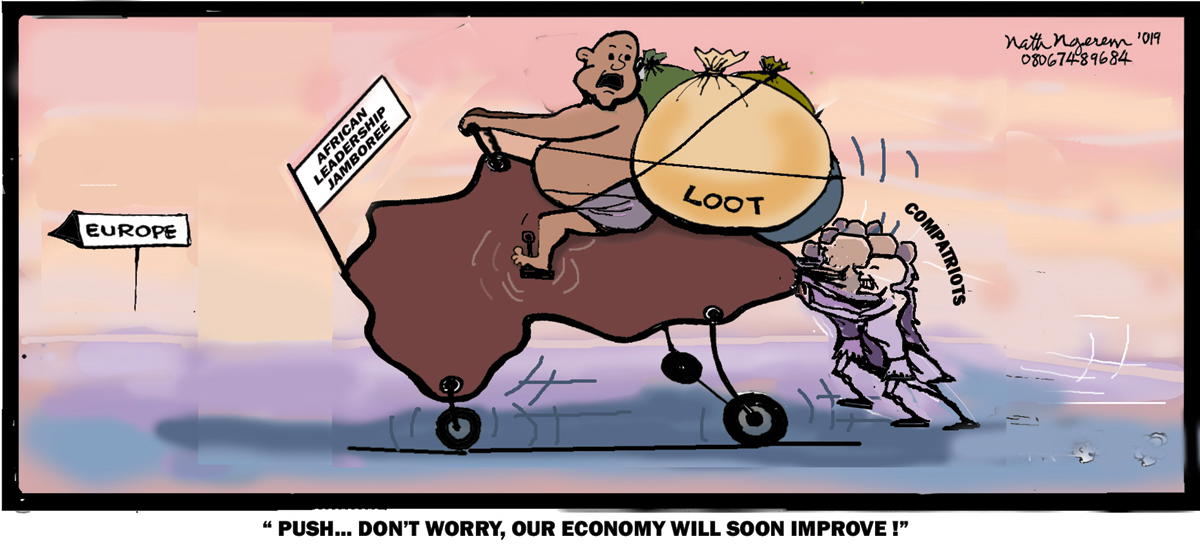
Cartoon
By Nkiruka Nnorom
Capital importation into the country has remained depressed over the years following the swing in investors’ confidence in response to the nation’s macro-economic development.

This is even as the nation’s Gross Domestic Product, GDP, fluctuates through significant growth rate and marginal growth and then a slide into recession, all within the two-decade of democratic dispensation.
Available records showed that in 2007 when the National Bureau of Statistics, NBS, started computing data on capital importation, the figure stood at $9.6 billion, it rose to $11.2 billion in 2008, but fell to $5.7 billion in 2009 following the global economic crisis. It started a slow recovery in 2012 and shot up to $21.3 billion in 2013 (the highest Nigeria has ever seen in capital importation to date).
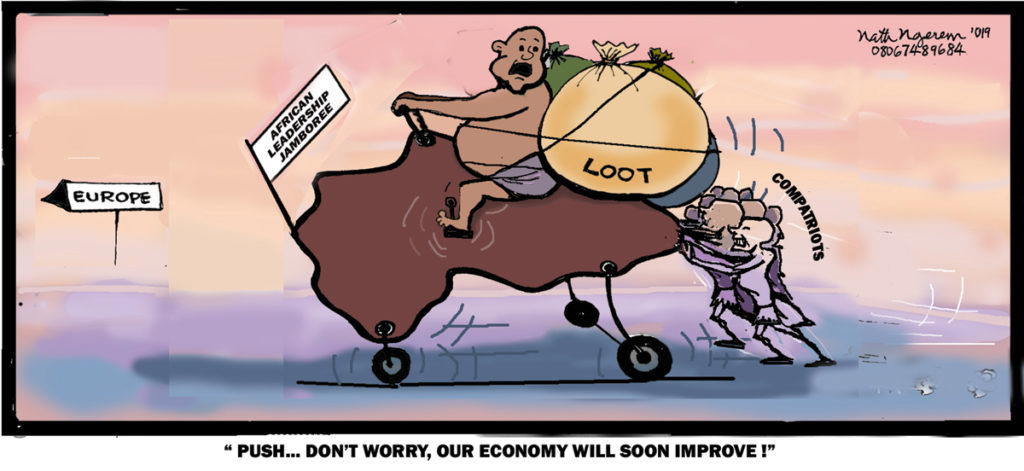
Cartoon
In 2014, it fell to $20.75 billion preparatory to the 2015 general election and then recorded huge declines to $9.6 billion and $5.12 billion in 2015 and 2016 respectively as a result of the general election and the subsequent economic recession that eventually hit the country in 2016. But it has recovered with 2018 figure at $16.81 billion.
The 2016 capital importation, according to the NBS, marked the lowest value since the series started in 2007, which reflects the numerous economic challenges that afflicted Nigeria in 2016.
“The weakening of the naira may have had an impact, a weaker naira means more can be purchased with each dollar, and therefore investment projects requiring naira payments cost less in dollar terms. Portfolio investment fell the most, by 69.81 percent. This investment type, whereby investors seek quick returns rather than control of management in companies they invested, is most likely to be affected by current market conditions,” said the Bureau.
GDP, on the other hand, has grown steadily in the 20 years of democracy rising from N1.19 trillion in 1999 to N95.51 trillion in 2014 due to depreciation in naira/dollar exchange rate.
The exchange rate within the 15 year period from 1999 to 2014 depreciated by 667.5 percent from N21.89/dollar in 1999 to N168/dollar in 2014, while the exchange rate recorded tremendous depreciation of 1,302 percent in the 20 year period, thereby resulting in the significant growth seen in the GDP numbers.
The figure fell to N94.15 trillion in 2015. In 2018, it stood at N127.76 trillion, while as at first quarter 2019, Q1’19, the figure stood at N31.79 trillion.
Economists explain
Prof. Uche Uwaleke, Professor of Capital Markets and Chief Economist, Securities and Exchange Commission, SEC, speaking on the trend in capital importation, said the trend is a reflection of swings in investors’ confidence in the domestic economy over the years driven by the performance of crude oil price given the country’s mono product nature.
According to him, “This explains why the volume of capital importation fell drastically in 2015 and 2016 when the economy went into recession on account of the plunge in international crude oil price.
“A second reason that explains the trend is the fact that capital importation into Nigeria, which has come mainly from UK and the USA, has been more of the volatile portfolio type that is short term in nature with foreign investors fleeing at the slightest sign of shock only to return after conditions normalize.
“By the same token, over the years, the trend in GDP growth (discounted for inflation) is also tied to oil sector performance as GDP size has always been influenced by crude oil output in particular, which usually drops with rising cases of shut-ins and oil facilities vandalism in the Niger Delta region,” he said.
Uwaleke recalled that the sudden collapse of oil price accompanied with reduced crude oil output led to the five consecutive quarters of contraction in GDP growth that the country recently went through, adding that the re-basing exercise in 2014 also contributed as it brought in new sectors that previously did not form part of the GDP figures.
What needs to change
According to the economists and investment bankers that spoke to Vanguard, measures that would drive foreign direct investment should be put in place by government to raise the size of capital importation in the country as well as achieve sizeable GDP growth.
Added to that is the need to address the high level of insecurity in the country to guarantee safety of investments.
According to Uwaleke, a conducive business environment is essential to attract, not just foreign portfolio investments, but also the much desired foreign direct investments which are more employment oriented. He stated that doing so would rub off positively on GDP growth. “Provision of adequate infrastructure especially power, roads and rail, as well as a focus on other employment elastic sectors of the economy such as ICT including agriculture, education and health should be the direction in the next 10 years.
“The good news is that the economy has achieved some degree of macroeconomic stability as well as remarkable improvements in the ease of doing business, while infrastructure and agriculture in particular are receiving attention,” he stated.
He urged the government to continue to invest in critical sectors of the economy (ICT, agriculture, education and health) including tapping the potentials of the capital market.
In his contribution, Mr. Johnson Chukwu, Managing Director/CEO, Cowry Asset Management, said: “The capital importation and GDP figures are products of the economic policies of the government. Given the right policies, investors will be willing to inject financial/economic resources into the Nigerian economy or any other economy for that matter, which in turn contribute to economic growth rate.
“To achieve sustainable economic growth rate and improved foreign direct investments, the government must maintain stable macro-economic policy environment by ensuring market driven but stable exchange rate and low inflation rate.”
He said there is the need for the government to create incentives to attract investments to specific sectors of the economy, particularly the sectors where Nigeria has comparative advantage.
“The government should also strive to improve on the country’s ranking on Easy of Doing Business” and “Global Competitive Index.
“Other factors that will attract foreign direct investments and stimulate economic growth include an improvement in the security situation as well as improvement in basic infrastructure such as power supply and transport infrastructure,” Chukwu concluded.
I cry for Buhari, governors and Nigerians(Opens in a new browser tab)
Disclaimer
Comments expressed here do not reflect the opinions of Vanguard newspapers or any employee thereof.