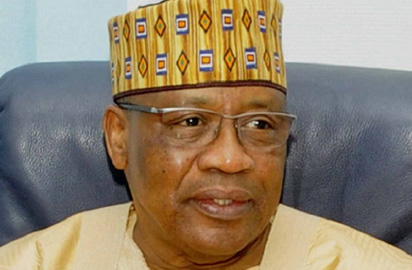
Former military head of state, General Ibrahim Babangida
By Emmanuel Aziken, Political Editor
The idea of a two-party system had for long remained an issue for Nigeria since the advent of independence in 1960. Where it was not immediately realized, political parties sought to find alliances in the second elections after the inauguration of the first two republics, to wit, the 1964 and 1983.
However, in the approach to the inauguration of the Third Republic, President Ibrahim Babangida took the bull by the horn when the administration by military fiat inaugurated two major political parties for the country.

Former military head of state, General Ibrahim Babangida
The two-party political system with the Social Democratic Party, SDP and the National Republican Convention, NRC conceived by the Babangida administration in 1989 was birthed to swallow the malaise that had until then stymied the country’s political system.
The two-party system was an offshoot of the Babangida transition system that was kickstarted with the debate on a political system to be adopted by the country in 1986.
Indeed, with an unusual democratic flair that followed the strict and taciturn style of the preceding Muhammadu Buhari regime, Babangida first allowed Nigerians in a popular national debate to choose whether to accept a N2.8 billion International Monetary Fund, IMF facility for the country. In rigorous debates Nigerians overwhelmingly rejected the loan, but the administration went on to foist the conditionalities on the polity.
The debate on the political system to adopt in the Third Republic was the next offer the Babangida regime threw to the populace.
The moderation of the debate was thrown to a 17 man committee headed by Dr. Joseph Cookey. The committee’s membership included several critical shades of opinion including Paschal Bafayu, a labour leader, Edwin Madunagu, one of Nigeria’s most unrelenting Marxists, Prof. Sam Oyovbaire, a former president of Nigerian Political Science Association, NPSA, and presently a political rock behind Governor Ifeanyi Okowa of Delta State and the late Middle Belt leader, Bala Takaya.
The media had Haroun Adamu and a former national president of the National Council of Women Societies, Hilda Adefarasin was there to represent the interest of the women.
The bureau after what as at that time was seen as the most extensive debate in Nigerian political history came up with recommendations that included:
However, the two-party system could not be immediately concretised as search for the two parties was swallowed up in intrigues, backstabs and other controversies that are particular to Nigeria. There were also insinuations that the Babangida administration was insincere and had designed its transition programme to fail.
This assertion was particularly fueled by claims that some leading officials of the Babangida administration were involved in the major political associations that were birthed at that time.
The late Prof. Omo Omoruyi, who was the head of the Centre for Democratic Studies, the Babangida administration’s political repository asserted as such in a paper he presented during the first term of the Olusegun Obasanjo administration.
“The two political parties had to be resorted to in 1989 when the military President placed before me a security report, that military officers, retired and serving (names withheld), sponsored most of the six political associations.
“I recall my meeting with the military President in his office one night about 12 midnight in early August 1989. He faced me with the reality of his survival based on the security report he had. He was scared and pleaded with me that a new system should be innovated quickly that would take his colleagues by surprise. This was the origin of the two parties, as we knew them in 1989.”
Giving further insights into the introduction of the two parties, Omoruyi had said:
“The innovation of the two party system in 1989 introduced some elements of discontinuity between the past and 1989 in terms of origin, composition, leadership selection, funding and the interest they serve. It removed the idea of ‘founders’ and ‘joiners’, as all were joiners. It removed the idea of owners, as the government financed the founding of the two parties and provided a level playing field for all those who wanted to stake a political career from either of the two parties.”
Noting the headway Nigeria would have had if the two party system had not been aborted by the June 12 fiasco, Omoruyi had said:
“If the system was not aborted in 1993, the year 2001 would have given the two political formations the opportunity to face over three major elections. There was a gradual reduction of the political salience of ethnicity, religion and region in 1993 as the data on the series of elections between 1989 and 1993 would demonstrate. Nigerians were beginning to have the opportunities and the experience to see politics and political affiliations and political programming as something that should cut across the known divides in Nigerian politics such as ethnicity, religion and region.
https://newlive.vanguardngr.com/2019/04/its-absurd-to-have-91-political-parties-prof-akintoye/
“For those who had reason to pass judgment on the period I am referring to, one could ask, how many of us still remember that the SDP had two Muslims on its ticket? I still recall that President Babangida was advised by his security aides to disqualify the Muslim-Muslim ticket (Abiola-Kingibe), because it violated known balancing act of Christian-Muslim.
“The data available to us at the Centre for Democratic Studies did not rate the religious affiliations too high. In any case, my advice to the President in 1993 was that we should let Nigerians decide in the election and Nigerians did ignore religion. We could not label any of the two parties as belonging to the south or the north or that this or that belongs to one religion or the other. We were beginning to see a party calling itself, progressive as opposed to what the other party was calling itself, as conservatives. This label had nothing to do with the wealth of the leaders of the party, as wealthy men were found in equal number in the two parties.”
“How many of us recall the Presidential debate when the issue of religion was raised? How many of us still recall the attempt of some Igbo Christian in the NRC to capitalize on the Muslim-Muslim ticket? How many of us still recall that the Christian religious leaders including the leaders of the Christian Association of Nigeria (CAN) endorsed the two ticket?
“In any case, the two party system delivered a shift of power from the north to the south through the interplay of democratic forces. How this was achieved is a subject of my forthcoming publication on the design and implementation of the transition program. This is a response to those who are arguing that the Constitution should specify “power shift” in the Constitution.
https://newlive.vanguardngr.com/2019/04/91-parties-cure-or-curse/
On how he was able to sell the two party system decreed by the Babangida administration, he said:
“First, I suggested to him that he should appeal to the ‘official’ leaders of the six political associations to sort these parties on their own into two political formations with an assurance that government would fund the take off of these two parties. I then made a case for him to raise with the political class in an open lecture, which President Babangida delivered as part of the Guardian lecture in August 1989.(10)
“Second, I did some (presentations), one to one meeting with some of the known official leaders with the prospect that political education would help them if they yield to the requirement of a two party system.
“Third the President followed this with informal pressure on the known officers of the political associations on a one to one basis with the security reasons why he preferred the two parties.
“Of course, the military officers who were behaving like the civilian founders and owners of political parties in the past as the actual owners of these political associations would not agree to the merger plea. General Babangida knew this, hence he decided to take his colleagues by surprise on October 7, 1989 when he announced the famous Abuja Declaration, which set up the two political parties with names and the training program under the Center for the Study of Democratic Institutions. This was later changed to the Centre for Democratic Studies (CDS).”
•Recommendations of IBB’s National Political Bureau
•Adoption of a two-party system based on certain conditions
•Adoption of a single five-year term for the presidency
•Rejection of the zoning principle
•Excluding traditional rulers from the political process
•A unicameral legislature
•Setting aside 10% of elected seats for women and labour leaders
•Mass mobilization as the cornerstone of a new-found political orientation
•The Creation of six more states
https://newlive.vanguardngr.com/2019/04/its-absurd-to-have-91-political-parties-prof-akintoye/
Disclaimer
Comments expressed here do not reflect the opinions of Vanguard newspapers or any employee thereof.