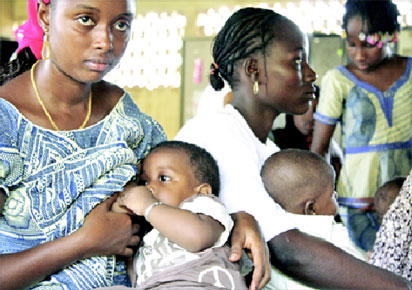
Breastfeeding: Still the best for babies.
By Chioma Obinna
The birth of a live baby brings joy in the community and ultimately compensates the mother for her endurance all through the nine months of pregnancy. But when it becomes the opposite, it throws the community and the family into perpetual sadness.
This was the situation some communities in Oyo found themselves a year ago until the State government, community leaders, UNICEF and other partners through the Accelerated Action for Impact, AAI, Initiative moved in to ensure that no child dies from preventable causes as well as put in measures that guarantee that the estimated 334.073 newborns and 1,670,366 under 5 children in the state reach their full potential in health and well-being.
In just six months, Oyo has reduced the number of unimmunised children in three Local Government Areas from over 2000 to 510, all thanks to AAI.
Previously, statistics have shown that in Nigeria, Oyo State is among the 15 States contributing to nearly 50 percent newborn deaths in Nigeria and the sadly, the 3rd highest contributor to newborn mortality rate in absolute numbers in the South West.
According to the Multiple Indicator Cluster Survey, MICS, 2016/2017, Oyo parades unenviable 42 percent of newborn mortality rate.
However, as Nigeria strives towards ensuring 100 percent child survival through different initiatives. In line with these efforts, Oyo State government with support from UNICEF introduced evidenced based intervention for women, children which has metamorphosed immunisation coverage in Ibadan North-East, Ibarapa North and Saki West Local Government Areas out of the six identified Local Government Areas with high burden of newborn deaths.
One unique thing about the interventions is the involvement of community, religious and traditional leaders and health workers among others. These leaders have introduced house-to-house mobilisation and sensitisation in the communities while the health workers embarked on constant outreach programmes even in the hard- to- reach areas in the state.
Today, in Oyo, it is taboo for a pregnant woman not to visit the hospital for antenatal or fail to immunise her children. Even Landlords quit their tenants who fail to access healthcare or immunise their children. Community members now come together to mobilise women to use health facilities at no cost.
A field visit to Ibadan North-East Primary Healthcare Centre, PHC, confirmed ws a revelation. Community members were all full of praises for government, UNICEF and other partners for saving their newborns.
In some communities like Oke-Adu, immediately, the National Orientation Agency alerted them on the death of children in the community and what needed to be done, the community leaders began house-to-house mobilisation of mothers and children to health facilities. “We banned Traditional Birth Attendants in the villages. We resumed house- to -house immunisation. We took it upon ourselves to ensure we monitor pregnant women and their children. Today, it is paying off. Our children are no longer dying,” Sulaimon Saudah, a community birth attendant narrated.
In the words of Chief Community Health Extension Worker, Mrs, JolasinmiAdebola, “Through the various interventions such as counseling and awareness, the number of women who usually brings their children for immunisation had increased.
“Usually, we used to have 56 women every month but today, we have over 78 coming to this centre alone. For exclusive breastfeeding, it has increased from 103 to 189. The only challenge we have is the fact that most women no longer deliver here since we stopped running night services and most deliveries happen at night.”
A report made available to Good Health Weekly on Ibadan North East showed 100 percent immunisation coverage in February, 2019. The report also showed that there was a decrease in neonatal deaths. By January, 2018 there were four cases of neonatal death between 0-28 days of birth and cause of death was Asphyxia. Today, the LGA has also achieved 100 percent reduction in neonatal death.
The State Immunisation officer, Primary HealthCare Board, Oyo State, Mrs. Eunice Nihinlola told Good Health Weekly that newborn death was commomplace due to low immunisation coverage, however, UNICEF introduced different intervention designed to save newborns and increase immunisation.
“We started with training of health workers because we had problems with their data documentation and data analysis, we also have issues of how they were addressing mothers, and the kind of attention they were given them then which made many of them stayed away from the facilities.
“The outcome of the training has helped in having more mothers coming to the facilities to have their children immunised properly against killer diseases and it has reduced the number of unimmunised children from over 2,000 in the three LGAs to 510.
“To address the issue of handling of vaccines to the hard –to- reach areas, the Chairman, Saki West provided us with Motorcycles to move down to hard- to- reach areas. From the Local government to get to Korete, we 10 hours going there and back.
Recalling that religious beliefs and ignorance were major factors affecting immunisation coverage, she affirmed that meetings with religious and traditional leaders have paved a way for smooth immunisation processes in the state.
“During these meetings, we address them on the importance of vaccination and the need for children to get all the immunisations including BCG to prevent tuberculosis, oral polio, Hepatitis vaccines, pentavelant vaccines, pneumococcal vaccines and measles vaccination.
Today cultural and religious barriers are history. The Imams help us when we have issues.
Corroborating these views, the Assistant Immunisation Coaching Officer for the LGA, Mr Ayobami Akinola, explained that the number of newborns immunised on a monthly basis had increased from 1,701 to 1,926 due the health interventions.
Ayobami said under the intervention, women are being taught proper immunisation, exclusive breastfeeding and post-natal services, among others.
He said to achieve this feat, Community Ward Development CBAs, were also established to address the negative belief on immunisation and encourage the people to accept it.
He said now, they have solar refrigerators and cold boxes to preserve the vaccines before distribution to other PHCs in the area.
Giving insight into the various interventions during a two-day, media dialogue with the theme: “Improving Health Outcomes for Children in Oyo State through Accelerated Action for Impact.”, the UNICEF Health Specialist, Akure Field Office, Dr Adebola Hassan, said the interventions became necessary after it was identified that Oyo was performing poorly in newborn health in absolute numbers.
According to her, some of the babies die as result of ill health after birth and so many things can kill new born within the 28 days. She said the intervention programmes had been having positive effects in reducing the number of newborn deaths in the council area.
Hassan who noted that there are six local governments in the state with highest infant mortality and neonatal death in the state was optimistic that with various interventions by UNICEF and the state government, the trend was changing.
Disclaimer
Comments expressed here do not reflect the opinions of Vanguard newspapers or any employee thereof.