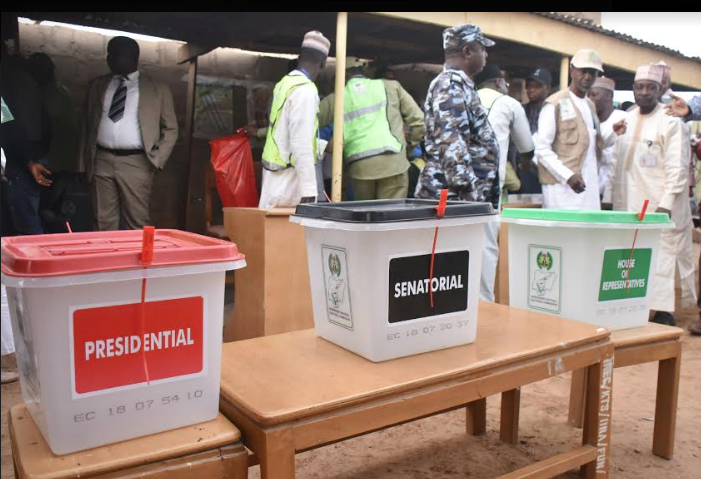
Ballot boxes for the Presidential and National Assembly Elections arrenged Ward A’ Kofar Baru 003 Sakin Yara Polling Unit during the 2019 National Assembly and Presidential Elections in Daura, Katsina State on Saturday
By Clifford Ndujihe
IF pre-election warnings and recommendations of various groups, including international observers had been heeded, the February 23 presidential and National Assembly polls would have been violence- free, Vanguard checks have shown.
Indeed, pre-election reports of two consultants commissioned by a national body listed issues that could halt the polls and urged urgent action.
In a mid-February report on ”Electoral law and human rights infractions that might hamper the 2019 elections,” one of the consultants warned that issues that could hamper the elections included: the late postponement of the Presidential and Federal parliamentary polls by INEC, barely a few hours to the elections on February 16, 2019; the pronouncements of the courts on the participation of APC candidates in Zamfara and Rivers states; President Buhari’s unfortunate comments on ballot snatchers paying for their infractions with their lives; and, the various violence, threats and intimidation violating the rights of Nigerians across Nigeria.”

INEC Adhoc Staff arranging non sensitive material at Ward A’ Kofar Baru 003 Sakin Yara Polling Unit during the 2019 National Assembly and Presidential Elections in Daura, Katsina State on Saturday
The consultant said the distrust occasioned as a result of the postponement might also have contributed to the breach of peace in various parts of the country.
Another consultant identified the Federal Government’s moves against the Chief Justice of Nigeria, Justice Walter Onnoghen, President Buhari’s removal of Matthew Seyeifa, a Niger-Deltan as DSS boss, the spat between Ohanaeze leadership and Anambra Governor, Willie Obiano and the IPOB initial boycott of the polls as other factors that could mar the elections.
Indeed, these warnings appeared not to have been adequately heeded.
In its report after the polls, the European Union said that on election day, ”91 EU observers saw opening, voting and closing processes at 261 polling units, and the collation of results at 94 centres across 31 states and the Federal Capital Territory.
“Polling procedures were not always followed, and in 14 per cent some essential materials were missing. Positively, in almost all observations of counting, party agents received copies of results forms. However, there were problems in filling out results forms and they were not displayed in half of the units observed, weakening transparency.”
Peoples Democratic Party, PDP, candidate, Alhaji Atiku Abubakar, on Wednesday, pooh poohed the results alleging rigging in some parts of country. Insisting that there were manifest and premeditated malpractices in many states which negate the results announced. He said that ”the militarisation of the electoral process is a disservice to our democracy and a throwback to the jackboot era of military dictatorship.”
Atiku Abubakar said he would challenge the results in court, adding that if he had lost a free and fair election he would have called President Buhari to congratulate him.
What should be done
To stop further heating up of the polity, one of the consultants urged the General Abdulsalami Abubakar-led National Peace Committee to meet with President Buhari and Atiku Abubakar to reiterate the importance of the peace pact and the need to hold their followers to its tenets and stoically accept the outcome of the elections.
Other advice include: Engage opinion leaders from across the country to sue for peace from their followers; acknowledge that the elections were fraught with irregularities, and call for a review of the logistics (including security) for future polls, and a redesign of its architecture to make electoral fraud less probable thereby reducing incidence of violence that accompany attempts at ballot snatching;
Engage INEC on its logistics to prevent future postponements and the management of the optics of postponements if they are unavoidable. INEC’s postponement of the elections created greater distrust among a polity that was already wary of the electoral process.
Others are: Meet with core civil society actors to elicit their support in reconciling voters and aggrieved communities; engage respected leaders from the South-West (particularly from Lagos) to engage the leadership from South-East to promote a healing of the ethno-relational breach in Lagos; call on law enforcement to ensure that hate speech and attacks on ethnic minority do not go unpunished.
Call on law enforcement to immediately begin to investigate reported incidences of irregularities in the polls and ensure their speedy prosecution to manage the optics of a free and fair process, and a sense of justice among the polity and advice a further view of the Electoral Act in view of the aftermath of the 2019 elections.
Disclaimer
Comments expressed here do not reflect the opinions of Vanguard newspapers or any employee thereof.