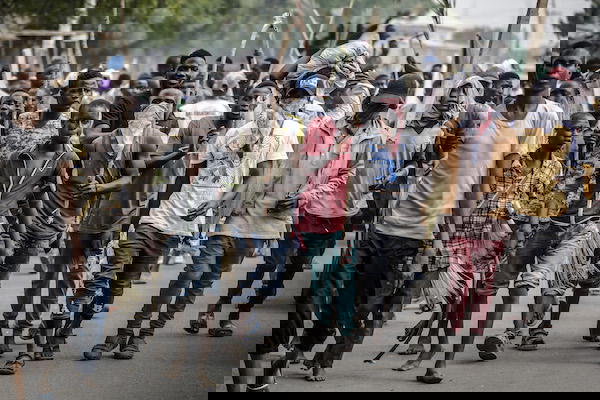
All Progressives Congress (APC) party supporters rally as they celebrate the re-election of the incumbent president and the leader of APC, in Kano on February 27, 2019. – Nigeria’s President Muhammadu Buhari said his re-election was “free and fair”, after his beaten rival denounced the results as a “sham” and promised a legal challenge that could dominate politics for weeks. The 76-year-old one-time military ruler’s victory was confirmed late on February 26, 2019, after rescheduled polling blamed on logistical difficulties. (Photo AFP)
ONE of the ugly sides of the recently-concluded Presidential and National Assembly elections held on Saturday, February 23, 2019, was the reported ethnic tensions arising from the alleged harassment and disenfranchisement of a section of the non-indigenous ethnic groups in some parts of Lagos.

The Nmanwu masquerades at the Igbo Cultural day celebration at the National Stadium, Lagos on Saturday November 3, 2018
The affected group complained of a prominent political chieftain threatening to have their shops demolished and markets shut if his party lost the elections in areas where they live in high numbers.
During the election, hoodlums had invaded polling stations, snatched ballot boxes, destroyed and burnt already thumb-printed ballot papers and chased away voters in areas like Surulere, Aguda, Isolo, Ojo, Okota and other areas. At least, one suspected miscreant was lynched while another was rescued and hospitalised.
Long before the elections, many non-indigenes called into radio stations complaining of the refusal of the Independent National Electoral Commission, INEC, officials in some areas in Lagos to issue them with the Permanent Voter’s Cards, PVCs, because of the fear they could vote against particular political interests.
The purported disenfranchisement of non-indigenes is a sign of major political retrogression in Nigeria because in the 1950s and 1960s Nigerians freely settled and fully participated in politics in any part of the country they chose to. Many of our founding fathers like Dr. Nnamdi Azikiwe, Dr. Egbert Udo Udoma and Mallam Umaru Altine (the first Lord Mayor of Enugu) enjoyed flourishing political careers outside their native regions.
Up till recently, Lagos State continued this commendable practice of inclusive politics and governance by appointing non-indigenes to top posts. This shows that the political elite in Lagos fully recognises the continued importance of the metropolis as the former political capital of Nigeria, its economic capital and social melting pot. Lagos is so important to Nigeria that there is hardly any village not represented there.
We wonder what led to this ugly turn of events, and call on political leaders to rise up and check the trend. Electoral contests are between political parties, not ethnic groups. If political leaders make their parties attractive to all groups they will get supported.
Law-abiding Nigerians have the constitutional right to settle in any part of the country, contribute their quota, and live peacefully without intimidation or harassment. Nobody should be victimised for supporting any political party or candidate of their choice. It is a violation of the Constitution and it endangers our collective efforts at nation-building.
Ironically, some of the leaders behind these dastardly acts once lived in foreign countries and even acquired foreign citizenship only to return home to victimise fellow Nigerians. This is wrong and should not be encouraged.
We call on the leaders of thought of the various ethnic groups in Lagos to meet often and discuss towards strengthening intergroup harmony. We should spare no effort to end further ethnic tensions.
Disclaimer
Comments expressed here do not reflect the opinions of Vanguard newspapers or any employee thereof.