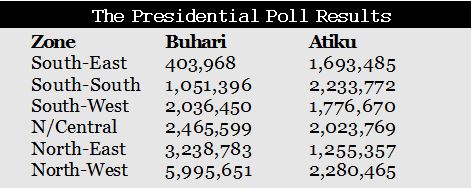
YIAGA AFRICA, a civil society organisation, yesterday, verified the Presidential election results announced by the Independent National Electoral Commission, INEC, saying they fell within its Parallel Vote Tabulation, PVT, estimated range.

Chairman, YIAGA AFRICA Watching The Vote, WTV, Dr Hussaini Abdu, made this known at a news conference on the group’s statement on the presidential election results in Abuja.
According to Abdu, for the presidential election, YIAGA AFRICA’s WTV utilised the PVT methodology, the gold standard citizen observation methodology that uses statistics and ICT.
He said the group deployed 3,030 observer teams in pairs to a random statistical sample of 1,515 polling units located in every local government area and states of the country.
He said the deployment to a statistical sample of polling units enabled YIAGA AFRICA to independently project the vote shares that each candidate should have received within a narrow range.
He said: “YIAGA AFRICA’s findings show that for the presidential election, All Progressives Congress, APC, should receive between 50.0 per cent and 55.8 per cent of the votes.
“The People’s Democratic Party, PDP, should receive between 41.2 per cent and 47.0 per cent of the votes; these figures are consistent with the official results as just announced by INEC. For both APC and PDP the official results fall within the PVT estimated ranges.”
Abdu said that YIAGA AFRICA results statement was based on reports from 1,491 polling units which are 98.4 per cent of sampled polling units.
He said YIAGA AFRICA’s projections were also consistent with the officially announced vote shares for the other 71 parties who contested in the presidential election.
He said that the group’s projections were based on the results announced in the polling units and would have detected any significant manipulation occurring during collation at the ward, local government area, State and national levels.
ALSO READ: Int’l observers laud INEC for free, fair election in Kano
Abdu said that INEC’s official results for turnout and rejected ballots were also generally consistent with YIAGA AFRICA WTV estimates.
He said YIAGA AFRICA estimated that turnout was 37.5 per cent with a margin of error between 35.9 per cent and 39.1 per cent and INEC’s official turnout was 35.7 per cent.
He said that similarly YIAGA AFRICA’s estimated rejected ballots were 4.0 per cent with a margin of error of between 3.4 per cent and 4.6 per cent while INEC’s official figure for rejected ballot was 4.5 per cent.
Abdu, however said that the Feb. 23 presidential election was characterised by similar shortcomings that marred previous national elections in Nigeria.
He said that as in past elections, logistical challenges faced by INEC resulted in widespread late opening of polling units and malfeasance by political parties compromised the ability of citizens to vote.
Abdu called on INEC to provide clarity on the pressing concern to Nigerians which were the 3.3 per cent cancelled ballots of all registered voters.
This, he said was because the figure was four times higher than the rate from 2015 when registered voters in cancelled polling units was less than 1 per cent.
He said that cancelled elections occurred across the country and states where the percentage of registered in cancelled polling units exceeded 4 per cent with Rivers having 22.7 per cent.
He said that other states were Nasarawa 9.5 per cent, Akwa Ibom 8.5 per cent, Cross River 8.0 per cent, Plateau 5.7 per cent, Kogi 5.2 per cent, Benue 4.9 per cent, and Kaduna 4.7 per cent.
Abdu said that although it did not affect the outcome of the presidential election, it disenfranchised a very significant number of voters in the state.
He said that discrepancies between registered voters as announced before the election and during collation by INEC clearly communicated that 84,004,084 voters were registered and publicized state by state breakdowns of this figure.
He said that the number of registered voters announced by the state returning officers at the national collation centre did not align with the figures published before the election.
He said that the overall number of registered voters as announced dropped by 1,659,959 voters for a total of 82,344,125 registered voters.
Disclaimer
Comments expressed here do not reflect the opinions of Vanguard newspapers or any employee thereof.