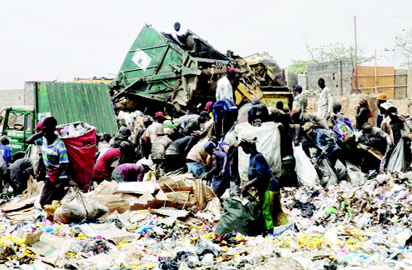
•Dump site in Lagos with Scavengers
By Tunde Johnson
Lagos, the commercial nerve of the Nigerian economy is arguably the most populated state in the country, (with close to 20 million people) and the most industrialized. It is therefore of little surprise that the mega city generates about 13,000 metric tons of waste daily.

File: Dump site in Lagos with Scavengers
This is, quite frankly, huge waste. In addition to a huge population and a high consumption of fast moving consumer goods, there are thousands of litter black spots and hundreds of illegal dump sites within the metropolis.
The most problematic of them all, however, is the absence of proper waste management infrastructure and citizens culture towards waste management. There is need for the average ‘Lagosian’ to see him/herself as a key participant within the waste management eco-system and not just a generator of waste.
Perhaps, a deeper understanding of waste management infrastructure will reveal the enormity of the challenge of waste management in Lagos state. The argument of course will be that, how was waste managed in recent past? The truth is that waste collection seemed a bit better but the management of the waste itself was a sham.
The reason was largely due to a lack of waste management infrastructure which includes components for Waste Collection, Packaging, Treatment, Transportation, Disposal, Recycling and Reuse. The aforementioned elements, aided by a public enlightenment campaign will always, in the mid to long term, produce desirable outcomes – in this case a clean and healthy environment.
Why CLI
It was based on the size of the challenge and the fragility of the previous waste management strategy that the Cleaner Lagos Initiative was conceived with a clear objective of developing a proper waste management infrastructure, that would not only ensure a cleaner environment but would also spur serious economic activity.
Hence, the initiative, was to give room for private capital and expertise, but subject to a strong and sound regulatory framework provided by the ministry of environment. Hence, the Cleaner Lagos Initiative was established to address, enforce and regulate the challenges in the solid waste management systems within Lagos state.
Like most systems, the complexity of the Lagos waste management had to be thoroughly investigated in a bid to finding the perfect leverage in dealing with the waste sustainably.
What CLI Doing
The cleaner Lagos initiative therefore carried out a comprehensive study in Lagos to understand, first, the habits of the waste generators, know the flash points, understand the real challenges and then develop a proper strategy to manage the waste. This study has provided vital information like population densities of communities, numbers of streets and households across the state and the amount of waste that will be generated at any given location.
There is also clarity about the amount of transfer loading stations required, transportation trucks, waste bins and other facilities. To this extent, the CLI has invested in several hundreds of trucks, waste bins and is now completing 3 new transfer loading stations. The CLI will also be rolling out its public enlightenment campaign to educate citizens on the best ways to package and dispose their waste.
It may interest you to know that between July 2017 and August 2018, 20,000 sites have been cleaned up with an average time of 2 hours per site, with a hundred and fifty dedicated trucks. As at the time of this piece, over 300 trucks have been dedicated to the cleaner Lagos initiative.
The CLI, interestingly, will now be implementing an integrated waste management system that will do the following:
Ensure primary prevention of waste by engaging manufacturers to reduce packaging materials for products, and use materials that are easier to recycle, reuse and repair.
Educate and encourage people to buy reusable products, repair broken items, reuse products and recycle.
Treating waste to reduce toxicity
Improve efficiency around collection and disposal
Maximize recycling centers.
The notion therefore, that the environmental situation in Lagos irredeemable and is in a constant state of decline is far from the truth and should be disregarded. The CLI is working extremely hard to ensure that the environment is not just clean but healthy, while several thousands of jobs are being created along the waste management value chain.
The journey to a cleaner mega city has surely begun and we are confident that the people of Lagos in the next couple of months will see evidence of the commitment of the Cleaner Lagos Initiate to keep Lagos clean.
*Johnson writes from Lagos Island
Disclaimer
Comments expressed here do not reflect the opinions of Vanguard newspapers or any employee thereof.