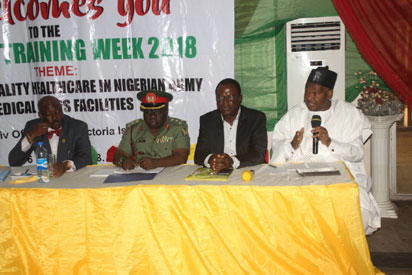
*Panel of discussants during the 2018 Nigerian Army Medical Corps Training Week in Lagos. From Left: Keynote speaker; Maj. Gen. O. A Ogunbiyi (rtd), Chief Medical Director, Brig-Gen. A Dada, 68 NARHY, Maj.Gen. Ameh (rtd) and Brig. Ben I. U Babangida.
By Chioma Obinna
With the security challenges facing the Nigerian Army which has put high demand on human and material resources, the Nigerian Army, NA, has embarked on restructuring and re-equipping of its medical corps facilities to ensure availability of world-class care for the safety of lives of troops when they need to be admitted in the hospitals for treatment.

*Panel of discussants during the 2018 Nigerian Army Medical Corps Training Week in Lagos. From Left: Keynote speaker; Maj. Gen. O. A Ogunbiyi (rtd), Chief Medical Director, Brig-Gen. A Dada, 68 NARHY, Maj.Gen. Ameh (rtd) and Brig. Ben I. U Babangida.
Disclosing this during the opening ceremony of its 2018 Nigerian Army Medical Corps Training Week, with the theme: Enhancing Quality Healthcare in Nigerian Army Medical Corps Facilities, the Chief of Army Staff, Lt. Gen. Tukur Buratai said already, the army has begun overhauling of facilities, especially in tertiary hospitals.
According to him, the hospitals can now boast of diagnostic equipment like mammogram, CT scan, MRI and others, as well as ultramodern theatre facilities for the management of surgical cases.
Represented by Maj.-Gen. Enebong Udoh, the General Officer Commanding (GOC) 81 Division of the Nigerian Army, he said the move was also to reduce medical tourism.
He said the training week was to reposition the Nigerian Army Medical Corps to deliver health care services in a more robust manner.
“NA is faced with security challenges that have put a high demand on human and material resources. To surmount these challenges requires that medical professionals should be well-trained and competent. All efforts, therefore, should be geared towards reducing the effects of sicknesses and injuries in the battlefield through an efficient casualty management system.
He said in view of the huge investment being made to upgrade the facilities, medical personnel are expected to be capable of handling and maintaining newer sophisticated equipment.
”I expect a more positive attitude in your care of patients and facilities placed at your disposal. It is for this reason that I appointed a monitoring and evaluation team to see that standards are maintained in the hospitals. I expect that you will make use of these findings to improve the quality of care in your facilities.”
In his welcome address, the Corps Commander, Medical, NAMC, Maj. Gen. Ikechukwu Okeke who lamented the shortage of medical personnel disclosed that all categories of staff of various specialties have been called upon to perform trauma care or nursing roles due to the exigencies of duties.
Stating that every personnel privileged to wear the maroon beret must have basic combat casualty care training; he said they have identified some gaps in the knowledge and training of NAMC personnel which has been seen not only in combat casualty care but also the quality of care in NA medical facilities.
“There is a need to reappraise what we are doing whether right or wrong and learn better ways of doing them. Basic issues such as infrastructure/equipment maintenance, emergency preparedness, clinical process and attitude to work are sometimes bizarrely neglected.
He said the lack of doctors and nurses have necessitated that more personnel be trained to provide care especially in the pre-hospital setting in the field. “As part of effort to enhance the quality of care in NAMC facilities, a new directorate has been established at the headquarters in line with NA Order of Battle, ORBAT 2016. The Corps is in the final stages of producing the NA medical doctrine as a guide to how we should do things and the mental health policy is almost ready for publication. All these are aimed at putting the corps in a better position to provide quality care.
In his lecture: Enhancing Quality Healthcare in Nigerian Army Medical Corps Facilities, Maj-Gen O.A Ogunbiyi who identified poor infrastructure, skilled manpower, funding, the attitude of healthcare providers and training as challenges facing NAMC, recommended that the Army Heaquarters should sustain the annual recruitment of skilled manpower via a special commissioning scheme.
Disclaimer
Comments expressed here do not reflect the opinions of Vanguard newspapers or any employee thereof.