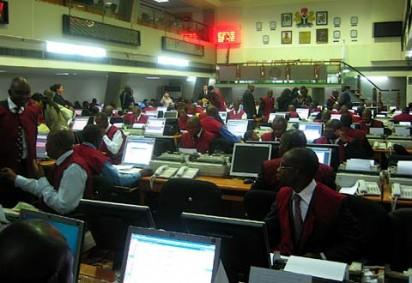
Nigerian Stock Exchange
By Emeka Anaeto
THE Nigerian equities market witnessed dramatic extremes in the first half of 2018, H1’18, as stocks hit the roof and the Nigerian bourse consolidating its place amongst top three global best performers in the first month of 2018. This stellar performance was, however, quickly reversed in the second quarter. The reversal into red territories have continued into the first week of the third quarter/ second half 2018, H2’18. We present analysts, Afrinvest West Africa, positions on the outlook for the various sub-sectors and some blue chip stocks for the rest of the year, to guide investment decisions going forward.
Afrinvest analysis, prognosis: Following the sterling performance of the local bourse in 2017 – (3rd best performer in the world, best performing market in Africa), investors marched into 2018 with high expectations for the year. As a result, the market was set for a bullish run and this was seen in the first month of the year. Investors positioned across all segments of the market, especially in stocks that had underperformed in the previous year. In the Banking sector, while tier 1 banks continued to enjoy buy interest, tier 2 banks became the toast of investors with rallies seen across counters despite weak fundamentals.
Positive sentiment
In the same vein, the positive sentiment filtered into the Oil and Gas, Consumer and Industrial Goods sector. Likewise, some Insurance stocks which had hitherto traded at the price floor of 50 kobo gained momentum during the period. Consequently, the local bourse trended northwards for most of January, with year-to-date, YtD, return as high as 17.9% on 19/01/2018.
However, after hitting this mark, the benchmark index began to pare gains as sustained profit taking by investors dragged performance in subsequent months; H1:2018 return settled flat at 0.1%. We projected then that market performance in 2018 will be largely determined by: (i) earnings fundamentals of companies; (ii) stability in the FX market; and (iii) fund flow dynamics to emerging and frontier markets.
While we have seen the aforementioned factors come to the fore in H1:2018, the impact has been more skewed towards negative than positive and we expect these to be major themes during H2:2018. Although we had forecast a 19.8% return for the market (base case), emerging events in 2018, especially policy normalization in global markets as well as risk factors around the 2019 general elections present compelling reasons to revise our forecast.
Our revision employed a blend of relative and absolute valuation methodologies with associated probabilities of occurrence. Hence, we have arrived at the following revised market performance numbers for full year 2018: Bear case (ASI: 39,076.96 points, +2.2%), Base case (ASI: 42,057.42 points, +10.0%) and Bull case (ASI: 45,233.98 points, +18.3%).
Based on current market sentiment, we place a higher probability of 50.0% on our bear case scenario as we expect market performance to remain pressured on the back of capital flow reversals ahead of the 2019 general elections. Nevertheless, we do not rule out the possibility of positives that could boost sentiment; thus, we place a 30.0% probability on our base case scenario with the most unlikely 20.0% chance of occurrence on our Bull case.
Even though our revised market projection suggest reduced return for 2018, we still expect a positive performance for the year. On the other hand, the fundamentals of the fixed income market have hitherto played out as we anticipated at the beginning of 2018, especially in terms of moderating yields in the domestic market – in line with the debt restructuring strategy of the Federal Government of Nigeria (FGN) – and on the global front, rising yield on emerging market fixed income assets as monetary policy across systemic central banks normalizes.
We envisaged paucity of supply of instruments, coupled with fast moderating yield relative to 2017, support attraction to bonds and force yields below benchmark rate. Nonetheless, we anticipated activity to determine the direction of SSA Eurobond yields. Actual market data for H1:2018 reflects our broad-based expectations for the market. Although we had forecast a 1.6% moderation in average bond yield, the current market conditions suggest possible volatility till year end. We are of the view that the strategy deployed to tracking the market will have to be double phased.
Yet, we still maintain that the yield environment in H2:2018 will be largely determined by market activities as have been played out in H1:2018. We envisage the possibility of an average of 1.5% uptick in short term rates, possibly to compensate for polity risks and prevent capital flight, with this potentially impacting on long dated instruments.
Any bright spots in H2:2018?
Performance across sectors in H1:2018 largely mirrored the movement of the broader index. At the start of the year, the improved sentiment in the market filtered into all sectors under our coverage. In January, the Banking sector – which outperformed other sectors in 2017, enjoyed the most buy interest. As the ASI rose to as high as 17.9% in January, the Banking index outperformed the market, expanding 30.2% in the same period. All tier-1 banks on the index received significant buy interest with Guaranty Trust Bank (GTB), Zenith Bank (Zenith) and UBA setting new price highs in January. Although the sector has continued to be the first choice of investors due to its high tradability and liquidity in the market, positive earnings and dividend expectations were priced into the stocks on the index as the year kicked off. Similar to the broader index, investors began to book profit on banking stocks, paring gains initially recorded.
As at Q1: 2018, gains on the index had moderated to 13.0% and by Q2:2018 had further shed 12.9ppts to 0.1%. Despite the moderation in gains, we maintain a positive outlook for the sector. Our thoughts are based on the following:
As a financial intermediary, the Banking sector is positioned to first reflect the state of the economy through its earnings growth and profitability. Hence, as all indicators (GDP, external sector variables, price level and PMI) indicate growth in the economy, we are optimistic of improved earnings in H2:2018. Furthermore, the banks have demonstrated resilience to turn out positive results amidst tougher operating conditions.
The Industrial Goods index followed, rising to as high as 18.2% (19/01/2018) as significant buy interest was recorded in Dangote Cement and WAPCO. After the release of FY:2017 results, sentiments on these stocks softened; while price depreciation in Dangote Cement was largely due to profit taking by investors after a significant rally, appetite for WAPCO weakened due to a largely unimpressive result.
By the end of Q1:2018, gains in the sector moderated to 11.9% and by H1:2018 declined to 1.7%. In H1:2018, Dangote Cement and CCNN were the major bright spots for the sector whilst WAPCO lagged as earnings releases continued to show weakness.
Following the recovery in global oil prices, cessation of attacks on oil installations in the Niger Delta and the positive outlook for the global oil market, sentiment towards the Oil and Gas sector strengthened at the start of the year. Buy interest across Seplat Petroleum, Total, Mobil, Forte and Eterna Oil improved significantly, however, Seplat enjoyed the most buy interest as expectations for a rebound in earnings was hinged on improving oil prices and production.
In line with the broader index, the sector returned 10.6% at the peak of the rally, then shed all its gains, recording a loss of 2.3% as at H1:2018. The dynamics in the global oil market will be a key factor in the performance of the sector especially for upstream operators – Seplat. We expect Seplat to post even stronger earnings on the back of higher oil prices recorded in Q2:2018.
In H2:2018, we do not envisage any knee jerk shock in the global oil market, however, possible tensions in the oil-rich Niger Delta as the 2019 general elections approach may pose a threat to earnings. For downstream operators – Total and Mobil, we maintain a conservative stance on profitability in H1:2018. Drags to profitability – high costs and slim margins, still exist and may continue to linger till a liberalization of the downstream sector occurs.
Performance of the economy
The Insurance sector is the highest gainer YtD, with a return of 7.9% for H1:2018. The sector equally enjoyed the rally at the start of the year – garnering gains up to 15.7% at the rally’s peak largely driven by price appreciation in Custodian and Allied, NEM and Mansard.
While earnings and profitability across counters in the sector were largely positive in Q1:2018, we expect earnings to come in stronger in Q2:2018 following the improvement in the economy and increasing disposable income. The sector feeds largely on the performance of the economy and grows at a faster pace during an expansion, hence we are optimistic of a positive performance in H1:2018.
Although the sector still underperforms relative to inherent potentials, we believe increased spending ahead of general elections will buoy total revenue in H2:2018.
Lastly, the Consumer Goods index was the worst performing with a total loss of 5.0% in H1:2018. Investors’ appetite towards the sector has remained relatively weak since the start of the year, gaining only 5.8% during the peak of the rally in January, primarily on the back of price appreciation in Nestle, Nigerian Breweries and International Breweries.
As H1:2018 earnings trickle in, we do not expect any negative surprises. We anticipate earnings to print at higher levels, despite pressures from lower volume sales whilst cost pressures could weigh on profitability. More on the H2:2018 forecast from Afrinvest will be published next Monday in this column.
Disclaimer
Comments expressed here do not reflect the opinions of Vanguard newspapers or any employee thereof.