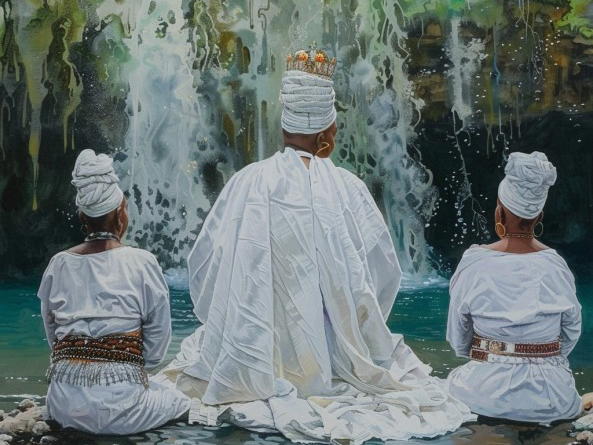
“Devout Memory” by Ruth Adeleye, 2025.
By Osa Mbonu-Amadi
Artist and fine art photographer, Ruth Adeleye, narrates a visual story regarding the pivotal role of women in modern society in her digital work, “Holding Memory: A Cultural Inheritance”.
Ruth uses fine art photography to bring the attention of her target audience to the unnoticed feats women achieve while performing their traditional duties as carers and transmitters of age-old cultural practices.
In this visual story, Ruth strongly asserts that women are custodians of that part of history, culture and social reality which still exists beyond the pages of books and other formal documentation. While focusing on women as socialisers, she highlights how they use stories, gestures, recollected memories and lived experiences to construct future narratives.
Some of the fascinating pieces in the series include Hands that Hold, a portrait of women as mothers and themes of nature and nurture, Abundance, a picture of women as custodians of cultural wealth, and Devout Memory, which shows women as historians, custodians of values and transmitters of knowledge.
The thematic issues such as labour, inheritance, abundance and collective memory are clearly expressed in Hand That Holds, Abundance and Devout Memory not only in the figures but also in a common thread which links them.
The dominant theme of cultural continuity is expressed in all the pieces in what appears to be a visual relay race where a generation of women joyously receives the baton from those before them and passes it to the succeeding generation.
The artist’s visual language is not only reflected in what they represent but also in colours, gestures, clothing, posture and even hidden spaces. She creatively blends symbolic images and figurative visual images in the visual narrative, putting women at the centre as the ones through whom histories, memories and cultural wealth are propagated across the generations.
Instead of portraying women literally in every frame in the form of distinct portraits, focusing on aesthetics, Ruth employs figurative language, imagery and imaginary settings to show women in metaphors.
Thus, the figure of the woman serves as a visual metaphor for the crucial role of women in preserving memory, cultural heritage, traditions and their trans-generational influence on society.
With digital intervention in Devout Memory, the artist creatively constructs symbolic images that narrate visual stories in dream-like settings while also presenting the lived experiences.
She stages her figures as individuals engaging in different activities, using objects, gestures and their social position to invite viewers to participate in the discussion.
Viewers can infer many other meanings from the frame as the artist does not adopt a prescriptive approach in her work. Notably, the surface suggests that there are many untold stories, unacknowledged sacrifices and experiences that are kept in secret or privately as family or communal tradition.
Ruth’s approach to fine art photography is quite revolutionary. She records memorable events and subjects in new context for future reference using photographs. She also objectifies abstract ideas, employing them metaphorically in her works to put across her intended message. For instance, memory is represented by concrete images while sacrifice takes physical form.
Also, she reconstructs womanhood as a temporary vehicle for history in all the frames. She employs figures that are imbued with cultural nuances to push her arguments challenging the dominant social ideology in all her sensitive subjects.
Across all the frames, the artist employs digital and traditional fine art techniques in crafting images which function in various roles, representing the human presence, cultural container and archived history.
Ruth puts her subjects in-between suspended motion and stillness, suggesting that change can happen silently through recollection, endurance and transmission of knowledge. She metaphorically represents the woman as a repository of knowledge in modern society.
The didactic nature of the collection depends on the moral lessons she imparts about cultural legacy. Each generation benefits from the labours of the previous generation, treasures the inheritance and then passes it on to the succeeding generation. It shows that there is a gradual change process and diverse perspectives to the prevailing socio-cultural realities.
The digital work of Ruth consists of images that are staged in an ambiguous space where iconic photographs are contrasted with imaginary visual spaces. As depicted in Abundance and Devout Memory, the artist employs photographs to depict lived experiences and recollected memories.
Since some of the photographs are neither distinct documentary nor full-fledged fiction, they put the viewer in-between the two worlds; the real and imaginary world. The resulting space becomes a space for contemplation as the viewer ponders on the things that remained, changed and need to be re-positioned.
The artist employs digital imagery to construct photographs with cohesive and well-textured messages for different audiences. She leaves the figures in a conceptual ambiguity to integrate viewers’ perspectives in the visual narrative.
Each image is creatively staged by the artist to trigger reflection on the role of women as custodians of culture who inspire the documentation, preservation and propagation of values through stories, collective memories and selfless lifestyle.
In Hand That Holds, Ruth portrays the woman as a carrier using a group of women whose appearance suggests collective identity, communal existence and the nurturing role of women as mothers.
In the series, the artist approaches the visual narrative in a new way. She does not belittle the noble role of women by portraying them in the frames as heroines with positive emotions like tenderness, love and vulnerability.
The frames show ordinary people in search of something extraordinary.
Since each work reflects memory beyond what is remembered and shows memory as embodied emotion state, the series is a good example of well-crafted fine art photography in which invisible structures are transformed into concrete images with tactile experience.
The photographs in the series reveal that the socialization process often depends on seemingly simple acts performed by women. These acts may include storytelling, recollecting collective experiences and enduring difficult situations.
In Devout Memory, the artist intentionally conceals the identity of the women by covering their faces from viewers while spotlighting their backs. This creates curiosity and effectively draws the viewer into the conversation.
Womanhood as a universal concept is also x-rayed in Ruth’s work from the perspective of social poisoning and traditional roles of a woman as a daughter, mother, grandmother, matriarch and larger community.
The works reflect a progressive trend in Ruth’s exploration of womanhood as a subject matter. The figure of the woman is represented as a carrier in Hand That Holds, but she changes to cultural heritage in Abundance and transmits culture and norms in Devout Memory while also becoming a living body.
Instead of representing the subject matter in an ephemeral way by focusing on the physical appearance of the women and their beauty, Ruth delves deeper to interrogate women’s existence and all they mean for the society and different generations. She portrays them as survivors, burden barrier and mothers.
Conceptually, the artist portrays women as mothers who bear personal sorrows while sacrificing to nurture future generations. Besides their duties as homemakers and caregivers, the women chronicle traditions, cultural practices and heroic deeds. They also tell stories, raise children, organize rituals, teach morals and nurture the young.
The metaphorical representation of the human body as an archive in Ruth’s work emphasizes her argument that women are rarely appreciated despite their numerous responsibilities. Apart from preserving the relics of history in libraries and museums, the artist argues that women are repositories of memories and history through their physical presence, costume, carriage and wearables like jewelry and other ornaments that define their cultural identity.
By making women and what they represent her main subject matter, Ruth challenges dominant social narratives that sideline women, making them almost invisible.
In Devout Memory, the artist creatively combines textured surfaces, bold colours and digitally composed figures to present a visual story.
According to the artist, memory, as a subject matter, is more than just remembering or forgetting. It is the past, present and future of the society and its people.
The thematic preoccupation of the collection is multidimensional. From labour to inheritance, material abundance to spirituality, and individuality to group identity, the artist systematically maps the dominant themes. She also employs silhouetted visual language to hide some of the figures. As reflected in Devout Memory, the faces are turned from the viewer. This intentional concealment of the identity makes the figures almost unrecognizable. The viewer must navigate the outline, posture and dress to recognize the concealed figures.
The conceptual significance of the composition depends on its portrayal of womanhood as a complex concept depending on the realization of the metaphor as both abstract and tangible entity.
In each frame, the innovative artist explores the role women play, highlighting what they inherit, preserve and sometimes sacrifice while fulfilling the responsibilities the society assigns to them. Inspired by traditions and daily life experiences, Ruth creates artworks that will be mentally and emotionally engaging to viewers. Her work creates memorable impression connecting people, cultures and shared experiences across generations.
In terms of style, there is a convergence of artistic techniques including the incorporation of traditional techniques in modern practices, digital image making, symbolic imagery and cultural elements.
Using the emblematic titles, Ruth builds a coherent investigation into the embodied emotions, using the frame to spark the conversation about women in modern Nigerian society.
The dominant visual strategy of the artist is portraying women as custodians, carriers and transmitters of collective memories. By this narrative strategy, she illustrates memory as an incomplete, reconstructed and constantly changing phenomenon.
She transforms ordinary acts and objects into symbolic representations of cultural continuity. She employs material metaphor in her choice of titles and colours. For instance, “The Hand that Holds” is a metaphor for memory and feminity while “Adornment” which literally means dressing implies cultural inheritance.
With the objects used for adornment serving as symbol for cultural wealth, the artist creates a coherent visual composition that viewers will find entertaining and convincing.
As an integral part of her visual language, Ruth navigates Hand That Holds, Abundance and Devout Memory, re-interpreting familiar objects and universal concepts in expressing new meanings. For instance, she uses water to signify continuity, and womanhood as an archive of communal history. She also uses shades of colour and atmosphere symbolically as in her portrayal of a silhouette for collective identity and red for urgency or tension.
Through her digital work, Ruth has made a commendable contribution to contemporary arts. The visual exploration of psychosocial realities in personal and collective relationships relates to topical issues like identity and cultural questions.
The series invites the viewers to think about the role of women as active participants in cultural narratives, custodians of memory and transmitters of values.
Unlike the normal trends in conventional narratives, the protagonists in the series are neither mere receivers of history nor victims of patriarchal machinations.
Ruth Adeleye has been participating in various exhibitions hosted by galleries in the UK and other countries. Her artwork mainly revolves around female figures staged beyond individual portraiture.
From Hand That Holds, Abundance, and Devout Memory, the artist creatively continues the exploration of what women carry, preserve and transmit as in her other works.
In the paintings, Ruth creatively links symbols and restrained emotions inviting viewers to question them beyond their surface meanings.
Disclaimer
Comments expressed here do not reflect the opinions of Vanguard newspapers or any employee thereof.