By Gabriel Ewepu
ABUJA – Nigeria’s Minister of Agriculture and Food Security, Senator Abubakar Kyari, has declared that the National Agricultural Development Fund, NADF, has been pivotal to agricultural mechanization programme to boost food production and security.
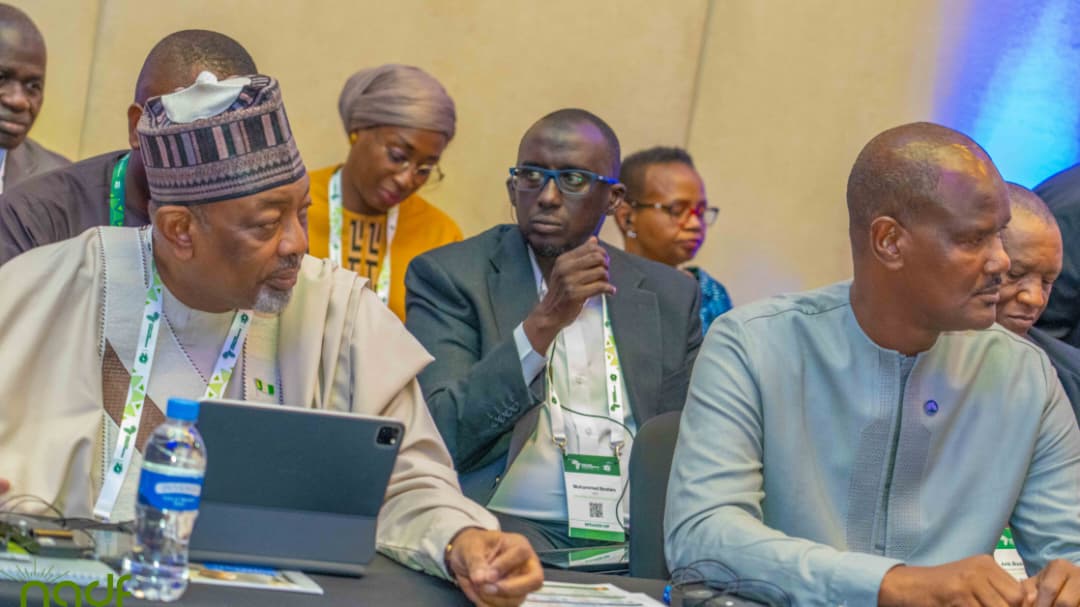
Kyari stated this while speaking at the 2026 Africa Food Systems Forum (AFSF) in Kigali, Rwanda, which also had in attendance the Executive Secretary of NADF, Mohammed Ibrahim, organised by Heifer International and the Mastercard Foundation, where the Minister also lauded NADF for building the technical capacity required to sustain the mechanisation programme.
The Minister also acknowledged efforts of NADF while he commended the Fund for facilitating the Federal Government’s mechanization programme – training 4,000 tractor operators and mechanics, provision of skilled manpower to operate, maintain and sustain agricultural machinery the Federal Government deployed across the country to galvanize food production.
He said: “Our shared objective is not simply to put more tractors in the field, but to build a sustainable system of finance, utilisation, maintenance, skills and accountability around them.”
Meanwhile, under the mechanisation programme the Federal Government has deployed 2,000 tractors and over 9,000 agricultural implements and spare parts using a service-provider model well articulated and designed to deepen farmers’ access to mechanisation.
Also, the plan is to ensure the programme’s sustainability, efficiency and proper asset management in order to meet the objectives in boosting food production.
Meanwhile, the Minister in his speech reiterated that sustainable mechanisation must go beyond the procurement and distribution of equipment while he emphasized that its long-term impact would depend on appropriate financing, effective utilisation, maintenance systems, skilled operators and strong accountability.
He also maintained that the Tinubu-led administration through the Federal Ministry of Agriculture and Food Security had reeled out strategic and sustainable interventions to boost food production and strengthen resilience, and it has massively invested in irrigation to facilitate dry-season farming, climate-smart agriculture, soil health and support for displaced farmers returning to agricultural production.
However, the Minister urged the private sector to upscale investment and establish stronger partnerships across the agricultural value chains, which he reassured them of government’s commitment by giving them reasonable and appropriate conditions for capital to flow into production, processing, technology, logistics and markets.
He also said Nigeria’s growing population should not be seen from only a food-security challenged perspective, but also as a major economic opportunity, particularly given the country’s youthful workforce, expanding domestic market and vast agricultural potential, and added that unlocking that potential would require stronger alignment between public investment, private capital, technology, infrastructure and human capacity.
He maintained that building a resilient and competitive food system ultimately requires bringing “land, water, technology, finance and markets together” within a coordinated framework capable of withstanding shocks, raising productivity and delivering sustainable prosperity.
NADF’s investment in developing skilled tractor operators and mechanics forms a critical part of coordinated framework, ensuring that Nigeria’s mechanisation drive translates into lasting improvements in productivity, employment and food security.NADF’s interventions pivotal push for agric mechanization – Kyari
By Gabriel Ewepu
ABUJA – Nigeria’s Minister of Agriculture and Food Security, Senator Abubakar Kyari, has declared that the National Agricultural Development Fund, NADF, has been pivotal to agricultural mechanization programme to boost food production and security.
Kyari stated this while speaking at the 2026 Africa Food Systems Forum (AFSF) in Kigali, Rwanda, which also had in attendance the Executive Secretary of NADF, Mohammed Ibrahim, organised by Heifer International and the Mastercard Foundation, where the Minister also lauded NADF for building the technical capacity required to sustain the mechanisation programme.
The Minister also acknowledged efforts of NADF while he commended the Fund for facilitating the Federal Government’s mechanization programme – training 4,000 tractor operators and mechanics, provision of skilled manpower to operate, maintain and sustain agricultural machinery the Federal Government deployed across the country to galvanize food production.
He said: “Our shared objective is not simply to put more tractors in the field, but to build a sustainable system of finance, utilisation, maintenance, skills and accountability around them.”
Meanwhile, under the mechanisation programme the Federal Government has deployed 2,000 tractors and over 9,000 agricultural implements and spare parts using a service-provider model well articulated and designed to deepen farmers’ access to mechanisation.
Also, the plan is to ensure the programme’s sustainability, efficiency and proper asset management in order to meet the objectives in boosting food production.
Meanwhile, the Minister in his speech reiterated that sustainable mechanisation must go beyond the procurement and distribution of equipment while he emphasized that its long-term impact would depend on appropriate financing, effective utilisation, maintenance systems, skilled operators and strong accountability.
He also maintained that the Tinubu-led administration through the Federal Ministry of Agriculture and Food Security had reeled out strategic and sustainable interventions to boost food production and strengthen resilience, and it has massively invested in irrigation to facilitate dry-season farming, climate-smart agriculture, soil health and support for displaced farmers returning to agricultural production.
However, the Minister urged the private sector to upscale investment and establish stronger partnerships across the agricultural value chains, which he reassured them of government’s commitment by giving them reasonable and appropriate conditions for capital to flow into production, processing, technology, logistics and markets.
He also said Nigeria’s growing population should not be seen from only a food-security challenged perspective, but also as a major economic opportunity, particularly given the country’s youthful workforce, expanding domestic market and vast agricultural potential, and added that unlocking that potential would require stronger alignment between public investment, private capital, technology, infrastructure and human capacity.
He maintained that building a resilient and competitive food system ultimately requires bringing “land, water, technology, finance and markets together” within a coordinated framework capable of withstanding shocks, raising productivity and delivering sustainable prosperity.
NADF’s investment in developing skilled tractor operators and mechanics forms a critical part of coordinated framework, ensuring that Nigeria’s mechanisation drive translates into lasting improvements in productivity, employment and food security.
Disclaimer
Comments expressed here do not reflect the opinions of Vanguard newspapers or any employee thereof.