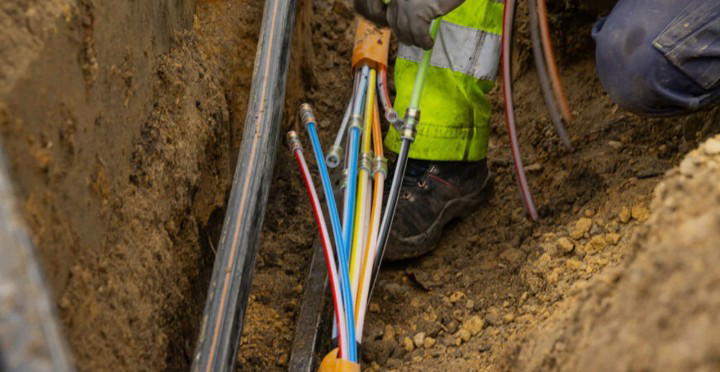
An Ogun State resident has raised the alarm over the alleged removal of fibre-optic cables by street scavengers, asking government to take measures to protect telecommunications infrastructure from continued vandalism.
The concern was raised during a Radio One 103.5 FM morning programme focused on digital literacy and the importance of telecommunications infrastructure to everyday life.
The caller, identified as Gbenga Adeola from Ogun State, alleged that area boys were repeatedly removing fibre-optic cables laid along roads and residential areas.
“Please, the agberos (area boys), the optic wire, cables that government fixed on the road, channeled down to the road and all those in our environment, these agberos guys (area boys) keep on removing it,” Adeola said, adding
“Right? Are these people doing their self-benefit or the government? And what measures are government taking to help?”
His complaint highlights a wider challenge confronting telecommunications operators, as fibre cuts caused by vandalism, theft, road construction and other excavation activities continue to impose repair costs and disrupt connectivity.
Industry data cited by the GSMA and sector reports showed that MTN Nigeria spent N11.1 billion in 2022 and 2023 to repair and relocate 2,502 kilometres of damaged fibre-optic lines.
The operator spent N4.4 billion in 2022 to rehabilitate 1,069 kilometres of severed fibre and another N6.7 billion in 2023 to repair 1,433 kilometres.
The spending underscores the cost of repeatedly restoring damaged infrastructure, while resources that could otherwise support network expansion are diverted to repairs.
Speaking on the programme, Information and Communication Technology expert and digital literacy advocate, Israel Ihaza, said the consequences of fibre cuts extend beyond telecommunications operators to businesses, financial services and individuals.
“These cables power economies,” Ihaza said,.explaining “If some of these cables are down, the financial ecosystem is down, banking generally… Like me, a startup founder, I will not be able to transmit information to my team, and so it connects the everyday life.”
Ihaza said fibre damage could occur through deliberate vandalism as well as accidental excavation during construction activities.
“There’s deliberate vandalism, meaning theft, right? And there’s accidental, in the sense that I could be doing some construction work, evacuation work, and then I’m just digging and just messing things up,” he said.
He cited the experience of a Nigerian professional who, according to him, lost a remote international job after a prolonged broadband disruption affected her ability to work.
The impact of fibre cuts can also extend to businesses and informal commerce that depend on digital connectivity for payments and communication.
Point-of-Sale operators, agency banking businesses, traders and other small businesses can be affected when network connectivity is disrupted, while digital banking and other online services can also experience interruptions.
The programme’s presenter also raised concerns about poor coordination during infrastructure and road projects, noting that one government agency could lay cables while another subsequently undertakes road, culvert or other construction work in the same area.
The presenter further cited instances where poorly protected or exposed ducts left telecom infrastructure vulnerable to physical damage, rodents and heavy rainfall.
Telecommunications infrastructure has been designated as Critical National Information Infrastructure (CNII), placing greater attention on the protection of fibre-optic cables, base stations and other network facilities.
Ihaza called for greater protection of vulnerable fibre routes through a combination of technical safeguards, security and community awareness.
He suggested that fibre routes should be clearly identified in the same way that areas containing pipelines are marked, warning people against damaging the infrastructure.
“Just the same way we have labeling for pipelines — ‘Oh, this area, there are pipelines here’ — I think we need to come up with that as well, where we know, okay, in certain areas we have fibre optic cables, so do not disrupt it,” he said.
He also advocated targeted CCTV surveillance around vulnerable infrastructure, security patrols along telecom rights-of-way and action against scrap networks involved in funding cable theft.
Ihaza further urged communities to become more vigilant and report suspicious activity around telecommunications infrastructure.
“What we’ve seen as Nigerians is that, ‘Hmm, what’s my business? It’s not my business.’ But what they are missing out is the action [the vandal] is carrying out, you might have a bad network,” he said.
And, emphasized “We need to tell ourselves that let’s look out for ourselves. If you’re looking at some suspicious activity… it’s affecting everybody.”
Disclaimer
Comments expressed here do not reflect the opinions of Vanguard newspapers or any employee thereof.