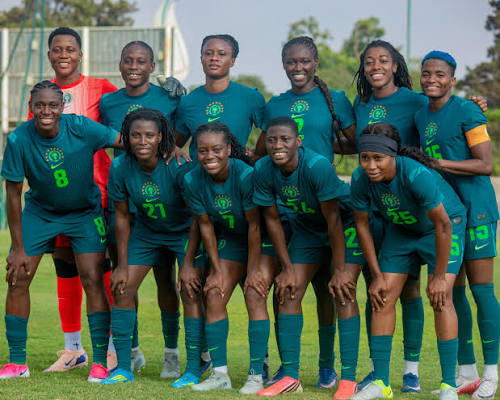
Super Falcons
By Sammy Etuk
The Super Falcons’ performances so far have exposed shortcomings that can largely be traced to the technical crew. The problem is not simply the choice of players but the inability to adapt the team tactically to the demands of each opponent. Football at the highest level is not merely about selecting the best eleven players; it is about selecting the right players for a particular match and assigning them specific responsibilities to neutralise the opposition’s strengths.
Elite coaches understand that every opponent presents a different challenge. There are occasions when a naturally right-sided player should operate from the left, or a left-sided player should switch flanks, either to gain a tactical advantage or to prevent an opponent from exploiting a particular area of the pitch. Such adjustments are part of modern football, yet they were largely absent from Nigeria’s performances.
Even if Nigeria eventually qualifies for the knockout stage, serious questions will remain about the team’s preparation, game management and ability to respond to different tactical situations.
Malawi’s attack revolves around the Chawinga sisters—Temwa Chawinga of Kansas City Current in the United States and Tabitha Chawinga of Olympique Lyonnais in France. Both possess blistering pace, intelligent movement, physical strength and clinical finishing. Their qualities have been Malawi’s greatest attacking weapons throughout the tournament. Surprisingly, Nigeria’s technical crew failed to develop a tactical plan to contain them. Rather than forcing the sisters into less dangerous areas or denying them space behind the defence, the Super Falcons allowed them to attack with freedom.
The same tactical deficiency was evident against Zambia. The Copper Queens’ captain, Barbra Banda of Orlando Pride in the United States, is among the most dangerous strikers in world football. Her explosive acceleration, physical power and intelligent movement make her extremely difficult to defend without a well-structured game plan. Nigeria’s coaches failed to prepare specifically for Banda’s strengths. As a result, Oluwatosin Blessing Demehin was repeatedly left in difficult one-on-one situations, eventually receiving a red card. With better tactical preparation designed to reduce Banda’s influence, Nigeria might not have lost a player through dismissal.
This is why one remembers coaches like Edwin Okon and the legendary Ismaila Mabo, whose teams were built on detailed preparation and thorough knowledge of their opponents. They identified opposing teams’ strengths and weaknesses and devised strategies to neutralise dangerous players before kickoff.
This also reminds me of the 2003 FIFA Women’s World Cup in the United States, which I attended with the Nigerian team. One tactical decision has remained fresh in my memory. The coaching crew made effective use of the experienced Maureen Mmadu, at times advancing her beyond her customary midfield role to hold up play and bring others into the attack. That tactical adjustment created opportunities for Nkiru Okosieme and captain Florence Omagbemi, who is now a coach. Ifeanyi Chiejine, who was relatively young at the time, also came in to provide tremendous support in midfield with her outstanding ball control, vision and ability to link defence with attack. It demonstrated how intelligent coaching can maximise the strengths of available players. The principal weakness of that Nigerian team was not its attacking organisation but its inability to match the tactical sophistication of Europe’s leading sides.
The present Super Falcons, however, are in a different position. Many members of today’s squad play professionally in some of the strongest leagues in Europe and the United States, facing elite opponents every week. They possess the exposure, experience and quality expected at the highest level. Yet, despite that advantage, the team has continued to display recurring tactical shortcomings. The problem therefore cannot be attributed to a lack of international experience; it points instead to deficiencies in technical preparation, tactical organisation and match management.
Across the two matches, Nigeria has relied mainly on its defence and attacking line, while the midfield has lacked balance. Whenever Rasheedat Ajibade leaves midfield to support the attack, there is nobody left to shield the defence or halt the opponents’ forward surges through the centre. A technically astute coach also understands that match situations sometimes demand tactical rotations. Ajibade has the versatility to move ahead of Asisat Oshoala during attacking phases, drawing defenders away, creating space and disrupting the opponent’s defensive organisation. Such variations were largely absent from Nigeria’s play.
Perhaps the greatest concern is that many of today’s young, gifted players with exceptional ball control, vision and technical ability are left on the bench while established names continue to dominate selection. Football should reward current form, tactical suitability and the specific demands of each match, not reputation alone. A courageous coach identifies emerging talent, trusts it when the occasion demands and builds a team around merit rather than status.
The Super Falcons must now approach the match against the Pharaoh Women of Egypt with greater purpose. They need to attack with intensity from the opening whistle and score enough goals to maximise their chances of reaching the knockout stage.
In an interview today, Asisat Oshoala admitted she was unhappy with the team’s performances and expressed hope that the players would raise their game against Egypt. She also acknowledged that Nigeria now finds itself hoping that the result of the other group match will favour the Super Falcons’ qualification. Depending on other teams is never the ideal situation, but Nigeria still has an opportunity to respond with a convincing performance and keep its campaign alive.
Disclaimer
Comments expressed here do not reflect the opinions of Vanguard newspapers or any employee thereof.