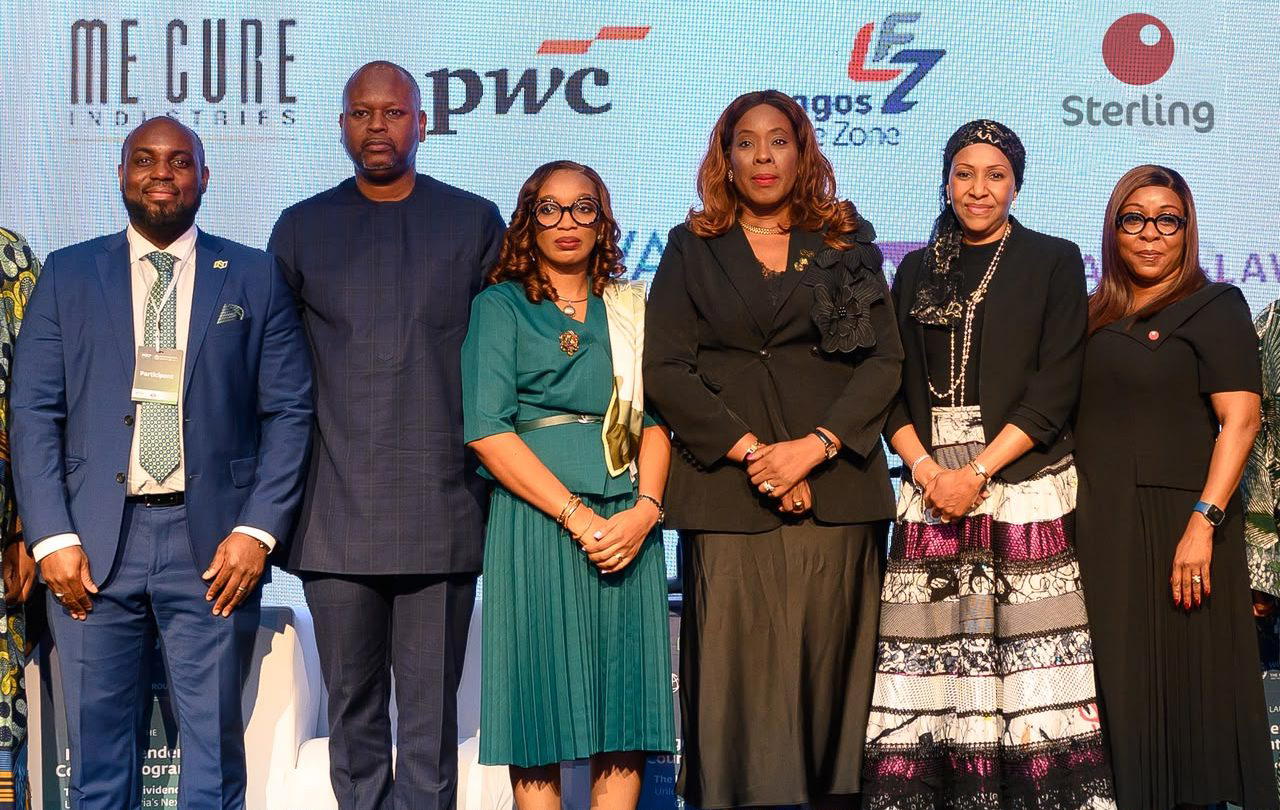
L-R: Olufemi Shobanjo, CEO, NGX Regulation Limited; Olivier Buyoya, IFC Division Director, Nigeria & Central Africa; Adaorie Udechukwu, Program Lead, IFC, West and Central Africa; Folashade Ambrose-Medebem, Honourable Commissioner for Commerce, Cooperatives, Trade, and Investment (MCCTI), Lagos State; Marieme Niang, Regional Gender Lead, IFC, Africa, and Temi Dalley, Group Executive, Human Capital & Corporate Services, Sterling Financial Holdings Company at the launch of the Nigeria Gender Country Program held in Lagos… recently.
…Champions structured pathways for women’s economic advancement
By Precious Enaike
Sterling Bank Limited has reaffirmed its commitment to advancing women’s economic participation in Nigeria through its support for the Nigeria Gender Country Program (NGCP), a multi-year private-sector platform designed to address structural barriers limiting women’s participation across employment, enterprise and leadership.
Anchored by the International Finance Corporation (IFC) in partnership with the Nigerian Exchange Group (NGX) and Lagos Chamber of Commerce and Industry (LCCI), the programme brings together businesses, financial institutions, regulators and development partners around measurable interventions capable of expanding women’s participation across Nigeria’s economy.
The Group Executive, Human Capital and Corporate Services at Sterling Financial Holdings Company PLC, Temi Dalley, articulated this position during the programme’s introduction in Lagos, arguing that execution remains the defining difference between organisations that embrace inclusion in principle and those that deliver measurable outcomes.
Dalley said: “Most institutions have these policies in place. What separates the ones that produce results is execution at the moments where women are actually lost like the transition into motherhood, the middle-management ceiling, the point where an entrepreneur has a good idea but no structure to scale it.
“At Sterling, we built initiatives like the Momship Programme precisely because we saw that we were hiring competent women at entry level but losing them at exactly the point where the organisation should have been getting the most out of their capabilities. What we have today is a structured intervention that encompasses mentorship, sponsorship, capability-building, flexible platforms, and a work environment that takes microaggressions seriously.
“We apply the same logic externally. In addition to capital, female-led enterprises need structure, knowledge, networks, and mentorship to thrive. If the private sector is serious about the ambition of the NGCP, we have to build that full ecosystem, not just write the cheques. Nigeria cannot grow around the productive capacity of half its population, it has to grow through it.”
Sterling’s participation in the NCGP builds on a broader institutional commitment to inclusive economic development, anchored in the Group’s H.E.A.R.T strategy, which directs capital towards Health, Education, Agriculture, Renewable Energy and Transportation. Internally, that commitment is reinforced through targeted programmes including Momship for working mothers and the Sterling Embrace Programme for colleagues with disabilities. Sterling Bank has also been recognised as one of the Best Workplaces in Nigeria by Great Place to Work for five consecutive cycles.
Speaking at the programme’s introduction, Governor Babajide Sanwo-Olu of Lagos State, who was represented by the Commissioner for Commerce, Cooperatives, Trade and Investment, Mrs. Folashade Ambrose-Medebem, urged businesses to make gender inclusion part of their core strategies.
“I want the private sector to embrace gender-smart strategies not as a matter of compliance, but as a pathway to competitive advantage. Business leaders should embed gender inclusion into organisational strategies and establish measurable indicators to track progress and accountability,” Sanwo-Olu stated.
The Minister of Women Affairs, Hajiya Imaan Sulaiman-Ibrahim, represented by her Special Assistant on Child Protection and Projects, Aishatu Digili, similarly described the initiative as “a shared commitment to move from intention to action, and from action to measurable impact.”
The NGCP complements the Nigeria Country Gender Profile and Roadmap to Equality 2030, developed by the Federal Ministry of Women Affairs and Social Development with the African Development Bank and UN Women, and provides a framework through which private-sector organisations can translate the country’s gender inclusion ambitions into practical interventions.
Disclaimer
Comments expressed here do not reflect the opinions of Vanguard newspapers or any employee thereof.