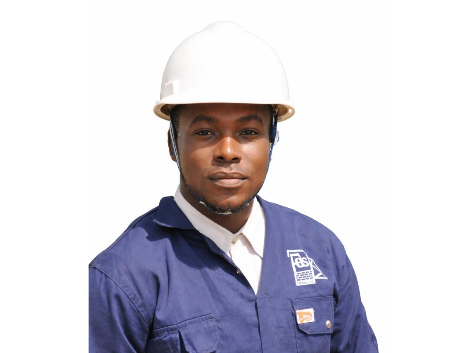
A Nigerian-born quality engineer based in Illinois has patented an augmented reality inspection platform that could cut manufacturing defect costs by more than half—and reshape America’s industrial future.
Every hour, on factory floors across America, products roll off assembly lines carrying flaws no one caught a hairline crack in a brake housing, a dimensional deviation in an engine block, a surface irregularity in a pharmaceutical tablet. These are not the failures of careless workers.
They are the failures of systems that have hit the limits of what human eyes and legacy machines can do. The global manufacturing industry pays for it with more than $260 billion in losses each year.
Love David Adewale has spent his career inside that problem. A quality engineer at Magna International’s in Illinois, and a Master’s graduate in Industrial Engineering from Southern Illinois University Edwardsville, Adewale has formally registered a patent (No. NG/PT/NC/O/2025/20158) with the Federal Republic of Nigeria for a technology he believes can fundamentally change those numbers.
The Gap No One Fixed
Human visual inspection achieves defect detection accuracy of 70 to 85 percent under real world conditions. Inspectors grow fatigued, shifts run long, and defects smaller than 50 micrometers are invisible to the unaided eye. Automated optical inspection systems do better reaching 85 to 92 percent but carry a steep price: $150,000 to $500,000 per unit, rigid single-product configuration, and no meaningful integration with enterprise systems. What the industry lacked, Adewale argued, was a system that addressed all of those limitations at once.
“Traditional systems miss as many as one in seven defects. That is not quality assurance. That is quality gambling.”
Love David Adewale
The Invention
The platform is built around five integrated subsystems. A multi-spectral imaging array captures RGB, near-infrared, and thermal imagery at up to 12 megapixels and 120 frames per second, with structured light projection mapping surfaces at 0.01 millimeter resolution. An AI processing engine built on ensemble deep learning trained on over 500,000 labeled defect images is projected to achieve greater than 99.2 percent accuracy across 150 or more defect categories, with inference latency under 150 milliseconds.
The augmented reality layer, running on Microsoft HoloLens or tablet interfaces, overlays defect locations directly onto the part the operator is examining, color-coded by severity and accompanied by step-by-step remediation guidance. Every inspection event is written to a blockchain-secured audit trail with SHA-256 cryptographic hashing immutable, tamper-proof, and built for aerospace and defense compliance environments. A predictive analytics engine then forecasts defect probabilities two to four production stages in advance, preventing failures before they occur.
“We are supercharging the human inspector, not replacing them. The AI sees what the eye cannot; the operator brings judgment the machine cannot replicate.” Love David Adewale
The Numbers and What Comes Next
Adewale frames his projections as engineering-modeled estimates anchored to peer-reviewed literature not yet validated in live deployments. The targets are nonetheless striking: greater than 98 percent defect detection rate, inspection time reduced 45 to 65 percent, quality cost savings of 30 to 55 percent per production run, and an implementation cost of $25,000 to $45,000 up to 85 percent lower than conventional automated systems.
He is currently seeking pilot partnerships in Nigeria’s Food and Beverage, Oil and Gas, Automotive, and pharmaceutical sectors as an initial deployment avenue, while positioning the platform for broader adoption including U.S. production facilities. Manufacturing quality defects cost the American economy an estimated $50 to $80 billion annually. A platform that achieves even the lower bound of its projected savings, deployed across a meaningful fraction of U.S. facilities, would represent a measurable recapture of that value.
“America’s manufacturing renaissance depends on closing the quality technology gap. This platform is designed to do exactly that, at 85 percent lower cost than anything that existed before.”Love David Adewale
The platform has not yet been deployed. But the patent is on file, the architecture is documented, and the engineer behind it has spent his career living inside precisely the problem he built it to solve.
Disclaimer
Comments expressed here do not reflect the opinions of Vanguard newspapers or any employee thereof.