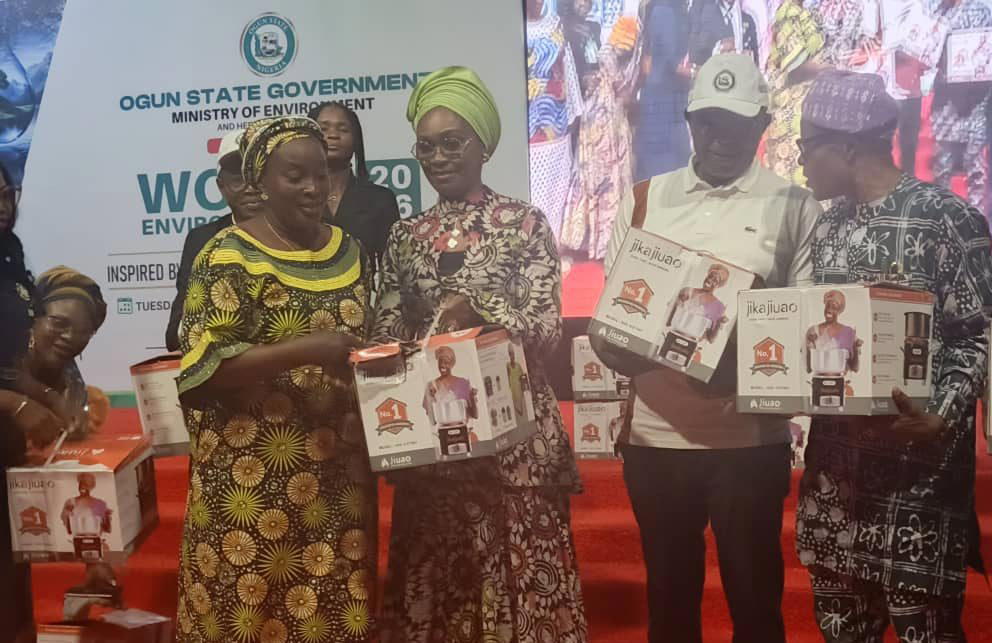
…distributes 3,500 stoves to residents to combat climate change
By James Ogunnaike, Abeokuta
The Ogun State government has reaffirmed its commitment to environmental sustainability, climate resilience and clean energy adoption, unveiling a series of initiatives aimed at tackling climate change and promoting a greener future for residents.
The commitment was reiterated on Tuesday during the 2026 World Environment Day celebration held at the June 12 Cultural Centre, Kuto, Abeokuta, with the theme, “Inspired by Nature: For Climate. For Our Future.”
Speaking at the programme, the First Lady of Ogun State, Mrs. Bamidele Abiodun, said the theme highlights the urgent need to protect nature and draw lessons from natural ecosystems in addressing the growing threats posed by climate change.
According to her, forests, wetlands, trees and biodiversity remain critical support systems for human survival and offer practical models for resilience and sustainability.
She said: “nature is not merely a resource to be exploited but a partner to be protected. The future we desire for our children and generations yet unborn depends largely on the decisions we make today regarding our environment.”
She described investments in the environment as essential to public health, food security, economic prosperity and sustainable development.
A major highlight of the celebration was the distribution of 3,500 Clean Cook Stoves to women across the state through a partnership between the Federal Ministry of Environment and the Ogun State Government.
The First Lady explained that the initiative was designed to improve public health, empower women and reduce environmental degradation associated with the use of firewood and charcoal.
“The adoption of clean cook stoves offers a safer, healthier, cleaner and more efficient alternative. These solutions reduce harmful indoor air pollution, conserve forests, lower greenhouse gas emissions and improve household productivity,” she stated.
She urged beneficiaries to become ambassadors of clean energy by educating members of their communities on the benefits of cleaner cooking technologies.
Mrs. Abiodun also highlighted the growing importance of Refuse-Derived Fuel (RDF) as an innovative waste-to-energy solution capable of converting combustible waste into alternative fuel for industrial use.
According to her, RDF supports the principles of a circular economy by reducing pressure on landfills, lowering methane emissions, creating green jobs and contributing significantly to climate change mitigation.
“As Ogun State continues to industrialise, embracing innovations such as RDF will help us achieve the dual objectives of effective waste management and cleaner energy generation while supporting sustainable economic growth,” she added.
Earlier, the Head of Service, Mr. Olanrewaju Iskeel Saka, charged staff of the Ministry of Environment and its agencies to remain innovative and committed to strengthening environmental compliance, embracing technology-driven solutions and deepening public engagement on environmental matters.
“The environmental future of Ogun State depends significantly on our commitment, professionalism and integrity,” he said.
He further praised the Federal Ministry of Environment for donating clean cook stoves to the state, describing the intervention as timely and impactful.
Delivering the keynote address, the State Commissioner for Environment, Mr. Ola Oresanya, said Ogun State has continued to prioritise environmental sustainability as a critical component of its development agenda.
According to him, the state has intensified climate action through tree-planting campaigns, ecosystem protection programmes and strategic partnerships with national and international organisations aimed at building climate-resilient communities.
“Nature offers the most reliable model for sustainability, resilience and balance. If we are truly inspired by nature, then these values must guide our policies, actions and lifestyles,” Oresanya said.
The commissioner explained that the promotion of RDF remains a key pillar of the state’s climate strategy because of its potential to convert municipal waste into alternative fuel while reducing greenhouse gas emissions and dependence on landfills.
He also disclosed that the government is expanding environmental education through Environmental Management and Climate Change Clubs in schools to equip young people with knowledge and skills in environmental stewardship and climate action.
Speaking on the significance of RDF, environmental expert and Professor of Environmental Management and Toxicology at the Federal University of Agriculture, Abeokuta, Prof. Babatunde Bada, described the technology as a vital tool for climate mitigation and sustainable waste management.
According to him, RDF is produced from non-recyclable waste materials such as plastics, paper and textiles and can be used as alternative fuel in industries including cement manufacturing and paper production.
He explained that RDF offers dual benefits by addressing waste management challenges while reducing dependence on conventional fossil fuels.
“By converting waste into energy, RDF helps reduce landfill dependency, lower greenhouse gas emissions and support the circular economy,” he said.
Prof. Bada added that RDF pellets generate fewer harmful emissions than coal and offer improved combustion efficiency, making them a cleaner source of energy.
He called on policymakers, researchers, entrepreneurs and communities to collaborate in advancing RDF technology in Nigeria, noting that the initiative aligns with several Sustainable Development Goals (SDGs) and presents significant opportunities for sustainable development.
Disclaimer
Comments expressed here do not reflect the opinions of Vanguard newspapers or any employee thereof.